Alex Mustard turns his attentions to muck diving photography for this edition of Mustard´s Masterclass.

The Unique Appeal of Lembeh Strait
I am coming to you this month from Lembeh, a slender, ten-mile ribbon of sea -never more than a mile wide – that lies squeezed between the lush volcanic slopes of Lembeh Island and North Sulawesi, in the heart of Indonesia.
Yet, within this short, sheltered strait, you’ll find around 20 dive resorts and, at times, a bunch of liveaboards catering to a devoted following. But despite its fame, Lembeh is not everyone’s cup of tea. Its signature black-sand diving is, much like the notorious yeast extract spread, something divers either devour or simply can’t stomach.
Lembeh Strait offers a very particular underwater adventure – the water is rarely crystal clear, many sites are littered with garbage, the scenery is understated at best, and encounters with large marine life are few and far between (although a dugong swam past our boat, yesterday). But for those who are passionate about marine life and travel with a camera in hand -this place is pure magic for muck diving photography.
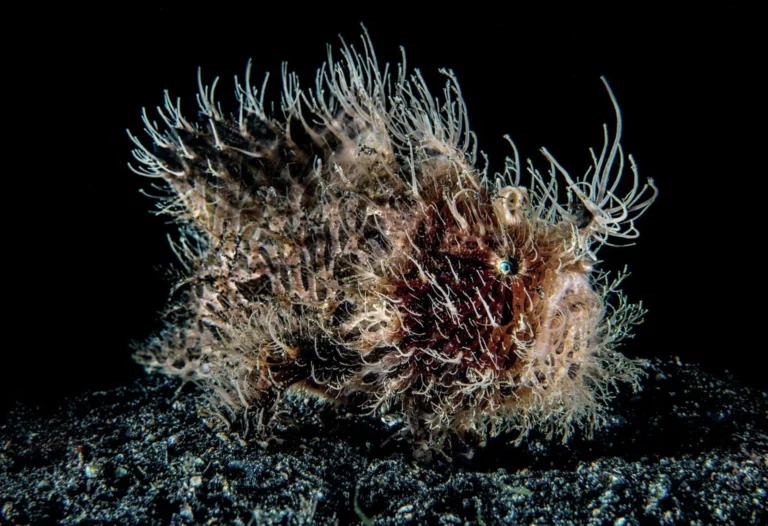
Lembeh is the undisputed, heavyweight champion of the world of critter diving! If you’ve ever flipped through a marine life ID book, marvelling at page after page of outlandish fish and oddball creatures you’ve never seen in the wild, Lembeh is where you can tick them off your list. Star attractions like flamboyant cuttlefish, hairy frogfish, pygmy seahorses, and mimic octopus are everyday sightings.
Some dives bring so many photogenic critters that diver groups surface laughing, or shaking their heads in disbelief. For photographers, it’s a dream come true – the abundance of subjects means you are always on a great subject, and most are so confident in their camouflage that they pose for the camera. No matter what camera you bring, you’ll leave with images to be proud of.

Our addiction to this type of diving comes from it pushing our primitive hunter buttons. Each dive is filled with the anticipation of the search and the rush of discovery. The photographic challenge is realising that the emotional summit of seeing a great creature is just the start of the imaging process. I tell my students that the guides will take care of the subject, their focus should always be on how to control the rest of the frame.
Shifting from Stamp Collecting to Memorable Images
Dives focused on ticking off species tend to turn photographers into stamp collectors, snapping up as many as possible, but our pictures remain simple record-style shots. They are memories of what was seen, they are not memorable images.
The solution is to remember we are here for muck diving photography and to not get too caught up in the critter buzz. When your guide points to an amazing animal, your first reaction should not be to shoot, but take a moment to consider if it will make a powerful picture and how you will do that. I like letting other people have first look, I’d like to claim this is out of politeness, but it is really because it buys me valuable thinking time. I will shoot most things that the guide shows me, but I will only invest chunks of my dive time in the best opportunities.
The Ethics of Critter Photography: Flash vs. Touching
Finally, we should never encourage guides to move a subject for a better shot. The latest scientific research shows that instantaneous flash photography has negligible impact on delicate creatures like seahorses, which is unsurprising to anyone who dives and knows light levels constantly flicker as the sun plays through the water’s surface. However, these studies show that touching marine life has a big impact. Corralling critters in the perfect pose is widespread in some other macro hotspots, especially where photographers want to use artificial backgrounds for effect, but once the cheap thrill of the shot wears off, photographers learn that they’ve probably missed a host of natural behaviour shots along the way.

Advanced Background Control in Muck Diving Photography
Perhaps the biggest photographic challenge of muck diving photography is the muck. Black sand isn’t black, but grey or brown and flecked with light-coloured shell fragments and pebbles. In short, it is a messy, distracting background for our photos. The good news is that there are many solutions to minimising the impact of this ugly muck on our pictures.
The simplest is subject selection. People ask me how to shoot a good shot of a frogfish when it is tucked head down in a sponge? The answer is look for another frogfish. Not every A-list creature is an A-list photo opportunity. We may need to earn that clean background by contorting ourselves to get the camera in exactly the right position. But sometimes we should just move on.
Advanced Lighting: Snoots and Host Organisms

We can also de-emphasize the distracting muck with our lighting. The most-common solution is using a snoot – which focuses our strobe beam into a spotlight. When aimed correctly this allows us to light the subject and not the background, giving instant impact. Better still the talent guides in Lembeh have learned to help photographers with their aim, making it a particularly easy way to shoot. Timely advice with Backscatter’s MF-3 flashgun just launched. If there is a downside, it is only that everyone is doing it. Snoot shots won’t mark your portfolio out in Lembeh.
Another simple background solution is to look for critters that live on other animals and use the larger animal as our entire background. We all know about anemonefish and anemones, but in the heart of reef biodiversity, almost every imaginable niche is exploited. Crabs and, particularly, shrimps get everywhere, making their homes on all sorts of other invertebrates: corals, sponges, sea cucumbers, starfish, crinoids, anemones, nudibranchs and more. If the larger species has pleasing patterns use a closed aperture and try and shoot from parallel to the subject to keep everything sharp. If the host has strong colours, consider opening the aperture and blurring it into a smooth pastel background.
Many of the star attractions of muck diving live out on the ugly sand. Seperation is the key here, and the further away the background is from the subject, the less focused, less lit and, in short, less distracting. The golden rule is to get the camera low to the seabed, so that the sand that the camera sees behind the subject is as far back as possible. Opening the aperture will throw the background even further out of focus.

The key to memorable muck diving photography images is that despite the thrill of the hunt, we must remember that this is just the start of the photography. Take seeing great critters for granted and dedicate your thoughts to capturing great backgrounds. That way you’ll come home with much more than a collection of fantastic subjects, you’ll come home with fantastic photographs.
Want to improve your underwater shooting skills? Click to see all the other Masterclasses here: Mustard’s Masterclass Series Archive.
FAQs
What is muck diving photography?
It is a specialized niche of underwater macro photography focused on finding and shooting rare, well-camouflaged marine critters that inhabit sediment-heavy, sandy, or silty environments rather than traditional coral reefs.
Where is the absolute best location for critter and muck diving?
Lembeh Strait in North Sulawesi, Indonesia, is globally recognized as the undisputed heavyweight champion of critter diving due to its high density of rare species like the flamboyant cuttlefish and hairy frogfish.
How do you fix distracting backgrounds in muck diving images?
Photographers can use subject selection, shoot from a low angle to frame critters against open water, use a wide aperture for a shallow depth of field, or utilize a snoot to isolate the subject with a spotlight effect.
Does using an underwater strobe or flash harm delicate marine life like seahorses?
Recent scientific research shows that instantaneous flash photography has a negligible impact on delicate creatures. However, physical contact, corralling, or touching marine life causes significant negative disruption.
What is an underwater photography snoot and why is it used?
A snoot is a lighting modifier that narrows an underwater strobe’s beam into a precise spotlight. This allows you to illuminate only the critter while keeping an ugly muck or black sand background completely dark.
This article was originally published in Scuba Diver Magazine
Subscribe today with promo code DIVE1 — enjoy 12 months for just £1!
