The Moray Firth is renowned for marine mammal sightings, but also boasts some great shallow diving as well. Gavin Anderson heads off to see why the dolphins find the area so appealing.
The Triangular-Shaped Moray Firth
Covering some 500 miles of coastline from Duncan’s by Head in the North to Fraser burgh in the East, the triangular-shaped Moray Firth is Scotland’s largest inlet. A mixture of stunning windswept cliffs and rocky shores, broad sandy bays and long sheltered inlets, it is one of the most-important places on the British coast for observing dolphins and whales.

The most-common species sighted are bottle nose dolphins and harbour porpoise, but common dolphins and minke whales can be seen too. Tourists flock to the coast to places like Fort George just to the east of Inverness, where the dolphins can often be spotted from the shore. Others jump in boats and head out for a closer encounter. But the Moray Firth isn’t just about its dolphins, it is also home to some great scuba diving.
The Majority of Wrecks
There are several excellent reefs and many first-class shipwrecks, but while most of the reef dives are relatively shallow, the majority of wrecks, such as the San Tibercio, Verona, Unity Moray and the Tantivity submarine, are all found well below 18m. However, there is one wreck which lies above 18m – in fact, an even-shallower 12m – and that is the SS Narr.
The SS Nar
The SS Nar was on her way from Sunderland to Burg head carrying a cargo of coal when she ran into bad weather on 13 December 1904. She floundered on a reef off Garmouth and sunk within sight of locals onshore, who were unable to do anything to help rescue those onboard. The water would have been very cold, the sea very rough, and it’s not surprising no one made it to the shore.
Today, despite being well broken up, many parts of the wreck remain recognizable, including her large boiler, various winches, plates, capstans and a large section of the bow. Last time I dived the Narr was some 20 years ago with Bill Ruck off Top Cat.

He is no longer taking divers out, preferring to concentrating more on commercial stuff, including ROV work, so this summer I joined Cathy and Chris off North East Dive, along with some of their regular divers, on their well-appointed RIB Acquisition.
Meet time was on a Saturday morning in the harbour car park at a respectable 9.30am, which wasn’t so bad as I only had to leave home at 6.15am.
It was a lovely summers day and the sun was shining, however during the week it had been windy so I wasn’t expecting conditions to be perfect. Sure enough, as we jumped off the boat just a ten-minute ride out from Lossie mouth harbour and descended on to a sandy bottom, we had a fair bit of water movement to contend with.
At first I wondered where the wreck was, but soon I noticed a faint outline of something familiar, the huge boiler. Totally covered in dead man’s fingers and plumose anemones, it’s also home to some ballan wrasse and grazing urchins.


Virtually intact but for one section where the plates have eroded away, revealing a view into some of the internal tubes, the boiler stands a good two to three metres high off the sandy bottom. Swimming right around as our eyes completely adjusted to our surroundings, we left the boiler and looked around for more of the wreck.
All that was visible was a small line of wreckage heading south and to our right a small piece of wreckage beyond a large capstan. We explored here first. The capstan seemed to have been a perfect place to tie off anchors, as it had two chains around it, one very new and one much older.
It seemed strange why this recent chain had been left here. Perhaps it was some fishermen who couldn’t release it, but how did it get tied around the capstan in the first place? Was it just a lucky loop, or perhaps the visibility had been so good that day they had managed to loop it around but failed to unloop!
Anyway, mystery unsolved we headed off along a line of wreckage past a large winch to what is the largest and most-intact section of the wreck, which rises a few metres from the seabed. It’s what is left of the ship’s bow and it was covered in dead man’s fingers, plumose anemones and several ballan wrasse, which weaved in and out of various holes.
Just past the bow were more ribs and more flattened wreckage, home to a shoal of bib, some saithe and a large cod which didn’t hang around too long.
Narr’s Wreckage
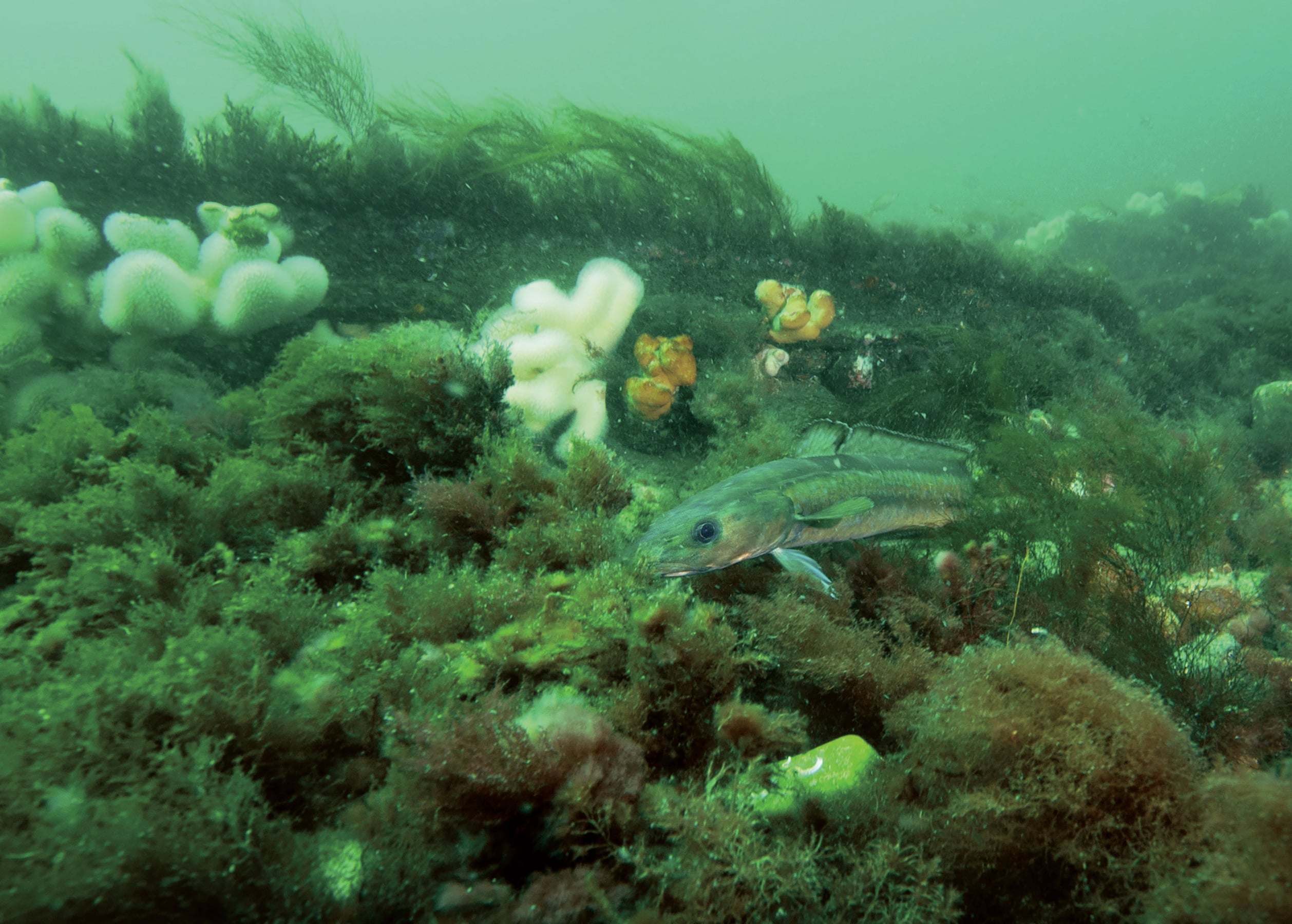
There were loads of hiding places within the Narr’s wreckage and we were lucky enough to find lobster, crabs, ling and a conger eel throughout the rest of our dive, along with a dogfish swimming over a weedy section of wreck. Diving on this wreck is a bit like diving in an aquarium, such is the diversity and amount of marine life – and I haven’t even mentioned nudibranchs!
The Great Channel in the Inner Moray Firth was dredged by engineers in 1917 for the safe passage of ships that wanted to avoid the long and dangerous passage around the north of Scotland, by transiting the Caledonian Canal.

The Channel went from the entrance of Munlochy Bay to the Meikle Mee Starboard Hand Mark, but was not maintained and filled in very quickly, which is probably a good thing for the marine life and the healthiness of the nearby reefs. One such reef is the brilliant Queens Street reef.
It’s usually the second dive after the Narr or Unity shipwrecks. At a depth of around 14m, it’s a perfect shallow dive among many small boulders and rocky outcrops, complete with tall animal turf and areas of kelp surrounded by sand and gravely areas.
The reef offers a great variety of habitat, with many crevices and ledges winding one way then the other, and it is home to an amazing variety and number of fish. Within minutes of us descending, we found ourselves right alongside a huge shoal of saithe.
They swept past us and disappeared into the kelp – it was a fantastic start to the dive, as it is always special to see a large shoal of fish in our waters.
As we swam along the side of the reef, our attention turned to a pair of large ling hovering outside a large hole in the reef. They watched us closely, slowly manoeuvring themselves a little deeper into the shelter of the reef overhang as we got closer.
A bit further, a small group of Centrolabrus exoletus – better known as rock cooks – were busy searching for food. Their markings were particularly stunning, on a par with the male cuckoo and corkwing wrasse for colour and detail.
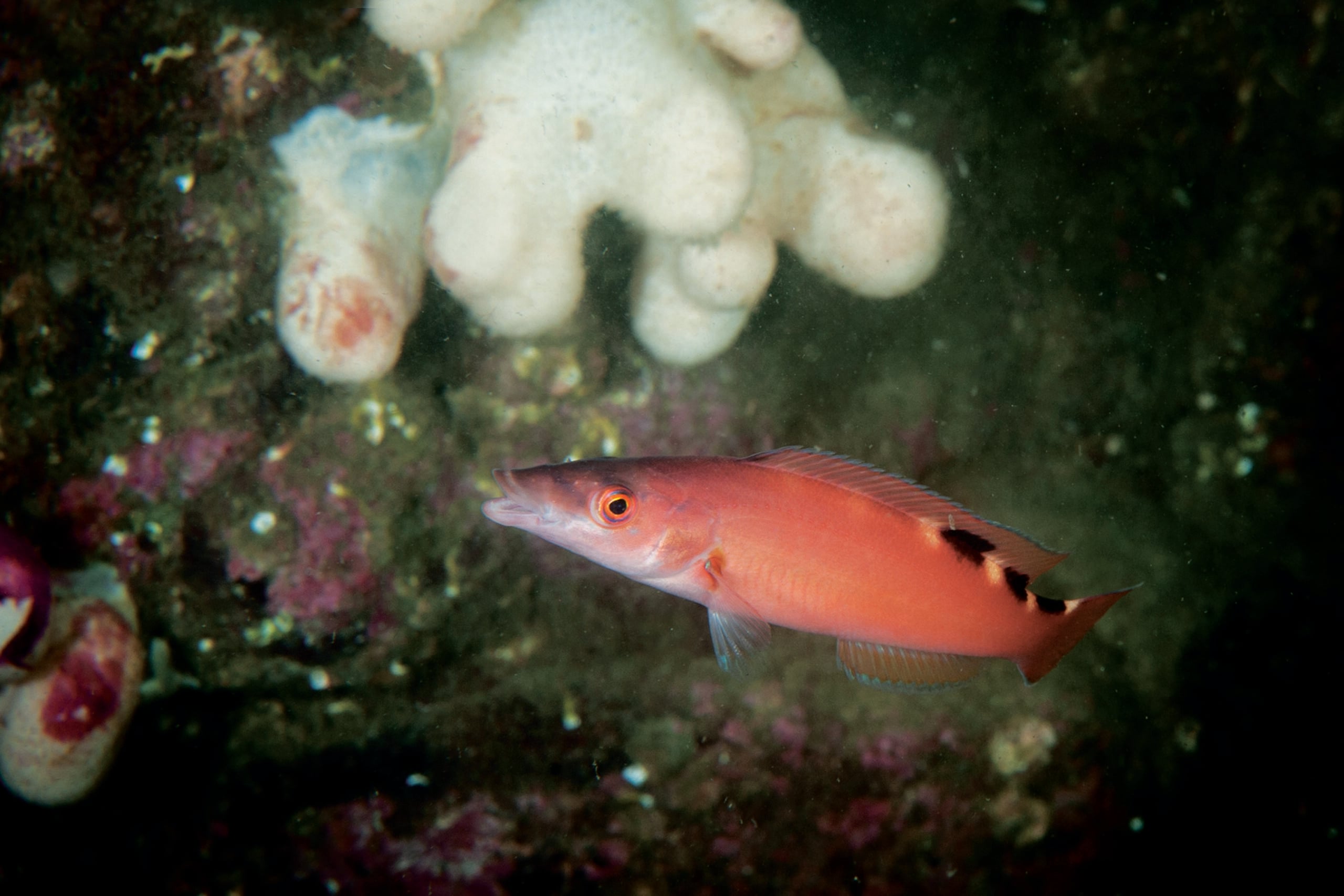
Not far away were another couple of colourful wrasse, this time some goldsinny showing their brilliant white teeth which they use to feed on small crustaceans and barnacles. Other fish included scorpionfish, Yarrel’s blenny and some poor cod.
Like the wreck of the Narr, the Queens Street reef is very rich in fish life but there’s more than just fish. On the sand we found swimming crabs and and a stunning octopus, and at the base of the kelp, spider crabs and various starfish, including common sunstar, spiny and bloody henry, and on the kelp itself tiny nudibranchs.
Sixty minutes is just not enough time here and it was with reluctance we finally sent SMBs to the surface and returned to our air-filled world, leaving our magic underwater one behind for another day. Our last view was of a lobster completely out in the open enjoying his crab dinner!
On the way to and from the dives, dolphins can sometimes ride the bow wave of the RIB, and on the dives themselves, seals are occasional visitors.
“Virtually intact but for one section where the plates have eroded away, revealing a view into some of the internal tubes, the boiler stands a good two to three metres high off the sandy bottom”
“The reef offers a great variety of habitat, with many crevices and ledges winding one way then the other, and it is home to an amazing variety and number of fish”
The Narr, Moray Firth:  -
What to Expect
Type of Dive
Boat
Depth
12-14m
Marine life
Bib, saithe, conger, ling, cod, ballan wrasse, goldsinny, rock, dogfish, lobster, swimming crabs, spider crabs, flatfish, scorpionfish, Yarrel’s blenny, starfish, nudibranchs.
Visibility
Five to 25 metres on exceptional days, average is around ten metres
Seabed
Sand, reef, kelp, boulders and wreck
Hazards
None
What to look out for
Conger, ballan, dogfish, Yarrel’s blenny, scorpionfish and you never know, a seal might just show up to say hello.
Photographs by Gavin Anderson