
If you were at the Go Diving Show 2026, you may have heard Andy Torbet talking about the first non-military skydive to scuba dive in the UK. Now you can read all about it as he explains his flight into the inaugural BSAC Scoob and Snork Fest at Spring Lakes.
As we banked over Spring Lakes, the venue for the inaugural Scoob and Snork Fest, I was offered an uninterrupted view of the water, shore and gathered crowd. My view was so completely unobscured because I sat on the edge of an aircraft that recently had the door, which constituted the majority of its right-hand side, removed to allow easy exit. However, escape was still going to be difficult, my manoeuvrability being hampered not only by the skydiving gear I wore but also the extra, and somewhat unusual, addition of scuba gear.
To increase the awkwardness, the wind speed during the struggle to get outside would be a breezy 80 miles an hour as we passed over our dive site, 2,500 feet below us. This would be a very ‘giant stride’. And, according to the British Sub Aqua Club and British Skydiving, the governing bodies for their respective sports, the first (nonmilitary) ‘skydive to scuba dive’ in the UK.
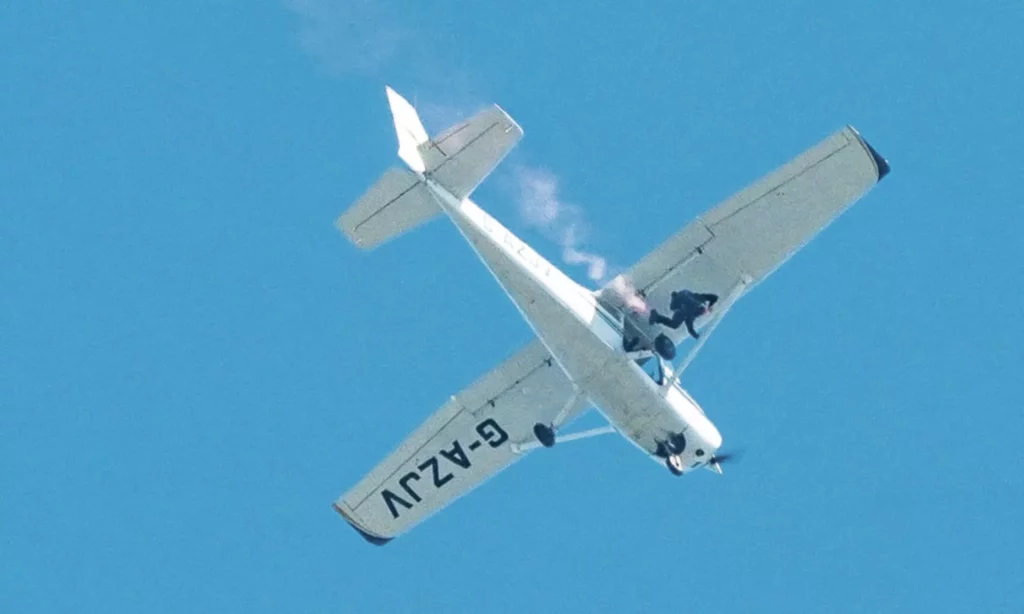
The Logistics of a “Giant Stride” from 2,500 Feet
The story really begins when, as a BSAC Ambassador, I was asked to attend the new festival. I, knowing Skydive Langar, a regular haunt of mine, was only minutes away by aircraft, jokingly replied that I’d not only come, but that I’d parachute in. Rather than the expected uneasy laugh, I received an enthusiastic ‘Yes please’. It’s always nice when people not only indulge but actively encourage and support your more-unusual ideas. What followed was the essential, but less-dramatic, logistics and paperwork. A jump like this requires registration as an official ‘demo jump’, which comes with its own stipulations. Further to this we’d be jumping into controlled airspace that fell under the remit of the busy East Midlands Airport. We’d have to agree a time and a relatively low exit altitude. Normal skydiving in the UK takes place from between 13,500 and 15,000 feet. Most people have deployed their parachutes by 4,000 feet. We’d not be under canopy until less than 2,000 feet… all being well.
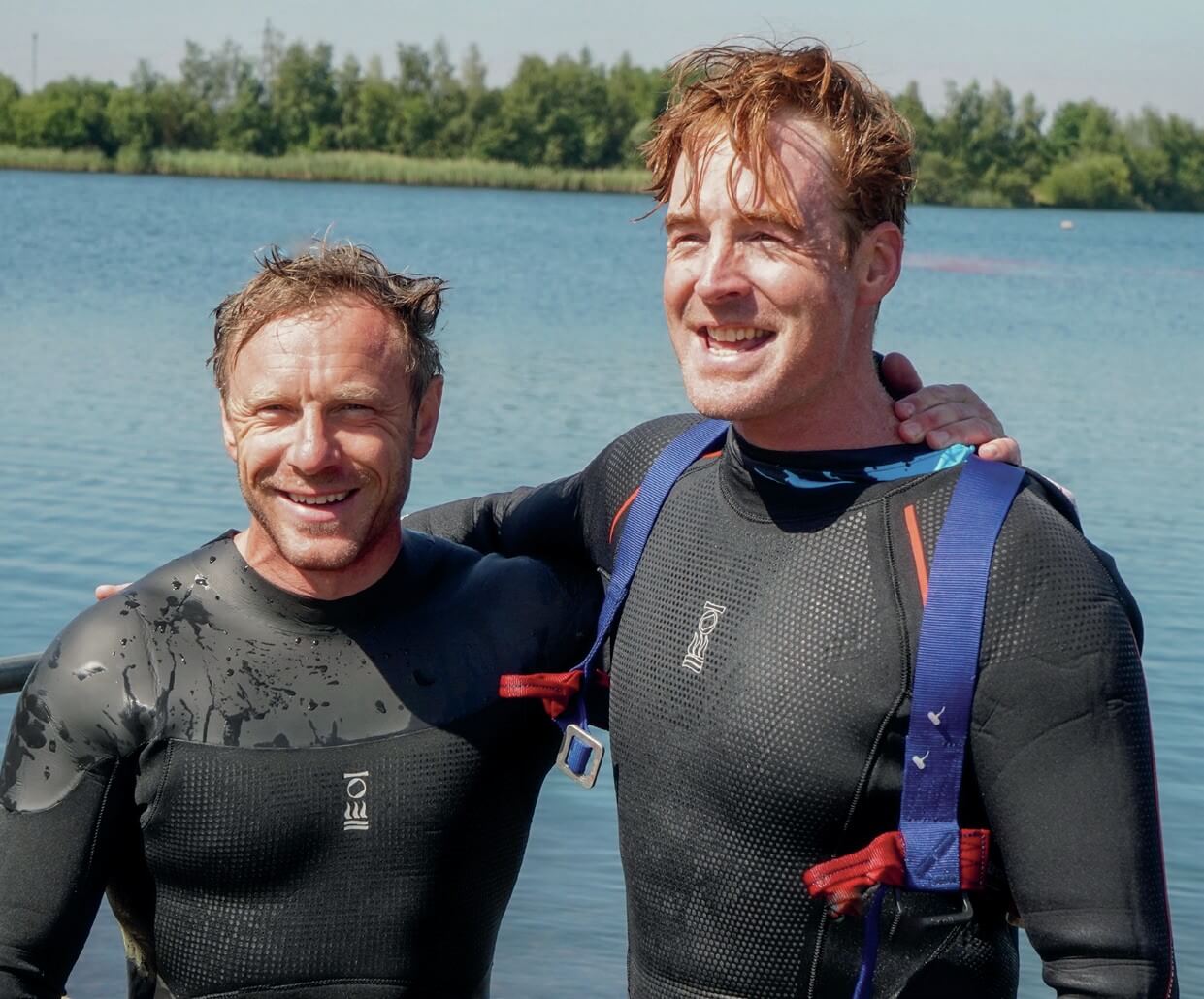
My friend Ally Milne has recently completed his PADI Divemaster, so he’d be more than capable of completing the short 50-metre underwater swim, at around 5m depth, we’d perform from our intended landing site to the exit on the beach in front of the assembled festival-goers. What made him even more employable as the second jumper is his status as one of the UK’s top skydivers, a British Skydiving Instructor Examiner and a man who has planned many demos and special skydiving projects, including some recent Red Bull events. I had volunteered him the responsibilty of filling out all the required paperwork, of which there is much, while I’d sort the dive kit.
Did you know?
While freefall speeds can be over 100 mph, skydivers do not feel like they are falling but rather being pushed by the air. Despite common perceptions, it’s a highly structured and safe sport with strict safety protocols and pre-jump checks.
Safety First: Modifying Gear for High-Altitude Entry
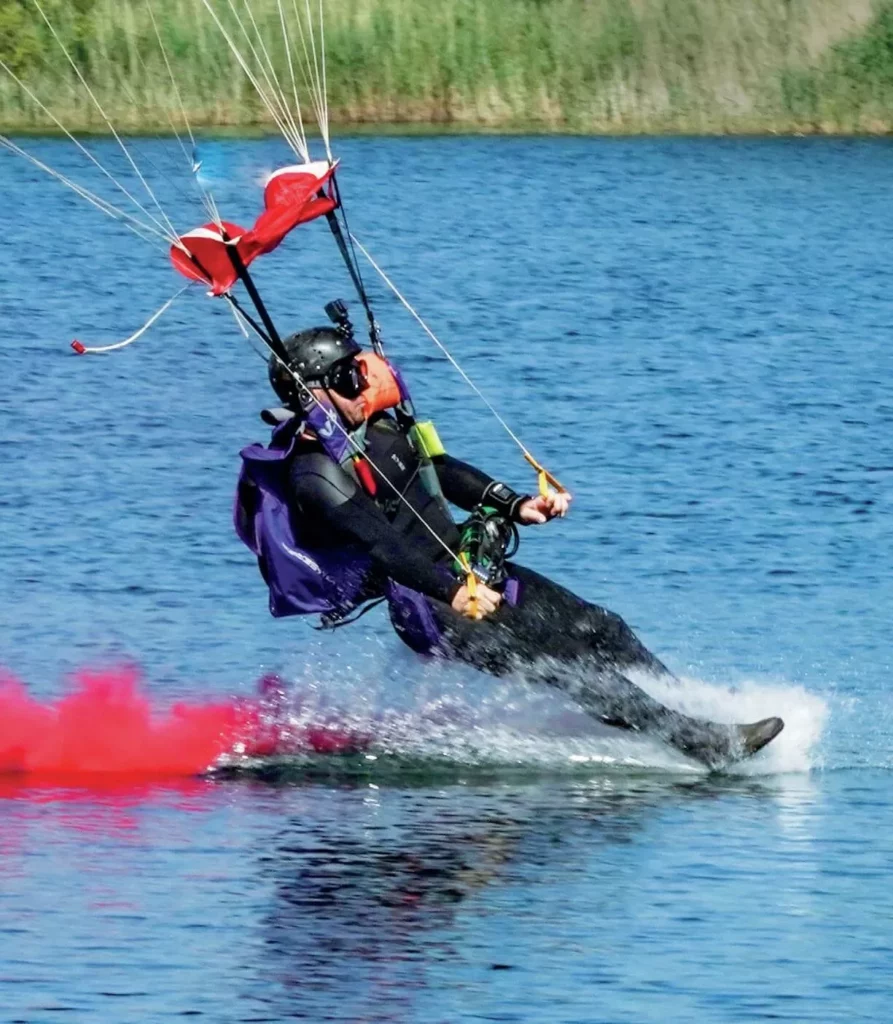
The weather was incredible. Blue skies, blazing sunshine and temperatures over 30 degrees Celsius. Which was good news for the festival. Less so for the two fellows fumbling around in black wetsuits, strapping on all manner of kit and barely keeping their internal temperature below the boiling point of steel. We’d done a couple of jumps the day before to ensure the diving system didn’t interfere too much with our skydiving rig, especially the emergency handles. Should there be an issue with our main canopy, we have handles, fitted either side of our torso, to cut away the malfunctioning parachute and deploy our reserve. Bail out options are not just for divers. So, it was imperative we could reach these handles unobstructed. In order to achieve this and, bearing in mind our skydiving gear is all back-mounted, we strapped the dive cylinders to our front. Belly-mounted. The hoses and regulators were strapped down tight to avoid any flailing during the short freefall, under canopy or upon landing.
Normally in skydiving we’ll either wear googles or a full-face helmet (think mini-motorbike helmet) which allows us to see in the high wind speeds. Fortunately, dive gear comes with the sub-surface equivalent and our low volume masks proved perfect for the job. Finally, it’s a British Skydiving policy that jumpers wear helmets, so I wore my cave diving helmet and loaned my spare to Ally.
We climbed on board the small aircraft, with Ally sat behind the pilot and me where the co-pilot’s seat would have been had we not removed it to allow me to sit on the floor, a necessity in all the equipment. With the door removed, the view during our ten-minute flight from take-off at Skydive Langar across Nottinghamshire and over Spring Lakes was fantastic. I hung out the door to benefit from the breeze and tried to cool down, still locked inside the now sweat-soaked wetsuit.
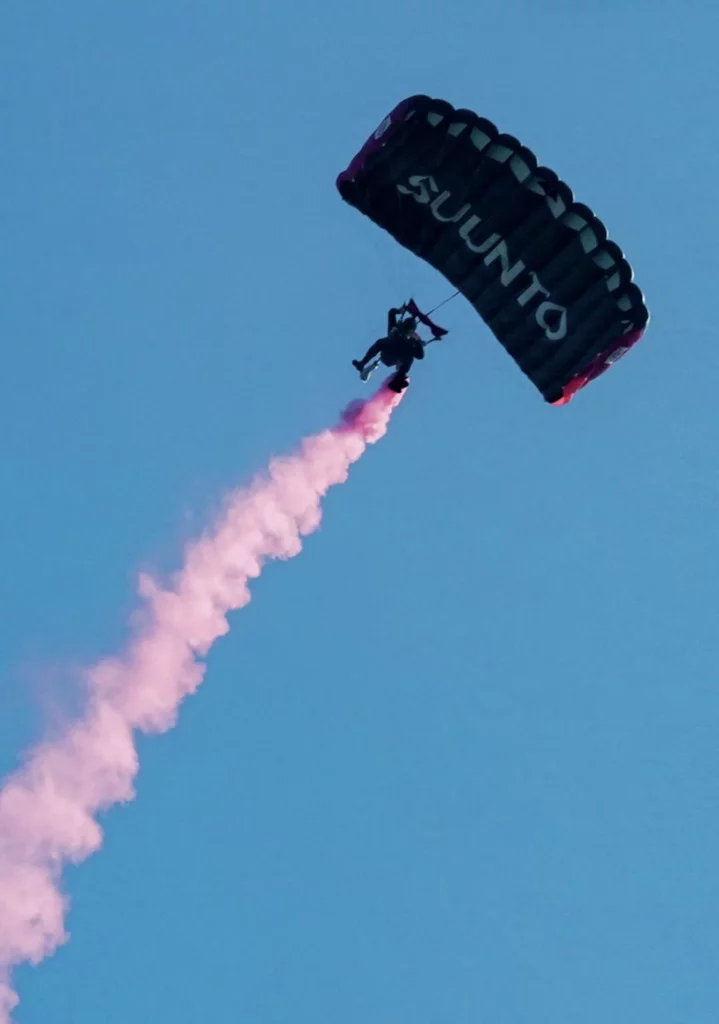
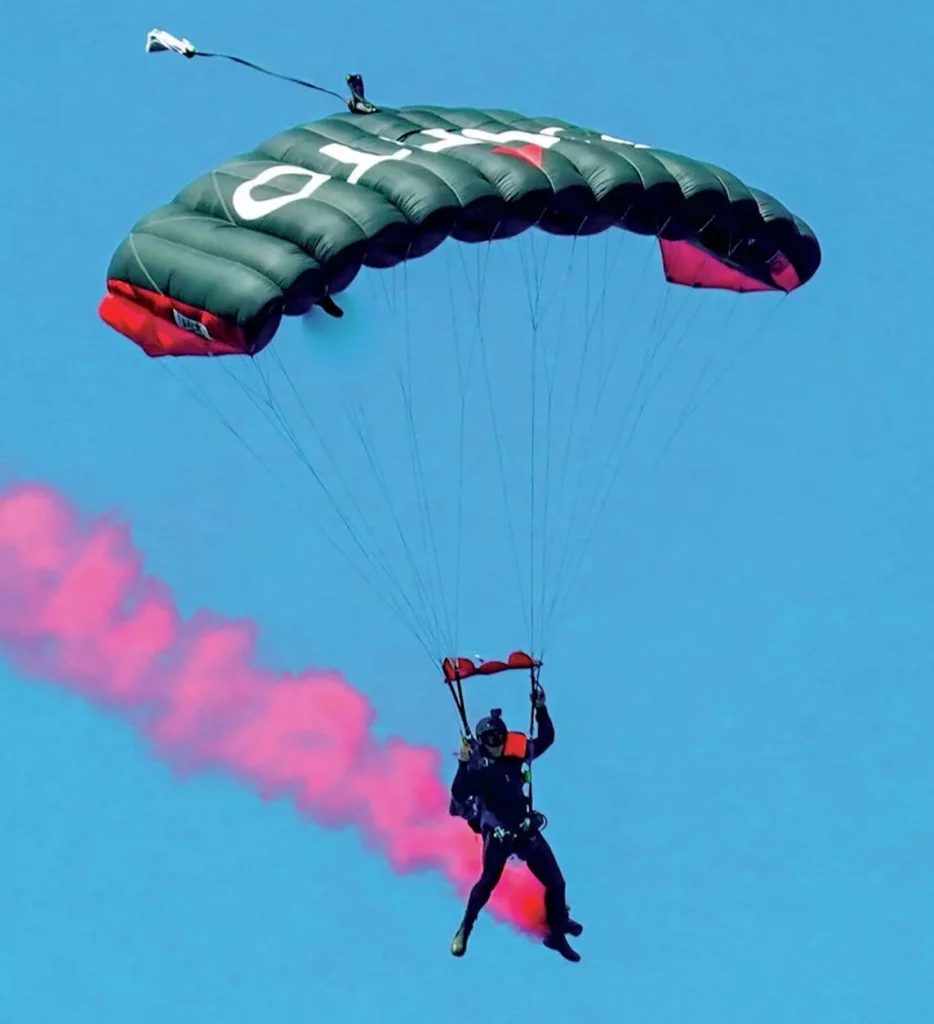
The Drop: Targeting Spring Lakes from the Air
We made an initial pass over the collection of lakes to eyeball the landing area and ensure we had the correct one. Spring Lakes comprises of eight closely situated bodies of water. I would be very embarrassing to go to all this trouble and land in the wrong one. I could see the crowd gathering on the beach, the collection of tents and stalls from dive manufacturers and training agencies lining the shore, and the buoy that marked the spot we needed to hit. As we flew upwind, I received the thumbs up from our pilot, the simple signal for me to climb precariously out to stand on the wheel, pull the pin on the red smoke canister fitted to my left ankle, dangle from the wing strut and then release myself into the air flow. The extra weight of the dive kit proved enough of a factor to change my exit position and I took an extra few seconds to orientate myself and get stable. Seconds at these lower altitudes can be important, but I managed to be open and have control of my canopy by around 1,500 feet. Ally threw himself out, with more control than I had managed, seconds later and was safely under canopy above me.
We flew downwind, over the cheering crowd to swing around 180 degrees to land by the buoys marking submerged feature for divers and, for us, a shot line to follow down and along the lake bed back to shore. On landing in the surprisingly warm waters, I stripped my skydiving harness off while the red smoke, still functioning despite being underwater, bubbled around me.
From Canopy to Cave Gear: The Underwater Transition
I swam towards Ally, who was in the process of freeing himself from his canopy’s lines after the wind had drifted the parachute back towards him. Normally we try and eliminate snag hazards when skydiving. Like cave diving, getting tangled in our lines can be dangerous or even fatal. With the extra diving equipment, there was a number of hard-to-reach protrusions to ensnare the thin parachute lines. A little bit of buddy-work and we were free and descending. It’s a requirement for demo jumps into water that there is one rescue boat per skydiver in the water. But our two boats were instructed to hold off unless there was an emergency. Although this was not a formal record, we felt that external assistance during the transition would invalidate the project.
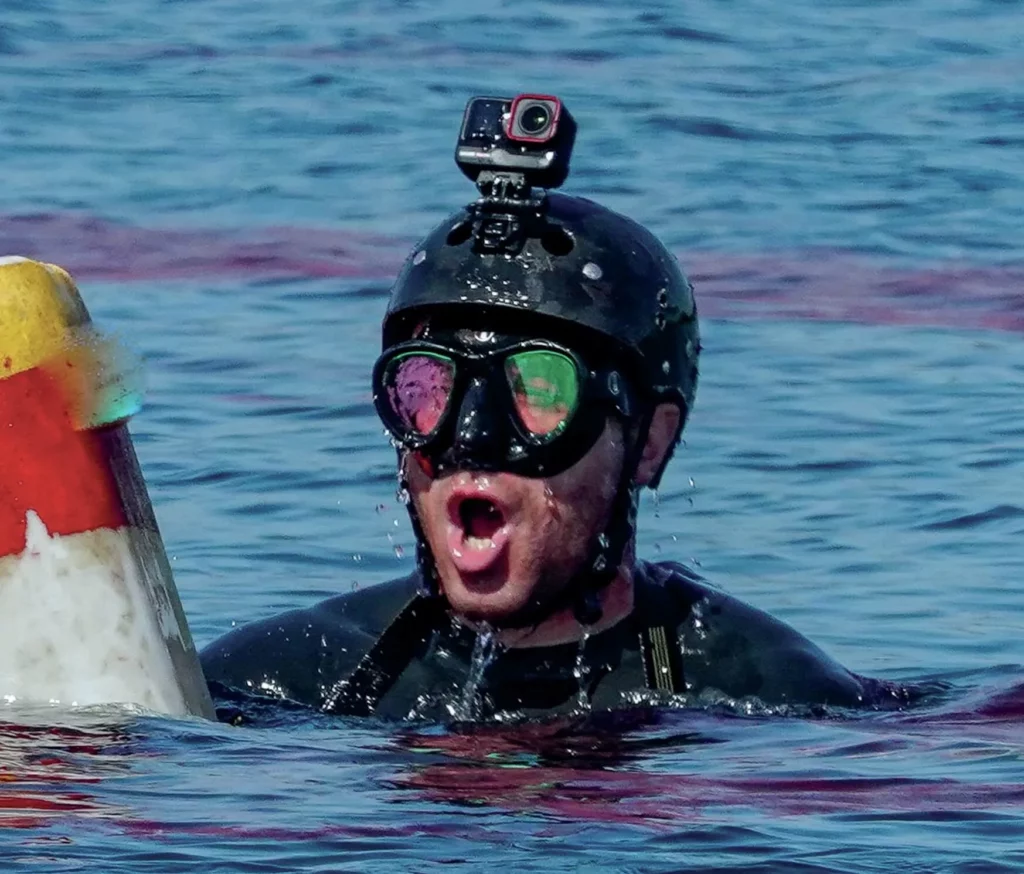
The visibility was far better than I expected from an inland lake and we quickly finned along the jackstay to emerge onto the shingle beach. It felt, albeit it in a slightly more modest form, like a Taylor Swift concert. I’ve done public events and talks before, but I’ve never been greeted by so many phones recording me. I had been a little anxious that the jump, as much fun as it had been, might not captivate a diving and snorkelling audience. But the response from the crowds was incredible and generated plenty of conversations with exhibitors, organisers and attendees.
Inspiring the Next Generation of UK Divers
The main thrust of the demo had been to draw in more people to this, the first year of the new festival, but also to reach a wider audience about the event, both divers and potential new blood. The inclusion and emphasis on snorkelling made it particularly important for the stunt to be used to reach out through social media and attract people for 2026. Spectacles and events like these combined with the accessible ‘gateway drug’ that is snorkelling are means of growing the diving community and keeping the industry alive.
Even before we’d bid our goodbyes to return to the Drop Zone and start the day’s long process of drying, checking and re-packing equipment, we had the organisers asking what we could do next year. Ideas are bubbling, so look to the skies and watch this space.
Frequently Asked Questions
What is a “Skydive to Scuba” jump?
It is an extreme multi-sport stunt where an individual parachutes from an aircraft directly into a body of water, immediately transitioning into a scuba dive using pre-worn equipment.
Who performed the first non-military skydive to scuba dive in the UK?
Professional adventurer and BSAC Ambassador Andy Torbet, alongside elite skydiver Ally Milne, performed the first civilian jump of this kind in the UK in 2024.
Where did the Scoob and Snork Fest take place?
The inaugural festival was held at Spring Lakes, a multi-lake watersports leisure park located in Nottinghamshire, UK.
Is skydiving with scuba gear dangerous?
Yes, it requires specialized training. The added bulk of cylinders and regulators can interfere with parachute deployment handles, requiring rigorous safety checks and custom gear configurations.
What is the BSAC Scoob and Snork Fest?
It is a diving and snorkelling festival organized by the British Sub-Aqua Club (BSAC) to promote the diving community, showcase equipment, and encourage “new blood” to join the sport.
This article was originally published in Scuba Diver Magazine
Subscribe today with promo code DIVE1 — enjoy 12 months for just £1!
