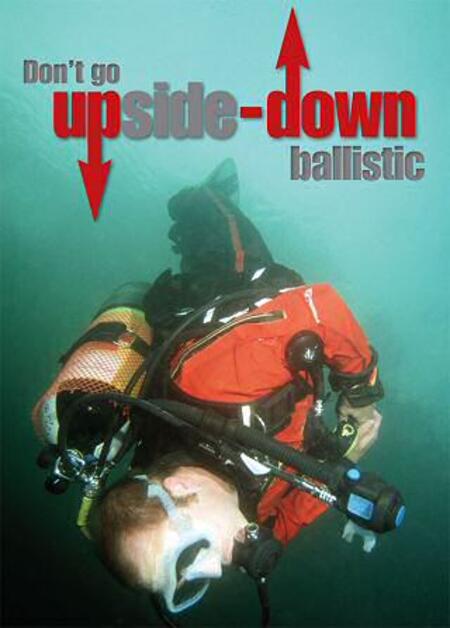
The Pool Incident: Recognising a Drysuit Inversion
More than a few years back, I was teaching at a club training session. I had my group of six budding divers and a couple of assistant instructors in the deep end practicing alternative air source (AAS) ascents.
Other instructors had their own training groups staked out in various areas of the pool, teaching whatever it was they were working on that week.
In between all this, various club-members not involved in training were just in for a swim, with or without scuba equipment, and one diver was trying out a drysuit.
She was a moderately experienced diver, but had only ever used a wetsuit. Another club member had just acquired a new drysuit, and the old suit, still in good condition, was now for sale.
Considering buying it, our diver was trying it out in the pool – by herself. The owner of the suit was not at training that week, and everyone else was already busy.
I first noticed her during an ascent with my trainees. I had to guide them to one side to avoid bumping her on surfacing. Sensible diver, I thought, she’s already practicing dryduit inversions on the surface. Feet on the surface, head-down, stretched out straight. Any minute now, she’ll tuck and roll out of it.
A couple of minutes later, perhaps at the top of another AAS ascent, I looked her way again. She had drifted along the pool a bit and was still stretched out upside-down.
She wasn’t moving much, but it wasn’t a calm lack of movement. There was something about the short jerky movements of her hands. When I looked closer, there was definitely something frantic about her eyes.
I didn’t waste time with OK signals. I just turned her the right way up and took her weightbelt off. Stuck upside down for several minutes, she was exhausted and choking on water that she had been unable to clear from her regulator— a classic drysuit inversion scenario.
No incident is really as simple as that, and neither are the lessons to be learned. I could digress into briefing, supervision, weighting, panic, loose feet that had popped off – all sorts of things.
But the aspect that is relevant to our refresher on drysuit skills is that she didn’t even know the principles, let alone practice, of turning herself the right way up again.
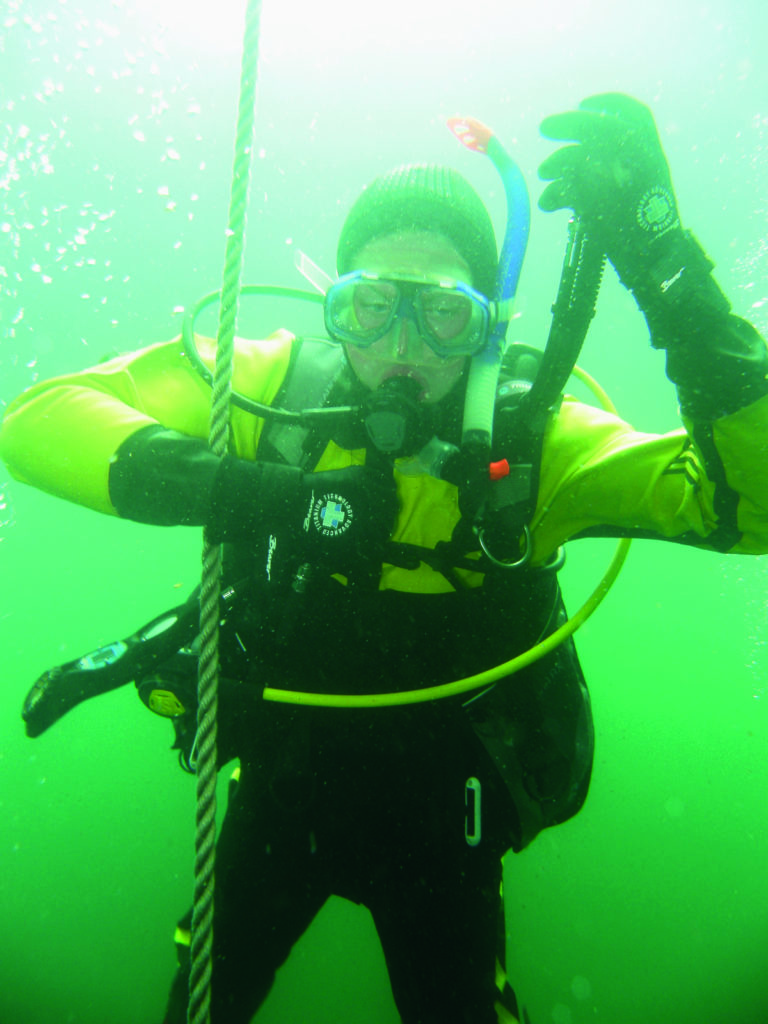
Why Drysuit Inversions Can Become Dangerous
The first thing to remember about an inverted drysuit is that it is not an urgent problem if a diver is neutrally buoyant in the first place. Rather than resting horizontally in the water, you simply rest vertically in the water with feet uppermost.
Even a wet regulator, as in the swimming pool incident, should not be a problem, because the diver had only to twist her head or turn it the other way up to get a dry breath.
But a drysuit inversion becomes a serious problem when a diver is both positively buoyant and inverted.
Given the tendency of most divers to think that they are neutrally buoyant when in fact they are negatively buoyant and swimming to stay level, it is during the ascent at the end of a dive that buoyant inversions become a more likely hazard.
The diver begins the ascent by swimming up, perhaps even adding a squirt of air to his suit to get off the bottom, then progressively dumping buoyancy to stay neutrally buoyant as the ascent progresses.
Then, while distracted by something else, perhaps fumbling with a reel, turning off a dive light or switching regulators, he becomes positively buoyant – a little too positively buoyant.
Preventing and Correcting a Drysuit Inversion
The stressed and very wrong reaction at this point is to try to swim downwards. The diver is now the wrong way up, positively buoyant, and the air is all rushing to his feet. Despite frantic finning, he will most likely continue to ascend feet-first, accelerating all the way.
So my first tip is not to worry about inversion, because while neutral or negatively buoyant, it isn’t a problem.
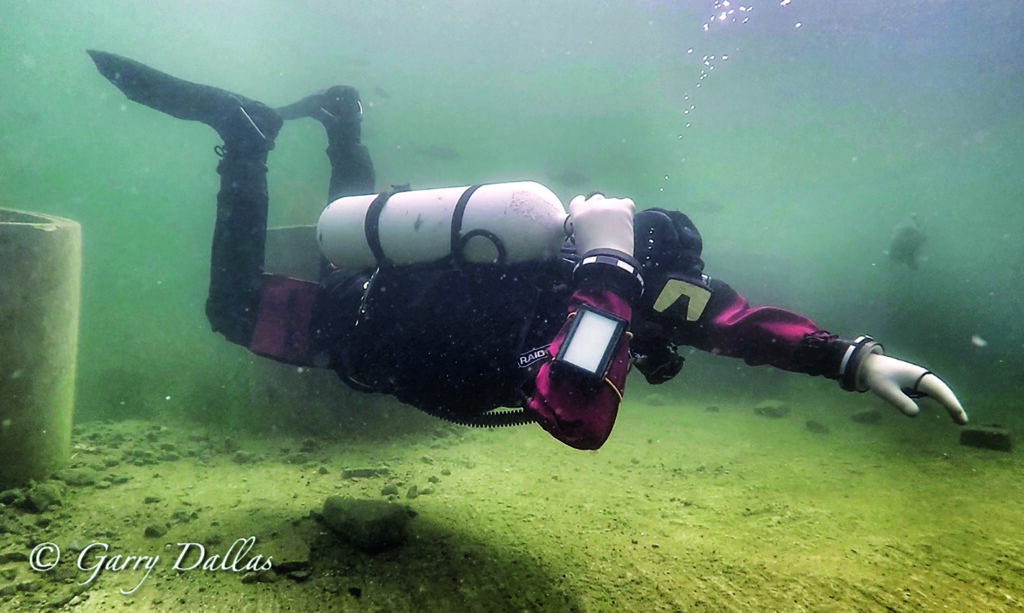
Something worthy of greater concern is good ascent technique, maintaining a horizontal or head-up attitude in the water, being constantly aware of buoyancy, and venting air from the drysuit in plenty of time to keep buoyancy under control.
Should it all go wrong, getting out of an inversion is so simple that experienced drysuit divers will do it without even really thinking about it. In fact, experienced drysuit divers just feel their position in the water getting a little bit awkward and sort it out before it develops into a full suit inversion.
Experienced divers handle a drysuit inversion instinctively by adjusting their position in the water before it escalates.
It was only when trying to get some pictures to go with this article that I noticed that no-one does it by the book.
Asking buddies on the average dive to demonstrate the skill showed that they could all get the right way up again, but in no instance was the technique demonstrated in a way that I could photograph to show how it was done.
I needed a controlled environment, and some divers who are very used to teaching drysuit skills, so I got John and Kev from A-Flag Diving, at Vobster Quay, to help out.
Practical Tips & Training for Safe Drysuit Handling
Any quarry has a reputation for cold water in winter, and so provides an environment for much drysuit training, but on a bright summer day the water was actually warm enough to allow diving without gloves or hood; ironically, the sort of day when a drysuit is hardly necessary.
The textbook solution is to tuck and roll forwards out of the inversion. Do this immediately to get into an attitude where air can be effectively dumped from the suit, then dump air fast to get the ascent back under control.
A variation is to roll backwards. It all depends on where you start, though a backward roll may be easier than a forward roll if a diver’s feet have popped out of the drysuit boots.
In practice, few experienced drysuit divers would bother to complete the forward or backward roll. As soon as the first quarter of the roll is completed, the diver will be close to horizontal on his back.
From this point, a 180Â? twist to one side is the easiest way to turn this into near-horizontal and the right way up.
Jammed feed
Another route to a buoyant inversion is when the direct-feed button used to add buoyancy to a drysuit jams open. It could be a sudden jam all the way open, where air rushes into the suit, or it could be a more insidious trickle that gradually fills the suit.
The solution is not that different to a skill all divers should have practiced during basic open-water training in case a BC feed jams open – to dump buoyancy and disconnect the feed.
While most BCs have a second dump valve at the bottom, drysuits generally only have one dump valve somewhere near the top. If a drysuited diver is foolish enough to try to swim downwards when a feed jams open, the most likely culmination is a feet-first buoyant ascent.
As with simpler reasons for a loss of buoyancy control, the priority is to get to an attitude in the water where buoyancy can be dumped.
FAQs
What is a drysuit inversion in scuba diving?
A drysuit inversion occurs when a diver ends up upside-down in the water, usually feet pointing upward, which can cause uncontrolled ascents if buoyancy isn’t managed.
How can divers prevent drysuit inversions?
Maintain neutral or slightly negative buoyancy, stay aware of suit inflation, and practice controlled tuck-and-roll techniques in a safe environment.
What should I do if my drysuit feed jams open?
Immediately adjust your position to horizontal or head-up, vent excess air, and disconnect the feed if possible to avoid an uncontrolled feet-first ascent.
Is a drysuit inversion dangerous if the diver is neutrally buoyant?
No, if neutrally buoyant, a drysuit inversion is not immediately dangerous. The diver can simply adjust their position to regain control of buoyancy.
Where can I practice drysuit inversion recovery safely?
Controlled environments like swimming pools or inland quarries, with experienced instructors, are ideal for learning safe inversion recovery techniques.
Subscribe today with promo code DIVE1 — enjoy 12 months for just £1!
