
It’s quite a while since Thailand-based technical wreck diver and Divernet correspondent TIM LAWRENCE did any coldwater diving, but how could he resist the opportunity to drop in on the fabled Lusitania off southern Ireland? Tim describes some hairy moments, and looks in depth at the still-controversial story of how the ship’s sinking swayed the course of WW1 – with photos by PETER McCAMLEY, who discusses recent challenges for his Project 17 team
While descending, a creeping cold sensation ran down my back. It turned out that I had partially flooded my drysuit after a struggle with the dry-gloves and a clip at the breakaway station. I ascended, thankful for the extra weight on the bars.
Also read: Divers find another rare rudder – marking buried treasure wreck?
The next day, Peter broke out a new suit. I was chuffed with the new look and thankful for the helping hands I needed to get into it (green curry has not helped the waistline).
We returned, entered the water, and I began my descent nice and warm. Not until 40m did I start to feel as if I’d jammed my manhood into a vice. The elevated pitch of my voice was not related to the helium content in my mix.
Also read: UK wreck-diving legend Jamie Powell dies
Unfortunately, the low-pressure inflator had disconnected. Ascending the line, I attempted to reconnect the LPI, but the dry-gloves impeded my progress. Frustrated after five minutes, I cut my losses and continued to the surface, calling over our support-diver Coran Markey, who quickly reconnected the inflator.
I headed back down the line, only to be welcomed by the last diver, Ken Blakely, freeing up the transfer line to the bars for the deco drift! Cursing my luck, I took the opportunity to practise some drills, reminded once again of the challenges of changing from warm water to cold…

Twists and turns
Through the ages, shipwrecks have shaped decisions far beyond their bowsprits, but few can claim the sort of historical impact made by RMS Lusitania. Her tale has more twists and turns than any Agatha Christie novel and still creates intrigue for anyone moved to turn the pages.

At the time of her launch at the John Brown shipyard in Scotland in 1906, the 31,550-ton Lusitania was the biggest passenger ship in the world – eclipsed only by her sister-ship Mauretania when she was launched some 14 weeks later at the Swan Hunter yard.
The British government financed both ships for the Cunard Line, helping Great Britain to compete with Germany’s growing dominance of transatlantic shipping, while at the same time providing it with a handy reserve of auxiliary cruisers for wartime use.
Both vessels were registered in Jane’s Fighting Ships of that period as auxiliary cruisers, and together they were soon dominating the transatlantic routes, with the Blue Riband switching between them. For speed and luxury, they were unmatched.
The outbreak of war saw a decline in shipping, and Mauretania was laid up while Lusitania continued to service the route.
Changing rules
It was a time of change. Up to this point, war at sea had been governed by the “Prize Rules” convention, which banned armed vessels from attacking merchant shipping without warning. Conditions applied, however, should a ship fail to stop or resist boarding.
The convention was intended to safeguard lives. If an unarmed vessel should be sunk or taken as a prize while breaking its neutrality by carrying contraband, the passengers and crew should be given safe passage to shore.
As German U-boats became more efficient at sinking ships, however, Britain began arming its merchant vessels, and these ‘Q-ships’ were breaking the convention. The Admiralty also directed its merchant fleet to ram any submarine attempting to stop them.
This strategy pushed the Germans to declare on 4 February, 1915 that warfare should be considered unrestricted in the war zone around the British Isles. At this time, unrestricted warfare was considered a war crime, and the change of policy resulted in the sinking of more neutral vessels.

RMS Lusitania was registered as an auxiliary cruiser, carrying munitions listed on her manifest and not neutral. In a New York Times advertisement placed opposite an ad for Cunard’s Lusitania the day before her 1 May, 2015 embarkation, Germany warned US nationals of the perils of undertaking a journey on any Allied ship entering the war zone.
This would be Lusitania’s 202nd voyage, a return from New York to Liverpool. Many passengers were unaware of the advertisement, but it had fuelled speculation among the ruling classes that Lusitiana was now a legitimate war target.
“No flags to be displayed during the crossing,” Cunard instructed. The predecessor of its current Captain Turner had controversially flown a US flag on a previous voyage, possibly to warn any U-boat that American nationals were on board.

Unknown to the passengers, a shipment of rifle cartridges, shell-casings, detonators and aluminium powder had been loaded. Listed on the cargo manifest and easily observed by German spies masquerading as porters, these planted a target firmly on the ship’s funnels.
Uncertain future
Lusitania headed out to an uncertain future, but most passengers were oblivious to the increased danger. Distracted by the vessel’s elegance and reassured by Captain Turner, they must have felt that the war was a million miles away. Coal restrictions meant that the fourth boiler-room was closed, reducing maximum speed from 25.5 to 21 knots.

The Atlantic crossing passed uneventfully, albeit with a short delay to pick up passengers and crew from the passenger ship Cameronia.
On the afternoon of 6 May, the 6,000-tonne British cargo ship Centurion was torpedoed and sank along with another vessel in a submarine attack, raising awareness of the presence of U-boats south of Ireland.
Entering the war zone, Captain Turner ordered a blackout. Skylights in the public rooms were covered, while the look-outs were doubled. All watertight doors were closed, and the lifeboats swung out to facilitate quicker launching. Gentleman passengers were warned against smoking on deck during any after-dinner stroll.

The Royal Navy was aware of the approximate positions of the active submarines, thanks to Room 40, a predecessor of Bletchley Park. This secret government department was intercepting and deciphering German communications, using captured code-books.
This and the Centurion sinking calls into question the decision for Lusitania to continue into the lion’s den, rather than divert around the north of Ireland.
Experts say that the decision was based on coal shortages and the number of extra days needed to take this route. In previous months it had also been marked out of bounds because of a German minefield, though it was declared clear on 26 April, four days before Lusitania left New York.

General warning
On the afternoon of 6 May, Captain Turner received a general warning advising of submarines active to the south of Ireland and suggesting that ships steer a mid-channel route, passing harbour entrances at full speed.
The Allies had created war-risk insurance in response to increasing shipping losses, and the reluctance of insurers to risk ships and cargo entering the war zone. This effectively diverted all communications for shipping entering the war zone to the Admiralty, and there would be potentially severe repercussions should losses be incurred.
A captain was free to command as he saw fit but, ultimately, he knew he would be answerable to the Trade Commission.


That early afternoon brought the last confirmed position of an active submarine in the area of the Coningbeg lightship, 70 nautical miles east of where Lusitania was attacked.
Despite Admiralty instructions, Captain Turner plotted a course passing closer to the Irish coast, anticipating that the submarine would have sought deeper water after any attacks made the day before.
Early on the morning of 7 May, fog caused him to cut speed to 15 knots and begin sounding the horn, alarming some passengers by what they perceived as an announcement of the ship’s presence.
When the fog cleared, Captain Turner raised speed to 18 knots and ordered a course change to close on the Irish coast before resuming his bearing.
He began obtaining a four-point fix. His speed and bearings would have to be measured if he were to avoid creating an easy target while waiting for the high water a ship the size of Lusitania needed to navigate the large shoal protecting the entrance to the Mersey.
There would be no Royal Navy escort through the war zone for Lusitania. Some historians point to the ineffectiveness of the available escorts, all of which had a slower top speed than the liner. Speed would be the giant’s best defence against submarine attack, so this was understandable.


The lack of escort might also have been a ruse to avoid flagging a British vessel. At the time, British naval ships had little offensive capability against submarines.
The Imperial German Navy had sent secret instructions to target without warning cargo vessels entering the war zone, putting neutrally flagged ships at risk. The previous month had shown an increase in sinkings of such ships.
Three months before the sinking, the pro-British counsellor for US Secretary of State Robert Lansing had drawn up a memorandum about the negative impact the USA entering the war would have on Britain’s war effort.
Was this a ruse to deflect attention from the Admiralty, should heavy American loss of life threaten US neutrality? If cargo vessels were targeted, it was only a matter of time before losses would begin to affect public opinion.
The memorandum stated that the USA entering the war would legitimise its ships as targets, further adding to supply problems.

Also, desperately needed arms and munitions would be diverted to the US military, creating a catastrophic shortfall for Britain, which was already under strain. However, some argued that this was unlikely, given America’s free-market economy philosophy and supply-and-demand attitude to business and profit.
Missing communications
Another aspect is conflict of interest. Sinking the Lusitania would have denied Britain access to the war materials it needed. While carrying munitions legitimised Lusitania as a target, would loss of the cargo actually create a significant shortfall at the front?
Later research highlighted five missing communications sent directly to Lusitania during the ship’s last days. Captain Turner admitted to receiving them but was not permitted to reveal their substance at the subsequent inquest, fuelling conspiracy theories about dark forces at work.
It’s easy with hindsight to identify the benefits to Britain from losing a ship such as Lusitania. Public outrage caused by Germany targeting civilians helped its cause no end.

Woodrow Wilson had already warned of severe consequences in the event of any US loss of life when the Germans first declared the area around Britain a war zone. Was the stage set, or was this, as many historians believe, a series of unfortunate coincidences?
The fog clears
On the afternoon of 7 May the fog cleared, bringing the promise of spring to the passengers – and also helping Captain Schwieger catch sight of Lusitania steaming away from him.
Unable to match her speed, he had thought the target lost – until Turner turned his ship for the four-point fix and presented U-20 with a perfect approach. The U-boat waited until the passenger ship was no more than 700m away before firing a single torpedo. Later Schwieger claimed that at this point he remained unaware of his victim’s identity.

The torpedo struck the giant between the first and second lifeboats on the starboard side below the bridge. The explosion was quickly followed by a second, deadlier eruption, causing the great ship to list to starboard almost immediately.
The unusual longitudinal bulkhead design could have affected the speed of the list, rendering the lifeboats on the port side almost useless. With the ship’s continuing speed, the lifeboats on the starboard side also became challenging for passengers to reach.
Captain Turner held off ordering the lifeboats launched as he tried to turn for shore. The helm did not respond and the generators also failed. Passengers not on deck became lost in a maze of corridors plunged into darkness.
The ornate iron lifts, a proud display of British engineering, became a deadly trap for those unfortunate souls trying to use them to escape.

CaptainTurner ordered his ship full astern, but ruptured steam-lines rendered this approach ineffective. In the time it took for the great ship to reduce speed, only six lifeboats had been successfully launched, with one floating off and many passengers simply taking their chances in the cold water.
Eighteen minutes was all it took for Lusitania to leave the surface. Of the 1,960 verified passengers, 1,193 perished. Many of the bodies were never recovered.
Despicable deed
U-20 returned to Germany, where the captain was at first lauded but ultimately recorded as one of history’s villains. The German command quickly sought to distance itself from his despicable deed.
Debate continues about the cause of the second, more intense explosion. Some historians claimed that the possible culprits were the boilers, though this theory was dented by photos taken by diver Vic Verlinden and Project 17, showing them to be still intact.
Another theory posited coal-dust as the possible cause. Paddy O’Sullivan’s excellent book The ‘Lusitania’: Unravelling The Mysteries blamed aluminium powder stored in no 2 hold, roughly where the torpedo struck. Both ideas seem possible, or was it a combination of the two? Finding any such residue is an objective of Project 17’s next expedition.

Many questions remain unanswered. Was the Admiralty guilty of criminal intent or neglect? It all depends on how the observer interprets the facts.
It seems like an invisible hand was at play in a high-stakes game of chess. The passengers were unwitting human shields for the war supplies.
The sinking of the Lusitania did not bring America into WW1 but it did light the touch-paper of a propaganda war that helped to shift public opinion, paving the way for the USA and its industrial complex to enter the conflict two years later. The rest is history.
No evidence has ever surfaced to implicate then-First Lord of the Admiralty Winston Churchill in the loss of the Lusitania, but a letter he had sent to the leader of Britain’s Board of Trade Walter Runciman on 12 February, 1915, did serve to fuel conspiracy theories.
Sent at the time of the German declaration of a war zone around the British Isles, he had written: “It’s most important to attract neutral ships to our shores in the hope of embroiling the USA with Germany. For our part, we want the traffic the more the better and, if some of it gets into trouble, better still.”

At the Board of Trade inquiry, Captain Turner was cleared of any wrongdoing despite Churchill’s instructions that he should be “pursued without check”. Was this an attempt to deflect attention away from the Admiralty’s incompetence? The inquiry laid the blame firmly on the Imperial German Navy.
The wreck, 92m deep, has seen many salvage attempts, some successful and some not. The sea lets go of its secrets grudgingly. The story of the Lusitania had begun to drift into history’s shadow until a salvage diver called John Light entered the arena in the 1970s.
Light conducted more than 200 dives on the wreck and initiated a salvage attempt that ultimately saw the wreck’s ownership pass to wealthy US industrialist Gregg Bemis. Gregg became driven by his desire to unravel how such a vast ship could sink in 18 minutes from a single torpedo strike.
His passion led him to spend more than £1 million defending his ownership of the Lusitania, and to become a technical diver at 76. He dived the wreck in 2004, after which activity waned.

In 2016 Project 17 took up the challenge (see below), enabling dozens of technical divers, including me, to assist in the scientific research. Over the past eight years, team-member Vic Verlinden has recorded hundreds of video hours in extreme conditions, with the footage decoded by Stuart Williamson.
On his passing, Gregg transferred ownership of the Lusitania to a museum set up to preserve the memory of this great ship, but not before giving written permission to Peter McCamley and Project 17 to continue their exploration.
Sadly, however, this 2024 season saw the museum refuse Project 17 permission to dive the wreck.
Gregg had wished, in his words, to “support technical divers from all over the world to continue exploring and documenting what many consider the Mount Everest of diving”, and continuing this mission is Project 17’s primary objective.
Fortunately, in recognition of Project 17’s valuable work, Dr Connie Kelleher and her team in the Irish government’s underwater archaeological department did grant us a permit to dive around the wreck this season. For which we are most thankful.
All these people’s lives are woven into the fabric of the Lusitania story. Many articles and publications have benefited from their endeavours to pursue the truth.
Journey into the past
Identifying the items in photos and videos becomes more complicated as every season passes. The depth of water, temperature and surface conditions all conspire to obscure the Lusitania’s incredible legacy from view. Every dive undertaken is a journey into the past.
I was invited to join Peter and Project 17 during the 2024 season. My technical-diving business is based in Thailand, and it was a long time since I had dived in cold water. I unpacked my drysuit to find that it was no longer fit for purpose, so Peter kindly offered me his spare.

I rushed to book a ticket, but because of the uncertainty of whether diving would be permitted or not, it was a last-minute roller-coaster ride I took to the dockside – saved by the archaeologists’ intervention.
I hoped that transitioning back to cold water would be a smoother journey. Meeting Peter at his base, I set about preparing my gear and trying out Peter’s spare kit, dry gloves and heated vest. Oh, the luxury!
We headed to Kinsale that evening, and the following day I met the team as we loaded up and headed out to the wreck-site. It was a curious mix of old hands from all over Europe and the USA, but I couldn’t have been in better company.
I intended to let discretion take control of my ego, working up my gear on the first day and opting for an easy descent at the breakaway station.
Confusing the context
I have already described what happened on those initial descents. Next day the guys held back so that I could enter, but this time I had swapped out the dry gloves for some old, thick wet ones.
I descended as the ambient light faded; the wreck became visible in my torchlight 5m from the bottom.
The wreckage is deteriorating alarmingly, and the main deck lies flat on top of the other decks in this area, confusing the context of the artefacts.
The Royal Navy’s depth-charge practice in the 1950s can only have accelerated the process but, despite its efforts, if you look closely some pockets of history jump out at you, helped by the angle of your torch-light.
Time capsules, holding out as if to challenge the environmental onslaught, included a chamber-pot lying beside the remains of a mattress. The irony of seeing a chamber pot while locked into a three-hour dive at 12°C in a borrowed drysuit without a pee valve was not lost on me!
My bottom time was over too quickly, and strobes guided the way back to the ascent-line. I recovered my marker and moved up to the bars to settle into the group, hanging there thinking of the enormity of the tasks faced by Project 17.
The weather in this part of the world is notorious. Experiencing four seasons in one day is not unusual, further complicating the mission.

The next day was a blow-out because of the wave height, but the following morning had us returning full of optimism. The shotline had held in place, making our orientation easy.
The strobes reassuring me of the line-placement, I swam out, stumbling over what appeared to be a large-diameter pole. What it was didn’t dawn on me until afterwards, when researcher Stuart identified it as the mast, broken and lying across the top of the wreckage.
Following the line of the mast, large metal frames about 3m across, folded like a napkin, confused the picture. Stuart again helped me to put the pieces together later – I was looking at the wall-frames of the second-class passenger rooms.
Again running out of time, I returned to the line to begin my ascent at the same time as Roal Verhoeven. On reaching the breakaway station, my counterlung began to fill!
Constantly throwing off my buoyancy and dropping my PO2, I realised that my automatic diluent valve (ADV) was leaking. I reacted by turning off my onboard dill valve, which was much easier than getting to the flow stop with thick gloves. I completed the earlier part of the decompression by fluttering the valve for dill when needed.
The transfer line had twisted around the shot, fouling the decompression bars. Roal reacted first, and Darron Bedford and I assisted in unravelling the line, like a couple of Morris dancers. Once free the drift station released, and the deco-drift began.
A good season
The forecast indicated one more diving day, and five days out of seven on the permit would constitute a good season. I would run the dill manually on my unit for this dive, because I lacked the parts to fix the ADV.
We left Kinsale surrounded by thick fog but reassured by the skipper of its temporary nature. Sure enough, after half an hour and a little distance from the shore the sun came out, and the fog cleared enough to show us a slow half-metre roll at the sea’s surface, approaching from the south.
On reaching the wreck we quickly descended, some of the team heading for the telegraphs spotted the day before. I ran a distance-line out to get an idea of scale. Three dives, and so much left undiscovered.
Once again we passed the chamber-pot, noting a curious assembly of pipes believed to be for water heating to the second-class cabins. All too quickly I turned the dive. Recovering my reel, we left the bottom to begin the long ascent and decompression.
The last team-member freed up the bars and we began to drift, settling into the 150-minute hang-time with boredom an ever-present risk, because any lapses in concentration at the final hurdle could be your last.
Reinforcing this point, Vic cleared the loop and pulled his mouthpiece off, leaving himself with a mouth full of rubber and water. Darron and I collectively turned on and passed the oxygen tank to Vic, who moved across to take it. Cool heads prevailed. We ended the dive, and our 2024 season came to a close.

Members of the expedition team present but not mentioned above were Rez Soheil, researcher Paddy O’Sullivan and the Sea Hunter crew John Gillen and Keven Shanahan.
LUSITANIA PROJECT 17, by Peter McCamley
Before Project 17, only Irish technical diver Eoin McGarry held a licence to dive Lusitania. However, when he lost a ship’s telegraph during an unauthorised dive in 2017, significant questions were raised in the Dáil Éireann (the lower house of the Irish parliament), marking a low point for Lusitania artefact removal.
Our good relationship with Gregg Bemis had been cemented by our commitment to relocating the biggest Lusitania artefact in Ireland, a ship’s davit, from a public toilet in Northern Ireland to the Old Head Museum in Kinsale. That took us nearly 18 months of meetings with local and government officials.

Gregg granted us permission to dive Lusitania in 2016, and our shared mission to uncover the truth behind its rapid sinking forged a strong bond. In 2021, a year after his passing, we finally gained access to the boilers, where Vic Verlinden photographed rows of them, all intact and so casting doubt on the long-standing theory that there had been a coal-dust explosion.
Since the formation of Project 17, with team members such as Stuart Williamson, Vic Verlinden, Rez Soheil, Frank McDermott, Dave Gration, Kari Hyttinen, Gerry Brown and Jimmy Lyons, we have broken the diving monopoly on Lusitania.
Over the past eight years and 10 expeditions, we have facilitated dozens of divers from across the globe in visiting the wreck, paving the way for even more to follow. Crucially, we have raised awareness of Lusitania’s historical significance and its role in shaping the world we live in today.
Eoin McGarry now sits on the main board of the Old Head Museum, alongside Con Hayes and Padraig Begley, to whom Gregg donated the Lusitania. In 2023, for the first time in eight years and in the third year under its new ownership, we were denied permission for our 2024 expedition to dive Lusitania.
This decision stemmed from our challenging relationship with the new owners and their imposition of unnecessary, restrictive regulations. Unfortunately, this appears to be driven by personal conflicts and a desire to reinstate the previous monopoly.
Government licence
The museum might own Lusitania but it does not own the seabed or the Irish territorial waters in which the wreck lies. Our licence has always stipulated that we do not disturb the wreck but hover above it to collect data, and this year was no different.
Fortunately, we obtained the necessary government licence, and our work continued as planned. Project 17 was the only team to dive Lusitania this year, and the data we gathered was unique. Once it has been submitted to Dr Connie Kelleher at the Underwater Archaeological Unit it will, as always, be made publicly available.
It is our hope that the museum will decide to collaborate with us in the future. In the meantime, we are moving ahead with plans for our 2025 expedition.
Stuart and Vic have put a tremendous amount of effort into this project, and all the work has been compiled by Mark Skillen, who keeps the Project 17 website updated.
I’d also like to highlight the dedication of Rez Soheil, who has been with me on every single dive since the project began. He is Project 17’s longest-serving dive-team member, with around 50-60 dives, 30-40 hours of bottom time on Lusitania, and around 150 hours’ total in-water time. Alongside Barry McGill, Rez was instrumental in locating and recovering the Lusitania davit.
For those who wish to delve even deeper into the story of the Lusitania, Vic Verlinden’s book Lusitania – The Underwater Collection gives a complete overview and contains 240 images, including those taken over five years at a depth of 92m, historical photographs and illustrations. The A4 hardback book has 200 pages and costs £36 – delivery is £19.50.
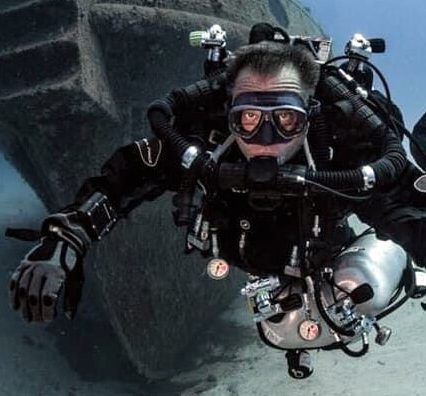
TIM LAWRENCE owns Davy Jones’ Locker (DJL) on Koh Tao in the Gulf of Thailand, helping divers take their skills beyond recreational scuba diving. He also runs the SEA Explorers Club.
A renowned technical wreck and cave explorer, and a member of the Explorers Club New York, he is an ANDI and PADI / DSAT Technical Instructor Trainer.
Also on Divernet: LUSITANIA OWNER BEMIS DIES AT 91, LUSITANIA OWNER GIFTS RMS LUSITANIA WRECK TO MUSEUM, DIVERS RETRIEVE LUSITANIA’S MAIN TELEGRAPH, LUSITANIA TELEGRAPH RECOVERED FROM 90M
I have an ancestor, Margaret Foulds, who lost her life on the Lusitania. She was a stewardess, and her body was never recovered. This was a very interesting article. Thank you.
Thank you for thsi article, it brought back many memories.
I completed a short dive on the Luisitani in 2000:
Greg Beamis was on board with us a well as Stuart Williamson who made notes and completed a painting which I still display on my wall today.
The myteries around the Lusitaina sinking inspired my technical diving for 20 more years.