Books remain a great bet as gifts for other people or for yourself (and a good use of those Amazon vouchers), even this far into the digital age. Some diving-related stand-outs were published in 2025 – STEVE WEINMAN has been turning the pages
Discovering Submerged Stories: A Personal Dive Into Britain’s History, by Duncan Ross

Stand by for a treat, especially if you’re into British diving, are intrigued by the distant past and have a hankering to dive with a purpose. Archaeological diving means getting hands-on under water, though you’re supposed to get the appropriate qualifications first.
What makes this fascinating tour of British underwater archaeological sites so appealing is author Duncan Ross’s infectious enthusiasm: “Later that evening, watching my GoPro footage, I heard that I had let out an audible “whoa!” as all this amazing stuff materialised in front of me. A military vehicle museum on land is quite special but, under water, it’s something else altogether.”
The author comes over as likeable, unpretentious and well-equipped to bring a wide variety of long-submerged stories to life. He is what amateur underwater archaeology is all about, and whether he’s diving an ancient crannog or a Civil War blockade-runner, he brings a passion to the task at hand and to sharing the love.
In fact Duncan comprehensively previewed his book for Divernet readers through an outline feature just over two years ago, so you can get a taster before deciding whether to spend your money, though I don’t think you’d regret it. This is another gem from the very good Dived Up publishing house.
The 12 chapters not only chart the author’s progress through the British nautical archaeological world – with his personal contributions modestly outlined- but paint a picture of the variety of experiences available.
He starts with a WW2 aircraft, shifts gear to visit Stoney Cove’s 16th-century training timbers and then explores the VOC treasury that is the Rooswijk on Goodwin Sands, a Victorian submarine, HMS Invincible and much more. I found the chapter on the amazing finds made while river-diving at Elvet Bridge in Durham particularly interesting.
The book is generously illustrated, with some 200 photos, drawings and maps. Sometimes Duncan seems to dig down into more detail than is strictly necessary in the context of this book, but it’s never less than interesting.
If you have toyed with the idea of attending an NAS training course and getting involved, reading Discovering Submerged Stories could well tip you over the edge.
Dived Up Publications, ISBN 9781909455641, Paperback, 16x23cm, 288pp, £25
Technically Speaking: Talks On Technical Diving Vol 2: Foundations And Strategies, by Simon Pridmore

He does it every time. I sat down to take a preliminary look at Simon Pridmore’s latest book and, many hours later, realised that it was getting dark – and that I had read it all. There is just something about the way he writes about diving that keeps you turning the pages.
Often it isn’t that the information is new so much as the fact that he makes you think quite differently about it, fitting elements together in a fresh way. His second Technically Speaking volume is aimed at would-be technical divers in the first half and existing exponents in the second, but I’m pretty sure that any diver would find it an informative and entertaining read.
The author was a pioneer of mixed-gas deep diving in Asia and has stayed ahead of the curve so the book, like his others, is the result of observation, years of practical experience and thought and a generous sprinkling of anecdotes and examples from real life.
But it isn’t that technical, so its combined elements will keep divers at most levels bowling along happily on what is a drift-dive of a book.
The content is drawn from talks the author has given and articles he has written and I certainly recognised parts of it, but they are more than the sum of the parts.
To convey what it does, I can’t do better than point you towards an extract from the second half of the book published on Divernet in August, entitled Why Do So Many CCR Divers Ignore Checklists?
Do yourself a favour, read the book and, if you haven’t already, go on to read all Simon’s other titles. They will almost certainly change the way you think about diving, and in ways you didn’t expect.
Simon Pridmore, ISBN 9798296112521, Paperback, 244pp, 12x18cm, £10.67. Also hardback and ebook
The Shipwreck Decoder: A Handbook For Divers And Maritime Enthusiasts, by Ashton East

Where was this great book when I needed it most? The Shipwreck Decoder would have saved me a lot of confusion and greatly enhanced my underwater experiences when I was starting out in diving in the UK – and would have gone on serving me for many years afterwards, not least when trying to interpret other divers’ wreck photos.
I remember wandering around on the shallow wreck of the Louis Sheid WW2-era steamer in south Devon as a novice in the early 1990s, wondering what the hell I was supposed to be looking at on this apparent scrap-heap.
I made a bit of an effort to mug up on my wreck-dives after that, helped later especially by John Liddiard’s Wreck Tours and other Diver features, but this book would have been a short-cut to enlightenment.
Ashton East takes us through the basics of what makes up a boat or ship and its remains as a wreck. It does this through clear, simple writing and more than 400 clear, simple illustrations – congratulations especially on the latter, because it’s not easy to make a point and valid comparisons using so few lines.
A diver since he was 12 and long fascinated by wrecks, Ashton started on this guide as a Covid lockdown project to aid his own understanding of the derelict hardware he saw on his dives – it was a friend who persuaded him that there would be a market for it.
He has a gift for simplification, because this book covers all eras of maritime technology, including details of hull construction, propulsion from sail onwards, armaments from the many forms of cannon to guided missiles and fittings and equipment.
I would recommend it to any casual recreational wreck-diver, to budding archaeological divers and, I reckon, it could fill many a gap even in experienced wreck-divers’ knowledge. You won’t spend a better £20 for a dive-related book this Christmas.
Dived Up Publications, ISBN 9781909455429, Paperback, 210pp, 15x23cm, £20
Underwater Museums: What Remains Of WWII In The Pacific, by Brandi Mueller

I’ve been a fan of US wreck-diver Brandi Mueller ever since she came up with The Airplane Graveyard: The Forgotten WWII Warbirds Of Kwajalein Atoll in 2018 – a page-turner of a book that gave a real feeling of underwater discovery.
When an author takes me along on the dive with them through their writing I’m happy, and Brandi has that ability, as she proved with a succession of wonderful Diver magazine features about her adventures.
Underwater Museums is quite unlike Warbirds in that it has such massive scope – potentially all 3,500 or so Pacific WW2 shipwrecks plus the many aircraft – but covers everything from the history to the diving itself in 144 pages, many of which are given over to photography.
She must have had to make many brutal cutting-room decisions to present this broadbrush impression of what divers can expect to find, sketching the wartime background, taking us on a few representative dives and concentrating on the dive-site star turns.
Chapters take in the wrecks of the Marshall Islands; the Philippines; Saipan, Tinian, Guam, & Palau; the Solomons, Truk Lagoon, where she has been based for much of her career, Vanuatu and, for the grand finale, Bikini Atoll, which she has visited twice. As a working dive instructor and captain as well as a writer-photographer, she really knows her stuff.
Divers looking for a comprehensive grounding in WW2 wrecks of the Pacific might be better off seeking out other books that zero in on specific island groups, but as an easily digested scene-setter Underwater Museums works fine, with the author’s writing as bright and enthusiastic as ever.
And because Brandi is such a good warmwater wreck photographer and this book is so generously illustrated – it contains 178 of her own and a number of historic images – it has a powerful graphic impact.
Permuted Press, ISBN 9798888452042, Hardback, 25x25cm, 144pp, £25
Snorkelling Britain: 100 Marine Adventures, by Emma & Gordon Taylor

The authors are scuba and snorkelling instructors – they met on an instructor course at university – and have spent 20 years exploring Britain’s coastlines, clearly spurred on by a desire to share their enjoyment of the underwater world with their children, initially on snorkel.
The title is prefaced Wild Swimming – the speciality of publisher Wild Things – and suggests that the Taylors feel that a lot of wild swimmers would enjoy a whole new perspective on their outings if they added a mask, snorkel and fins to their kit and took a good look below them.
“We aim to inspire and empower you to embrace the unencumbered freedom of snorkelling as you explore the amazing world of nature beneath the waves, whether you’re a complete beginner or an accomplished scuba diver,” say the Taylors.
The site-locator map at the front highlights that no-one need travel too far to find a site suitable for snorkelling around Britain’s coastline, but the locations are sensibly divided into those best for beginners and those for more experienced snorkellers.
Other categories include Urban Access, Wrecks & Piers, Great Beaches, Tidal Pools, Seagrass, Kelp Forests, Rock Formations and those sites Off The Beaten Track. The regional divisions are South-west, South and North & East of England, Scotland and Wales.
Each of the 100 entries includes a thoughtful intro to set the context, and a factfile that includes reasons to visit, how to get to the site and park your car, and useful notes.

Here’s a random sample on Dancing Ledge Tidal Pool in Dorset: “This really is delightfully easy marine exploration: find a place to stand or float, put your face into the water, rest your focus on a section of the pool wall, and you’ll discover a wonderful microcosm of life: barnacles, limpets, snakelocks anemones, beadlet anemones, perhaps some shrimps and small fish.
“Once you’ve finished looking around at the life on the pool walls, it’s worth inspecting the floor, where you might spy some crabs and bottom-dwelling fish hiding between the rocks.”
There is also a little guide to commonly seen inshore marine life, and plenty of advice on safety and so on including, I was pleased to see, IPO awareness. This guide is carefully thought-out and lavishly illustrated with excellent underwater as well as topside photography (it’s always a nice day, of course).
Many scuba divers, especially those with younger children, might be inspired to use this as a guide for shared adventures – highly recommended.
Wild Things Publishing, ISBN: 9781910636473, Paperback, 280pp, 17x20cm, £18.99 (though see the Amazon price below), also ebook
IN BRIEF: FOUR FROM PRINCETON UNIVERSITY PRESS
Into The Great Wide Ocean: Life In The Least Known Habitat On Earth, by Sönke Johnsen
Princeton can be relied on for both its high production values and literary merit in its books, and this exploration of the open ocean and pelagic creatures from giant squid and jellyfish to anglerfish is no exception. Biologist Sönke Johnsen, a professor at Duke University, describes the environmental challenges they have evolved to manage – and those that might yet prove a bridge too far.
ISBN: 9780691181745, Hardback, 248pp, 14x21cm, £20. Also ebook


Reefs Of Time: What Fossils Reveal About Coral Survival, by Lisa S Gardiner
The author is a geoscientist who writes about climate change. Understanding how ancient reefs managed to survive the climatic and other challenges over millions of years can help guide today’s and tomorrow’s efforts to save coral, she says.
ISBN: 9780691247335, Hardback, 288pp, 15x23cm, £25. Also ebook
Shark: The Illustrated Biography, by Daniel Abel & Sophie A Maycock
This is a book about shark biology, ecology and behaviour using particular diverse species to examine their lifetime development, and notably featuring fine watercolour illustrations – 100 of them – rather than photography. Many divers might opt for a more conventional field guide if they don’t already have one, but this is an attractive and illuminating route to understanding sharks.
ISBN: 9780691261676, Hardback, 224pp, 17x24cm, £25. Also ebook


The Wake Of HMS Challenger: How A Legendary Victorian Voyage Tells The Story Of Our Oceans’ Decline, by Gillen D’Arcy Wood
HMS Challenger embarked on the first round-the-world oceanographic expedition in 1872. Over four years the scientists recorded numerous marvels such as the Mariana Trench and Mid-Atlantic Ridge while collecting some 5,000 marine-life samples, capturing a comprehensive picture of the oceans a century and a half ago.
The author sets out to compare what these explorers found then and what they would find now in our climate- and pollution-raddled 21st century world. The news was never going to be great, but the concept makes for compelling reading.
ISBN: 9780691233246, Hardback, 328pp, 14x22cm, £25, also ebook & audiobook
MOST-READ SCUBA-DIVING BOOKS ON AMAZON.CO.UK (6 December)
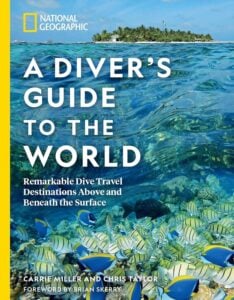
1 National Geographic A Diver’s Guide To The World, by Carrie Miller (Paperback, £21.98)
2 National Geographic 100 Dives Of A Lifetime, by Carrie Miller (Hardback £23)
3 Fifty Places To Dive Before You Die, by Chris Santella (Hardback, £17.97)
4 Snorkelling Britain: 100 Marine Adventures, by Emma & Gordon Taylor (Paperback, £10.99)
5 The Troubled Deep (Cam Killick Norfolk Mysteries), by Rob Parker (Paperback, £7.28)
6 Scuba Diving Hand Signals, Black & White Edition, by Lars Behnke (Paperback, £6.93)
7 Deep: Freediving, Renegade Science And What The Ocean Tells Us About Ourselves, by James Nestor (Paperback, £10.95)