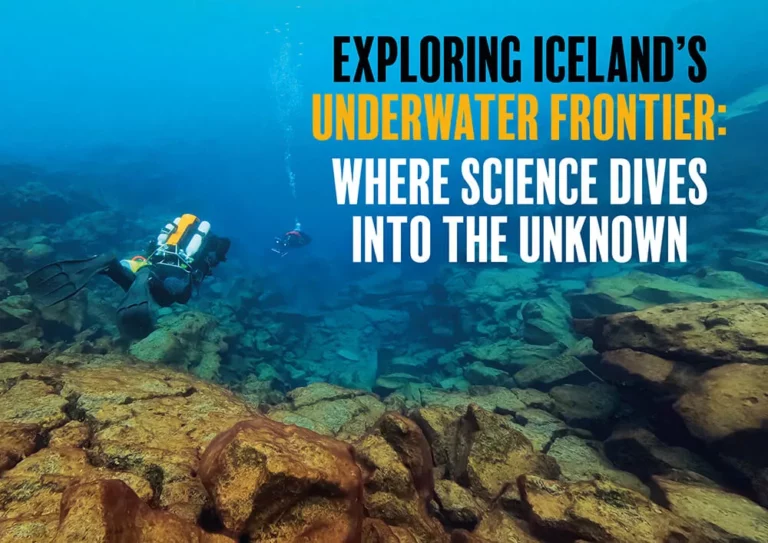

Exploring Iceland’s Underwater frontier, Yana Stashkevich recounts her recent experience on Bernie Chowdhury’s Iceland 2025 expedition, vividly describing the surreal underwater landscapes and scientific potential of Iceland’s Silfra Hellir.
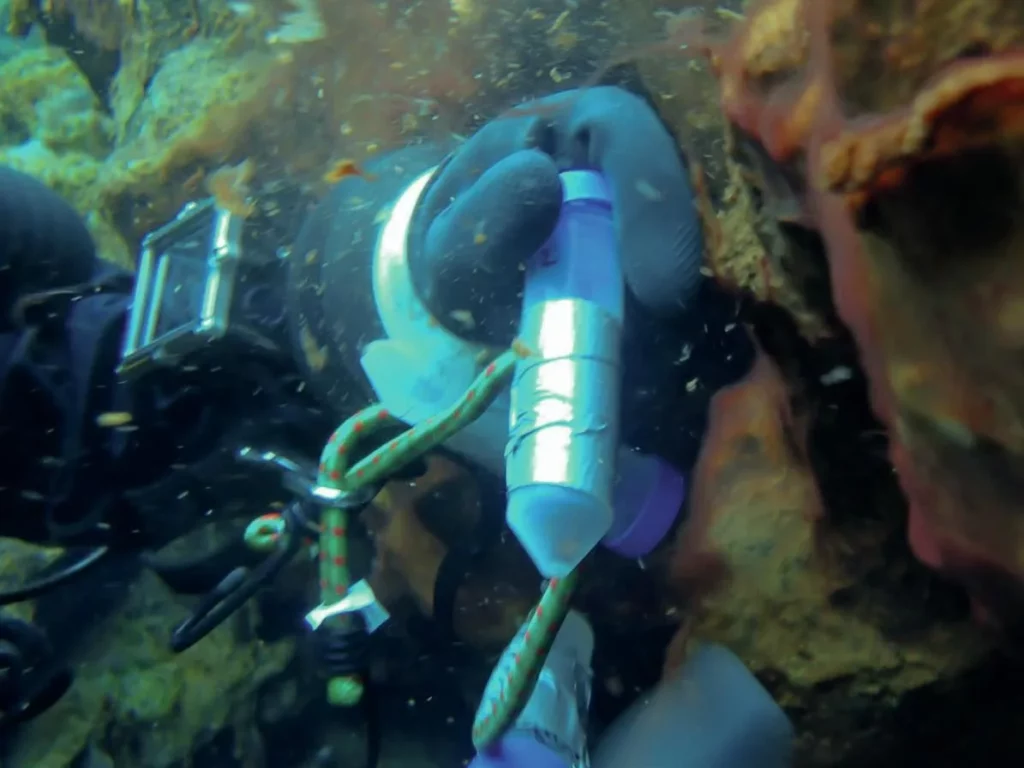
Slowly gliding over the rugged boulders obscured by dark burgundy, almost purple, soft and feathery three-dimensional biofilm, I search for a suitable spot to take samples of this alien texture. Frothy formations, swaying gently in the hardly detectable water movements, create an impression that the rocks at the bottom of the fissure are alive and breathing. Mesmerising, yet incredibly difficult to capture in a plastic lab sample tube underwater.
I notice glimmering sun rays breaking through the surface, almost blinding me, and I momentarily look straight ahead. The water is so luminous blue that I feel I am about to swim into an episode of Blue Planet. I lose my concentration for a split second and feel myself quickly drawn to the surface from 5ft. I immediately regret attempting such a shallow dive on a rebreather – a piece of equipment warranted by much deeper and longer dives – and not switching to a single cylinder. This snaps me back to reality after a perfectly surreal moment. We are here on a mission. A mission that started in 1997 – and one I feel incredibly excited and honored to be part of now.
The Legacy of Bernie Chowdhury: From 1997 to Today
The Iceland Expedition in September 2025 is a follow-up to Bernie Chowdhury’s 1997 expedition, where the diving pioneer, explorer and author of The Last Dive carried the Explorers Club Flag along with his team. Nearly 30 years ago, this was the prime time for cutting-edge cave exploration. Divers had less reliable and much heavier and bulkier equipment, no heated undersuits or other luxuries of modern-day technical diving, but unmatched perseverance and spirit of adventure. Many things have changed over the past few decades – people, equipment and technology – yet one thing has remained the same: the contagious thirst for adventure and the spirit of Iceland’s Underwater exploration. You could undeniably feel it back in the briefing room, with both old and new expedition members gathered, buzzing with excitement for the challenge ahead. We were back to the Land of Fire and Ice, the unique Nordic island situated at the confluence of the North Atlantic and Arctic Ocean.Part of the mission was to revisit and survey the Silfra Hellir cave, the most-significant cave in Iceland, in the hope to extend the end of the line (with the ROV).
But more importantly, it was also the ‘proof of concept’ of the viability of conducting field research and analysis of the multifractal microbial environment. Microbial research in these extreme underwater environments could yield groundbreaking discoveries – from antibiotics to advances in DNA science. The potential of this expedition was phenomenal. All knowledge gained from the research will be documented in The Global Microbial Hot Spot Atlas, the open-source platform used by scientists worldwide.
Remote Exploration: Guiding an ROV Across the Atlantic
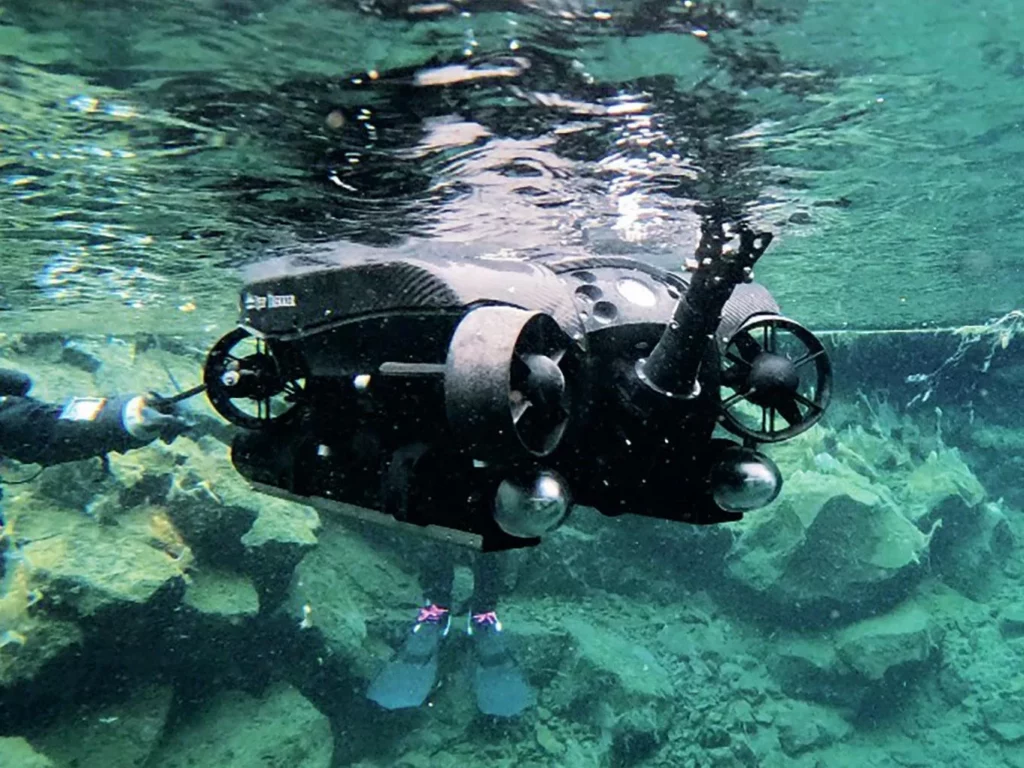
But this was not the only ‘first’ for the expedition. Kim Martin, a highly experienced pioneering technical diver and a member of the original 1997 team, was set to operate the ROV – a remotely operated underwater vehicle / robot – from his apartment in Toronto, guiding it into environments too dangerous for divers to enter. Sadly, a diving accident six years ago left the Canadian explorer paralysed with only limited use of his hands. Thanks to advanced technology and the unprecedented support of the Icelandic diving team, he was able to play a critical role in the expedition. Nothing like this has ever been done before on any previous mission.
Martin said: “It’s incredible. Who knew that 28 years after our initial exploration of Silfra Hellir that I could go back and explore the cave from the comfort of my apartment in Canada, through the eyes of an ROV.”
“Ascending through the fissure feels like trying to squeeze through the closing doors of a London Underground train – except each ‘door’ has jagged edges, unpredictable curves, and a rough, porous surface sharp enough to cut”
Navigating the Abyss: The Deep Trekker ROV Challenge
The logistical challenge of transporting the highly advanced Deep Trekker ROV to Iceland was a mission in itself – one that inspired the expedition’s motto: Ever Onwards!
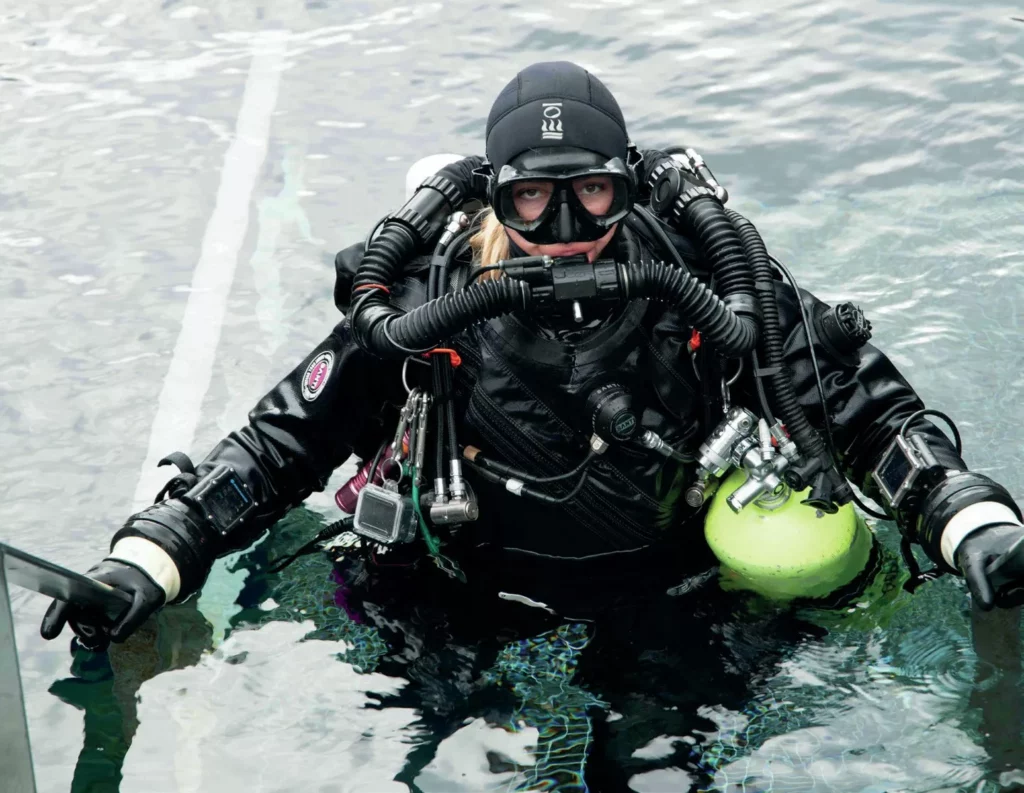
Hovering at 16ft in the headpool just outside Silfra Hellir’s cave entrance, with the ROV cable in my hand, I felt the reassuring pull from the surface – a signal that we were ready to start. I watched as the shadow of the sophisticated machine disappeared into the darkness. Sylvía, my dive buddy on the ‘ROV in-water support team’, and I exchanged excited looks as we felt the cable slide through our hands and the chill of the current flowing out from the cave. The water that fills the rift comes from the nearby Langjökull Glacier. As it filters through layers of volcanic rock, it becomes exceptionally clear – and equally refreshing – maintaining a steady temperature of 35-39°F year-round. Everything was going to plan. Well, apart from my malfunctioning heating system, but that was insignificant compared to the challenges the team had overcome to get to where we were.
Tectonic Shifts in Iceland’s Underwater Fissures
The Icelandic rift was formed by the tectonic plates of North America and Europe slowly moving apart. It is believed to be the only diveable cave in the world formed by this phenomenon, offering a truly unique underwater experience, accessible only to highly qualified teams for scientific and research purposes. Silfra Hellir is captivating in every sense. We review the ROV footage in excitement – it brings you into the surreal untouched underground world. Swimming through carved, rugged passageways that narrow perilously as you venture further into the cave, you can’t help but feel small and insignificant. It’s rugged, raw and unpolished – imposing and hostile, yet also fascinatingly beautiful with shimmering glimpses of graphite particles and other minerals of volcanic origin. If Salvador Dalí had ever painted a flooded lunar landscape, this would be it. It’s captivating, but you can’t give in to the temptation to descend to the very bottom. The openings are deceiving and you risk getting wedged between the rocks if you were to venture there.
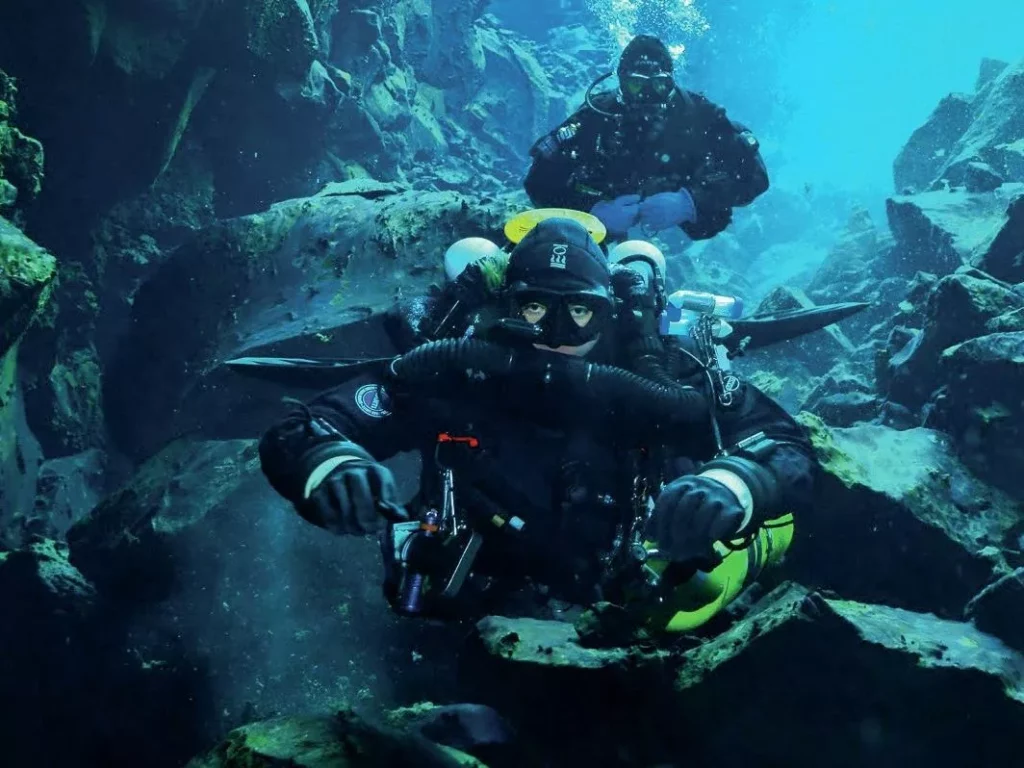
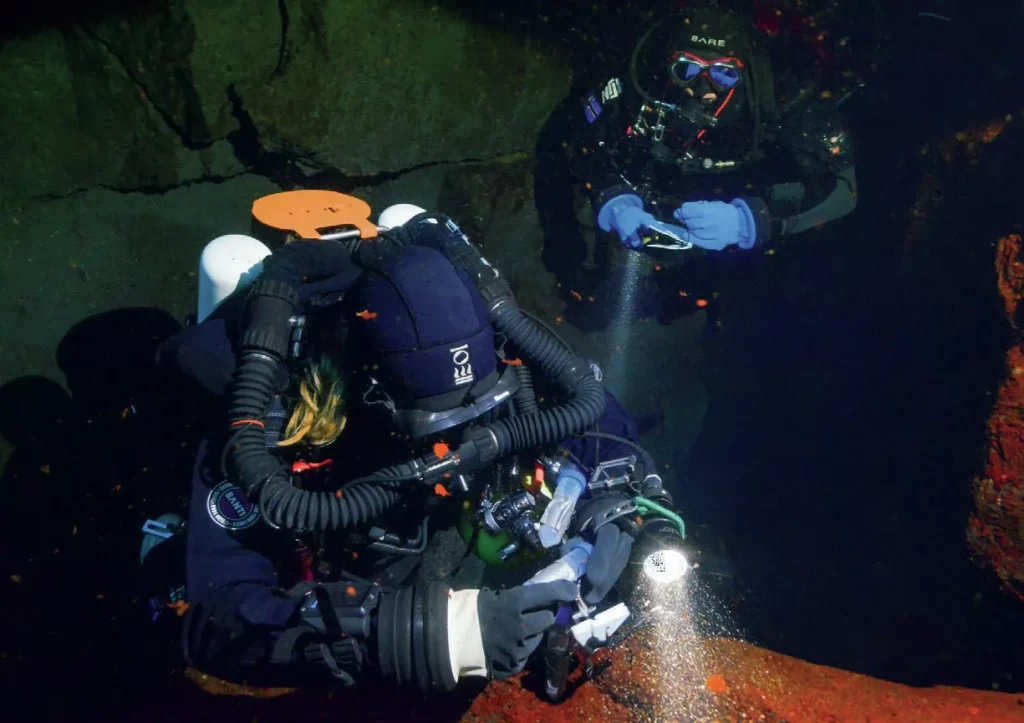
Did you know? A fissure, in geological terms, is a long linear crack in a rock, formed by tectonic and volcanic activity.
The “Velcro” Grip: Navigating Iceland’s Underwater Tectonic Rifts
Ascending through the fissure feels like trying to squeeze through the closing doors of a London Underground train – except each ‘door’ has jagged edges, unpredictable curves, and a rough, porous surface sharp enough to cut. Though the walls are actually moving apart as a result of tectonic shifts, you can’t shake the sinking feeling that they’re closing in around you. Your mind begins to play tricks and the faint glimmer of light from the entrance appears so far away that it is hard to tell whether it marks the exit or just another opening in the ceiling.
I remember watching the video and thinking that it’s not a friendly cave. I could see how easy it would be to start to feel trapped. Both psychologically and physically. Kim’s words echoed in my head: ‘the walls grip you and you stick to them like Velcro in your neoprene suit’. The same feeling you get crawling inside dry lava tube caves.
Tracking the line between the plates, I had flashbacks from watching footage from the original 1997 expedition. I recognised the stacked fallen boulders at the bottom and the imposing rock once wedged between the two walls, now collapsed onto the original line. Clear evidence of the tectonic plates slowly creeping further apart. The fallen rock was the culprit of our ROV return attempt – trapping the cable. After some tense maneuvering, the cable was untangled and our machine was freed and brought to the surface in a strange balancing dance – marking the end of our surveying efforts.

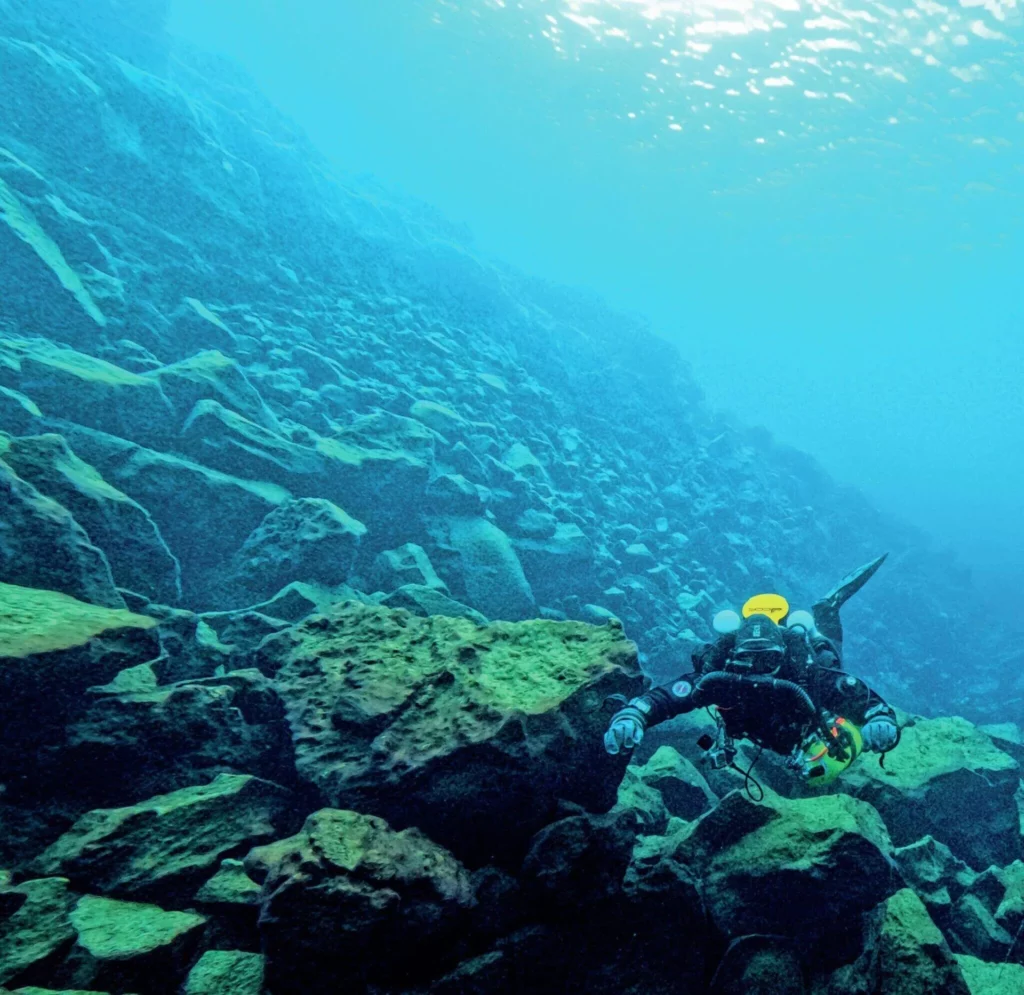
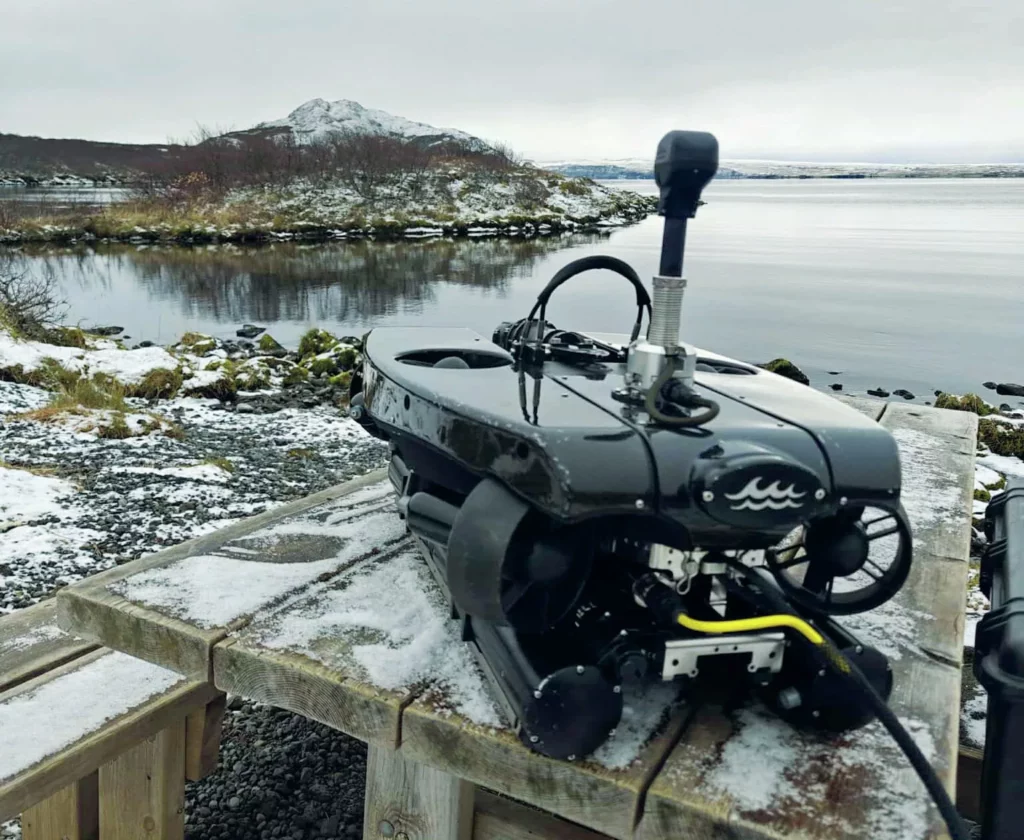
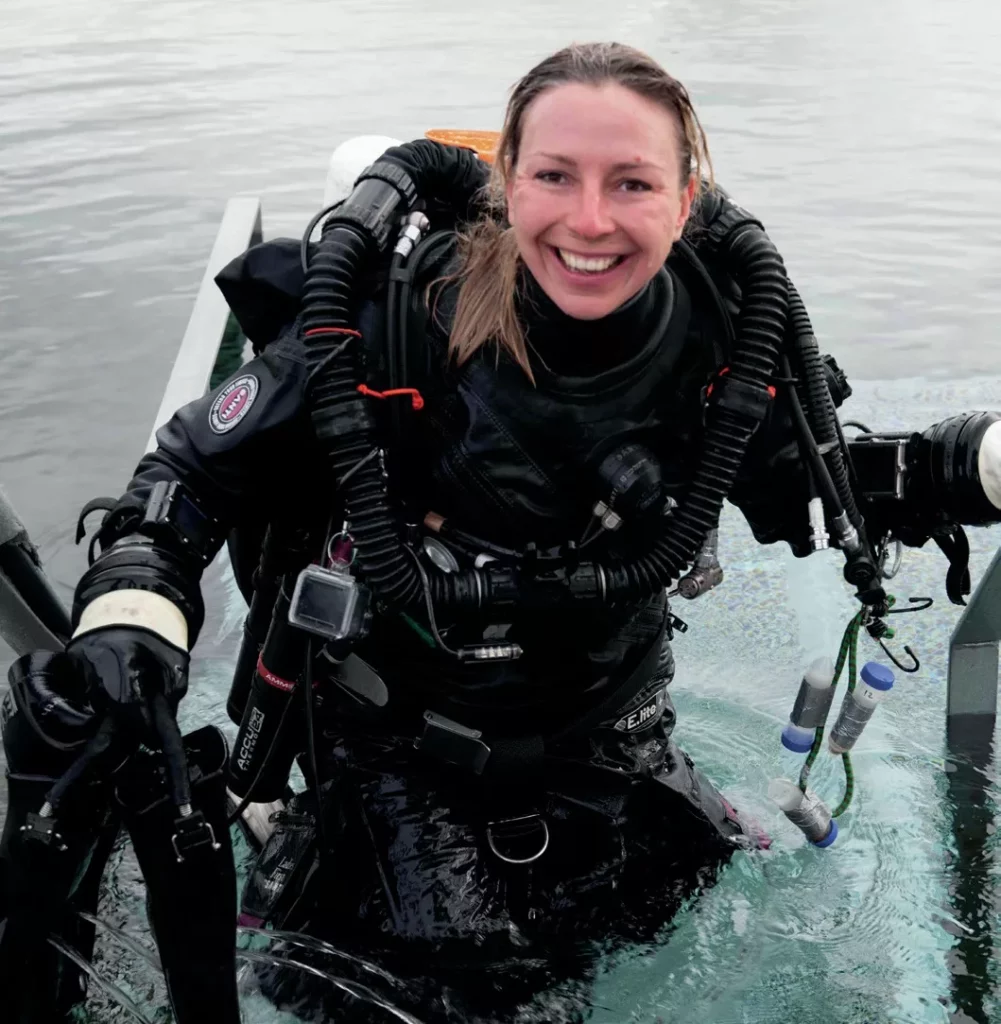
Did you know? Silfra Rift, a fissure caused by tectonic plate movements and volcanic activity in Thingvellir National Park in Iceland, is a designated UNESCO World Heritage Site and a true geological phenomenon. It lies between the North American and Eurasian tectonic plates that are diverging and moving apart half an inch each year.
The Future of Icelandic Underwater Research
Over two weeks we collected numerous samples from Davíðsgjá (David’s Crack) fissure and other diving and dry lava cave sites identified as suitable for research. Davíðsgjá is only a mile away from the Silfra Rift, where some 80,000 snorkelers each year waddle down the steps like a colony of penguins in their quest to swim between two drifting tectonic plates.
With over 100 metres of visibility, it’s unsurprising – but largely due to the work of the original 1997 expedition. More research results will be revealed in the forthcoming Explorers Club Report, but initial biological analysis revealed that 85% of the microbes collected in the bio-samples are unknown to science.
While there is more to explore in the deeper parts of Silfra Hellir and other dry lava caves -with the official government permission to collect samples at every site – I’m particularly excited about Strytan in Eyjafjörður, North Iceland – a geothermal vent that rises 213ft from the seafloor and releases mineral-rich water. It is a protected site and the only place in the world where divers can explore an open-water geothermal chimney. Ever onwards!
FAQs
What is Silfra Hellir and why is it significant for divers?
Silfra Hellir is the most significant underwater cave in Iceland, located within the Silfra Rift. It is geologically unique as it sits between the North American and Eurasian tectonic plates. Divers value it for its 100-meter visibility and the rare opportunity to dive directly between two continents.
Who led the original 1997 Iceland expedition?
The original 1997 expedition was led by Bernie Chowdhury, a renowned diving pioneer and author of The Last Dive. The 2025/2026 mission serves as a direct follow-up to his initial exploration and survey of the Silfra Hellir cave system.
How was the ROV used in the latest Iceland mission?
In a groundbreaking “first,” pioneering diver Kim Martin operated a Deep Trekker ROV remotely from Toronto, Canada. This allowed the team to explore dangerous, narrow sections of Silfra Hellir that are inaccessible to human divers due to the risk of entanglement or collapse.
What scientific discoveries were made during the Iceland expedition?
The mission focused on microbial research in extreme environments. Initial biological analysis of samples collected from the fissures revealed that 85% of the microbes found are unknown to science, offering massive potential for DNA research and antibiotics.
What is the water temperature in the Silfra Rift?
The water in Silfra originates from the Langjökull Glacier and filters through volcanic rock for decades. This process keeps the water exceptionally clear and maintains a constant, refreshing temperature of 35-39°F (2-4°C) year-round.
This article was originally published in Scuba Diver Magazine
Subscribe today with promo code DIVE1 — enjoy 12 months for just £1!
