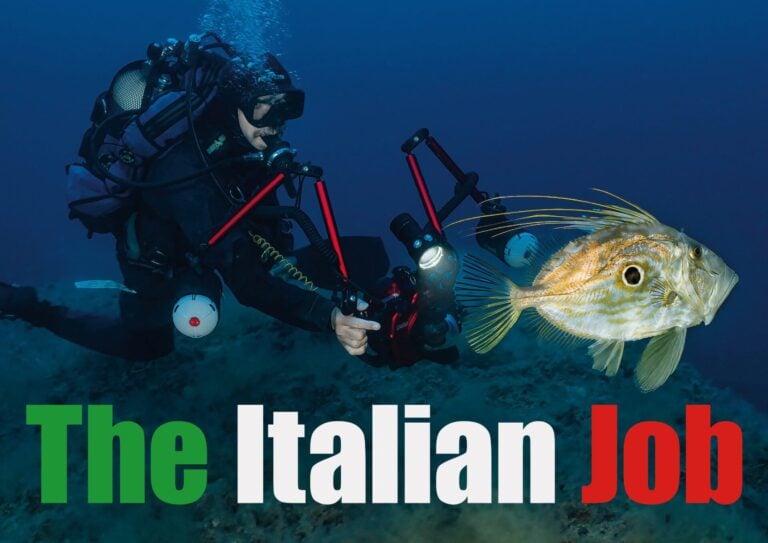
Don Silcock found himself on a steep learning curve when he was introduced to the ‘Italian way’ of deep diving in the Mediterranean
Photographs by Don Silcock
Three months had quickly passed since I completed my TDI training in the Gili Islands, and yet I had not managed to do a single ‘tech dive’ in that period… Lots of recreational dives in Papua New Guinea, Raja Ampat and the Lembeh Strait, but all using single back-mount 12-litre cylinders with 32 percent nitrox.
My special sidemount BCD, twin DIN regulators and the rest of my newly acquired gear had not seen the light of day since their debut at Gili Trawangan! Learning Point #1 -As obvious as it seems now in retrospect, I simply did not understand that most dive resorts and liveaboards are not able to support any form of technical diving.
I was not particularly concerned though, as my trip to Italy to dive and photograph some of the deep reefs near Tuscany and in the Straits of Messina was fast approaching and I had essentially taken the tech training to be ready for all that.
Learning Point #2 -All things are not equal, or put another way… there’s a right way, there’s a wrong way, and there is an Italian way!
The Italian way…
Let me be very clear – Italy is one of my favourite countries. I love the place, its culture and the people and I have been fortunate to have been there a lot, plus I worked with many Italians during the 14 years I lived in the Middle East.
Plus, my best diving buddy is Italian, and we have had many wonderful underwater adventures together, with the deep reefs the next in that series. But Italians do things their way…
And so about ten days before I was due to leave and had started to pack for the trip, it gradually dawned on me that my perception of how we would be doing those deep dives was not aligning with the reality that was emerging from all the WhatsApp messages.
Drysuit and tech fins – yes. But just bring one DIN regulator configured for recreational diving, a regular BCD and leave all that other stuff in the dark!
Tuscany My friend Filippo Borghi is an incredibly talented underwater photographer whose images are a constant source of inspiration to me – let’s just say he’s very, very good!
He lives in Siena, the arch-rival of the more-famous Florence, and it’s a beautiful city which I like more each time I go there. But the deserted main bus station at 10pm on a Wednesday night after a 30-hour
journey from Bali is not its best side… But Filippo was there to meet me and whisk me away to a local bar-restaurant cum guesthouse called Cepo in the nearby Chianti he had booked for me – leaving me with a warning to tell the owners not to force-feed me Tuscan style at breakfast.
Cepo turned out to be one of the delights of the trip as it was warm Tuscan hospitality at its best and I stayed there in between both diving trips, almost becoming one of the locals!
We spent most of the next two days preparing gear, tanks and cameras for our trip to Giglio Island and my first exposure to the deep reefs of the Mediterranean and ‘the Terrore’.

Giglio Island
Pronounced ‘jeelio’, Giglio is a 27km long granite island, located about 16km off the coast of Tuscany that is a popular domestic tourist destination. There are regular ferry services to it from the town of Porto Santo Stefano and hotels, restaurants, and cafés catering to those tourists.
Giglio was the island where the Italian cruise ship Costa Concordia ran aground in 2012. The eventual refloating and relocation to Genoa created a boom on the island as 2,000 workers moved there to work on the project!
There are a few dive shops that cater to local divers and freedivers who either travel over on the ferry or use Terrore’s boat, the Seagull, which can cater for four divers, typically for two to three days.
Terrore’s real name is Lorenzo, but everybody calls him ‘the Terrore’ (the Terror). I never really got to the bottom of how he got his nickname, but it’s apparently related to his behaviour when young.
He was a really nice guy, but had the look of somebody you would endeavour to be on the right side of at all times!
Diving the Tuscan Mediterranean
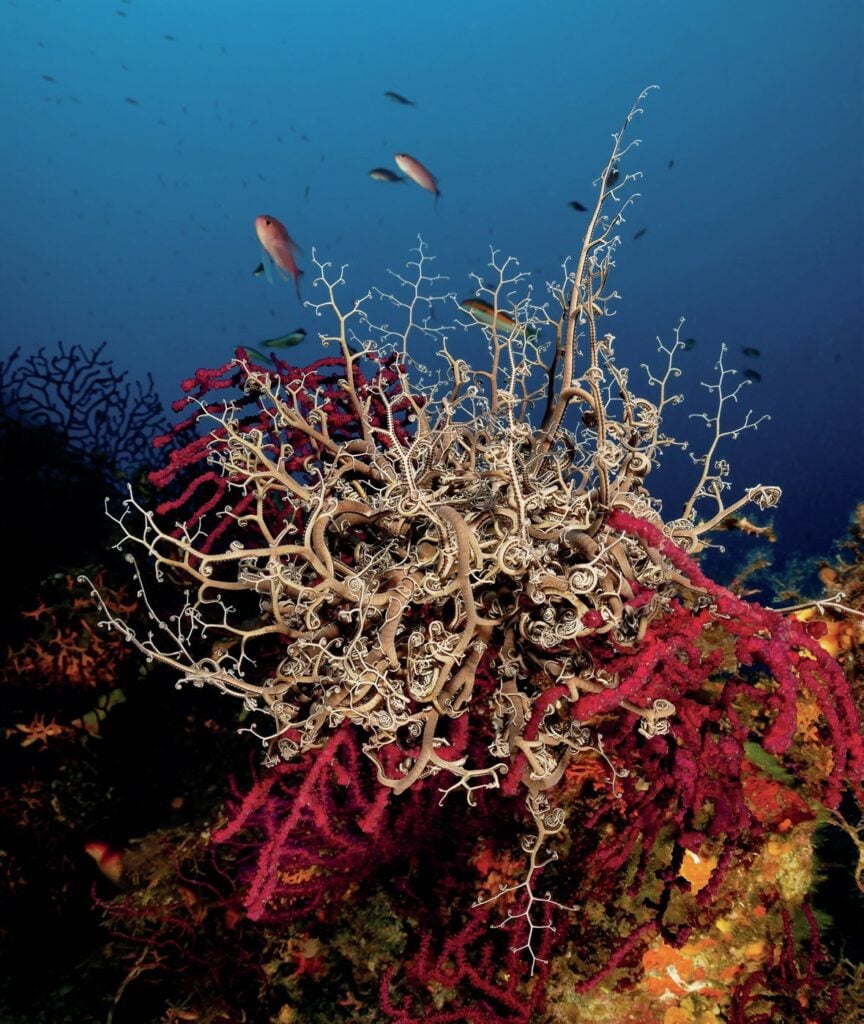
There are a few things you need to know about diving this area of the Mediterranean Sea. First of all, the water is deep blue and incredibly clear, but… there is not much to see above 30m to 35m!
The good stuff, the deep and colourful reefs, only really start at 35m and basically shallow diving is not much of an option. So, you have to dive deeper and it seems everybody does – on air with 15-litre cylinders, and deco is normal.
Not really understanding this in advance came as a bit of a shock, particularly on the first day when I was still a bit jet lagged. But, by the second day I was okay with it all and had normalized it by the third and final day.
My main temperate water experience has been in South Australia and Tasmania, so I found the Mediterranean very different but also very intriguing.
Reggio Calabria
It’s 1,000km from Siena to Reggio Calabria on the toe of Italy and directly across the Straits of Messina from Sicily. The journey took about eight hours each way, so if you do the math, it quickly becomes apparent speed limits are more of an option than a legal requirement in Italy.
The speed is one thing, but Italian driving involves a lot of multitasking as potential traffic jams ahead are contemplated, WA messages are responded to, and the occasional phone call is answered in true Italian fashion (both arms in the air).
But here’s the thing… as you look across at fellow travelers on the Auto-Strada, you realize that it’s all normal and you are the only one who is worried!
But we made it and were warmly welcomed that evening by the local diving guru, Isotta ambassador and accomplished underwater photographer Domi Tripodi and his lovely wife Giuditta.
All the dives we did in Reggio Calabria were shore dives, straight off the beach and into the Straits of Messina – a quite incredible area that is 3km-5km wide and almost 250m deep.
A configuration that results in regular upwellings of really cold water from the depths, which brings all sorts of deep-sea creatures up into much shallower waters. Essentially, you never know what you are going to see there and it’s all pretty exciting.
Again, we were diving in the 40m region on air using 15-litre cylinders for the day dives, but much shallower on the night dives. In all, we had four days of excellent diving, with deco on all the day dives.
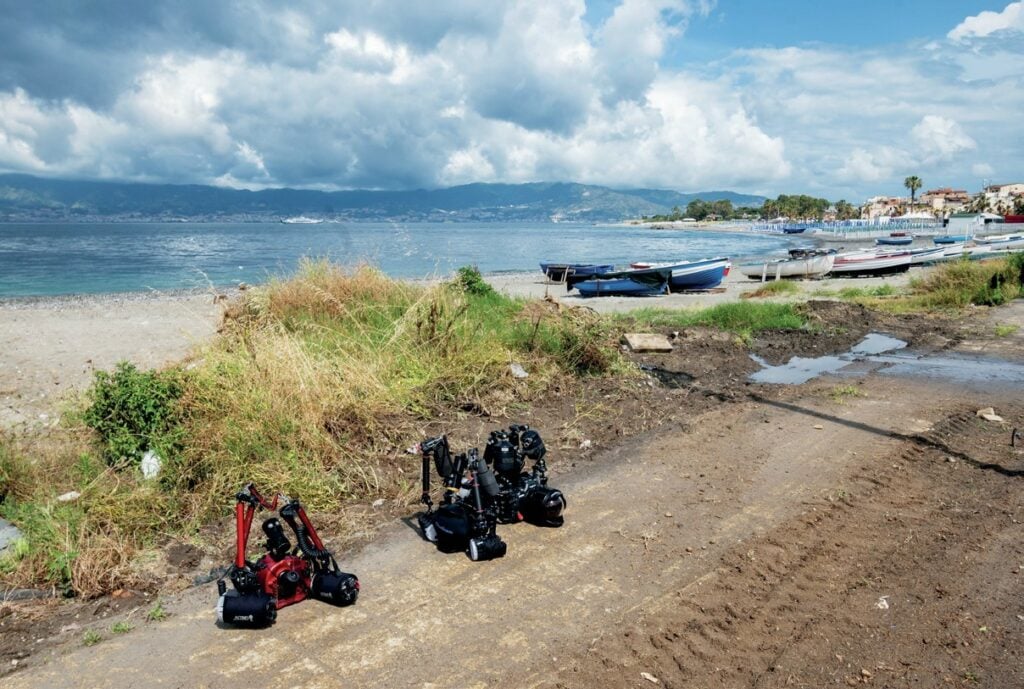
Only in Italy…
Because it was summer, we were typically not getting into the water till 9pm, which meant it was about 11pm before we were out and ready to eat!
On the first night I figured the only option would be a McDs, but no, this is Italy and we walked into a restaurant at 11.15pm and the owner seemed to think it was perfectly normal – as did everybody, except me!
Lessons learned
#1: The Italian way works well when overlaid onto the foundation I had established from my TDI and GUE training courses.
The 15-litre tanks were always filled to their maximum 230bar pressure and I was able to use my Shearwater Perdix AI proactively to monitor and control my surface consumption rate (SCR) to maximize my bottom time and safely manage my deco stops. Basically, once I adjusted to it all, I felt safe and in control…
#2: I should have done a much better job of discussing and agreeing the dive plans in advance. But that said, I was in Italy after all – so am not sure that’s a rational objective as Italians seem to love nothing more than last-minute improvisation!
#3: The training works, and I am a better diver because of it. I have always been nervous about deep diving and running out of air before completing any incurred deco, but was able to deal with what came at me in Italy and felt pretty good about it all. Was it perfect – no… Was it good – yes! Did I learn – yes!

What’s next?
This is the second in a series of articles that will document my progress in the world of tech diving, and next up is how I intend to address my overall lack of ‘match fitness’ for tech diving. Plus, how I intend to get ready for dedicated tech diving trips to the Solomon Islands in April and Bikini Atoll in June of 2024.
Watch this space
Don Silcock
Don is Scuba Diver’s Senior Travel Editor and is based on Bali in Indonesia. His website has extensive location guides, articles and images on some of the best diving locations in the Indo-Pacific region and ‘big animal’ experiences globally.
This article was originally published in Scuba Diver UK #82
Subscribe digitally and read more great stories like this from anywhere in the world in a mobile-friendly format. Linked from The Italian Job