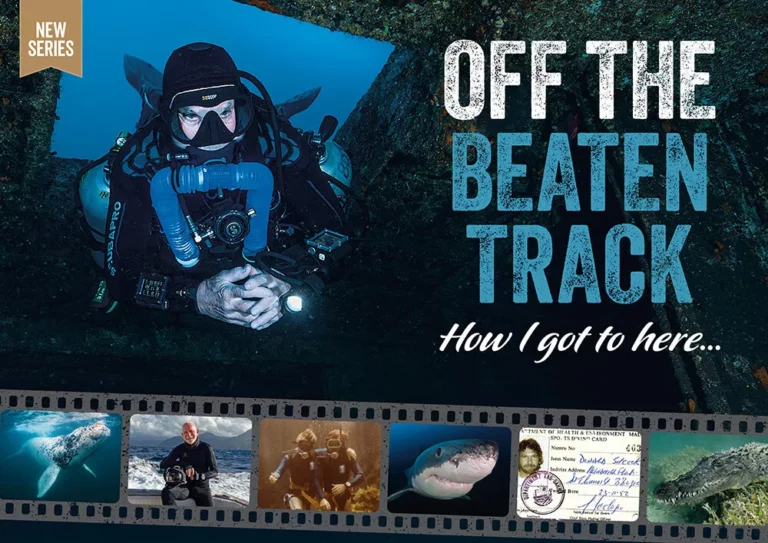
Don Silcock kicks off a new series focusing on some of the more remote diving destinations he has visited, and the challenges associated with organising a dive trip to those places
When the editor of Scuba Diver asked if I’d like to write a series about remote diving and the unusual places I’ve visited, my first reaction was doubt. Who would want to read my ramblings about remote destinations and the challenges of diving there?
But flattery is a powerful thing, and before long, I agreed. After much back-and-forth we settled on the title Off the Beaten Track – a fair description of what I’ve tried to do throughout my diving life.
But, as the first deadline loomed, I wrestled with how to begin as I didn’t want to sound like yet another self-styled ‘adventurer’ the diving world seems to encourage.
Then it struck me: the best way was to tell these stories through the lens of my own unlikely journey – one I hope might encourage others to chase their own.

The Middle East…
I grew up in the 1960s and 1970s in the working-class, industrial heartland of northwest England. Back then, life seemed pre-ordained: you worked in the local petrochemical plant, went to the pub on Thursday (payday), and the football match on Saturday.
That wasn’t for me. As soon as I finished my apprenticeship, I left – first for a job on a petrochemical plant in Libya, intended to last one year. Fourteen years, three other countries, a wife, and two children later, it was time to move on. Those years really changed me. They broadened my horizons, exposed me to a much-bigger world, and, most importantly, gave me the means to embrace scuba diving and underwater photography. By the time I left for Australia in 1991, I was a BSAC Advanced Instructor, owned two Nikonos cameras, had logged several liveaboard trips, and published my first few articles.
The lucky country!
One of my basic motivations in emigrating to Australia was to open a dive shop. But in those days, it seemed every street corner already had one, and nobody had heard of BSAC!
So, I changed course and joined a US technology company, which launched me into nearly two decades of travel and work across Southeast Asia, Japan, and China.
Living and working there gave me a deeper appreciation of its cultures and opened my eyes to the incredible diving scattered throughout the region.
What began as casual curiosity soon became a burning desire to experience it all. And that desire has led me to some remote and extraordinary dive sites.
Time to get serious about remote diving
Time is an incredible commodity – one that, when you are young, seems to stretch out endlessly before you. But as you age, becomes increasingly precious as the years flash by.
By the time I got into my 60s the realization dawned that if I was ever to become a ‘serious’ underwater photographer I had better make a move! So, I embarked on what would eventually become my third career and to do that meant ending my well-paid second one…
On 1 May 2019, 25 years to the day that I joined, I said goodbye to everything I had established with the US company. The next ten months exceeded all my expectations and then I learned what a pandemic was, and life ground to a halt…

Post-pandemic
Like most of us, the pandemic induced a lot of soul-searching about what I could achieve in this new phase of my life, and my conclusion was that I just had to double-down and get on with it.
Fortune, as they say, favours the bold and it was some of the projects I kicked off in those uncertain months that really launched my third career. Specifically, last year I became the operations manager for Papua Diving’s Raja Ampat SEACAM Centre at their prestigious Sorido Bay resort on Cape Kri in the Dampier Strait.
Then a few months later, I was appointed as a full ambassador for SEACAM – joining the very ranks of some of the underwater photographers who have long inspired me.
Why Your Next Adventure Should Be Off the Beaten Track
Underwater photography is challenging but immensely rewarding – if you can master it. The key is to capture images that tell, or at least hint at, a compelling story.
That’s why travel is so important. My journey from a petrochemical plant in northwest England to where I am now is the direct result of countless trips and dives around the world. If I can do it, the only thing stopping you… is you.
FAQs
What is the “Off the Beaten Track” dive series about?
This series by Don Silcock focuses on the world’s most remote and challenging dive destinations, detailing the logistics, photography, and unique marine life found far from the tourist trail.
Who is Don Silcock?
Don Silcock is a renowned underwater photographer, BSAC Advanced Instructor, and SEACAM Ambassador with decades of experience exploring remote regions like Raja Ampat and Papua New Guinea.
How do you organise a dive trip to a remote location?
Planning involves navigating complex travel logistics, understanding local seasonal patterns, and ensuring technical self-sufficiency, as these areas often lack standard diving infrastructure.
Why should I choose remote diving over popular dive hubs?
The primary draw of remote diving is the opportunity to see pristine, untouched coral reefs and marine life that hasn’t been impacted by mass tourism.
Why is remote diving worth the extra effort?
Remote diving offers access to untouched ecosystems, higher marine biodiversity, and “bucket-list” encounters that are often impossible to find in heavily trafficked diving hotspots.
This article was originally published in Scuba Diver Magazine
Subscribe today with promo code DIVE1 — enjoy 12 months for just £1!
