
Adjusting Your Scuba Trim: Aluminum vs. Steel Cylinders
@TheDeafGecko
#AskMark: As a mainly UK drysuit diver, whenever I go warm water diving, with a wetsuit and aluminium cylinders, I’m always ‘head heavy’, but neutrally buoyant.
You have to think of your body in the water as a seesaw with the fulcrum around your waist. The more downward or upward force you apply from that fulcrum, the more your body will tip. As divers, we refer to our body position in the water as trim, and for optimal horizontal trim, you want the forces pulling you up and down to balance along your body.
Steel cylinders are most common in the UK and have different buoyancy characteristics from an aluminium cylinder. Most of the weight of a steel cylinder is in the bottom of the cylinder, whereas an aluminium cylinder is heaviest at the valve. Because you now have less downward force around your hips and more downward force over your shoulders, you have a head-heavy trim. Try mounting the aluminium tank lower and move lead further down your body if you’re head-heavy.

The Safety Concerns of Tinted and Mirrored Masks
@user-ob3ob3ii3u

#AskMark: What do you think of tinted masks? I’ve heard they pose a safety risk.
The biggest worry about tinted masks is obscuring your eyes. You can see a lot about a diver’s state of mind by looking at their eyes. You can see from a distance if a diver is panicking, unconscious or not paying attention if you can see their eyes. Mirrored masks are not popular among instructors for this reason because it’s important for students to see your eyes. If a student can see that you’re calm by looking at your eyes, it can help calm them.
There’s also an argument that a mirrored lens can either scare or antagonise fish but, I don’t know if there’s much merit to that. For recreational diving, it’s up to you. Most of the treatments are beneficial in some way to the diver by either filtering out harmful UV wavelengths or some of the blues and greens for a better view of underwater. But personally, I prefer un-tinted masks. See more on our tips to buy your mask.

Equipment Care: Best Practices for Storing Regulator Hoses
@jadurkin1
#AskMark: Is it ok to keep regs rolled up in a reg bag or will this damage the hoses?
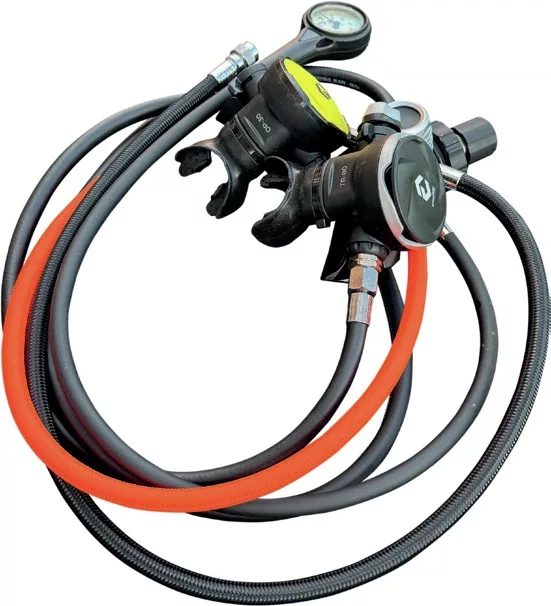
Regulator hoses are best stored as flat as possible if you have the space. When stored curled for long periods, the hoses will keep that curl, which isn’t necessarily dangerous, but it can be annoying at times if it bends in the wrong direction. A gentle curve is fine for a hose, but avoid folding the hose so much that it pinches, because that can lead to damage.
If a hose is folded in one spot, especially frequently in the same spot, the stretching and compression of the internal hose can lead to damage, which is why it can be common to see hose protectors near the ferrule where hoses commonly pinch from the weight of the hose and whatever is on the end of the hose pulling it downwards. Curl your regs in the reg bag, but check each hose to make sure that none are pinching and inspect your hoses when you pull them out for any signs of damage.
FAQs
Why am I head-heavy when diving with an aluminum cylinder?
Unlike steel tanks, aluminum cylinders are heavier at the valve (top). This shifts your center of gravity forward. To fix a head-heavy trim, try mounting the tank lower in the BCD strap and moving trim weights further down toward your hips.
Are tinted or mirrored scuba masks dangerous?
They aren’t inherently “dangerous,” but they can pose a safety risk by obscuring your eyes. Clear eye contact is vital for instructors and dive buddies to assess your state of mind and detect signs of panic or unconsciousness.
Does a mirrored mask scare away fish?
Some divers believe reflections can startle or antagonize marine life, though this is largely anecdotal. The primary concern remains diver communication and safety rather than fish behavior.
How should I store my regulator hoses?
Do I need hose protectors on my scuba regulators?
Hose protectors help prevent the hose from pinching at the ferrule (the metal connection point). They are useful for reducing strain caused by the weight of the second stage or gauges pulling the hose downward.
This article was originally published in Scuba Diver Magazine
Subscribe today with promo code DIVE1 — enjoy 12 months for just £1!
