What is reported to be an extraordinarily well-preserved Roman shipwreck was discovered off the south-east Italian coast near the town of Gallipoli last summer – but according to authorities it had been kept under wraps until now for its safety.
Units from Italy’s Financial Police (Guardia di Finanza or GdF) detected an anomaly in June 2025 during routine scanning of the Ionian seabed off Puglia, the heel of Italy’s ‘boot’.
When scuba divers were sent down to investigate they uncovered the essentially intact remains of a large merchant vessel dating to around the 4th century AD, the time of the late Roman Empire, with a cargo of hundreds of amphoras still in place.
The terracotta jars were thought to have held in particular garum, the fermented fish sauce highly prized in Roman cuisine, as well as oil, wine and other goods. Some of the amphoras have now been brought to the surface for conservation.
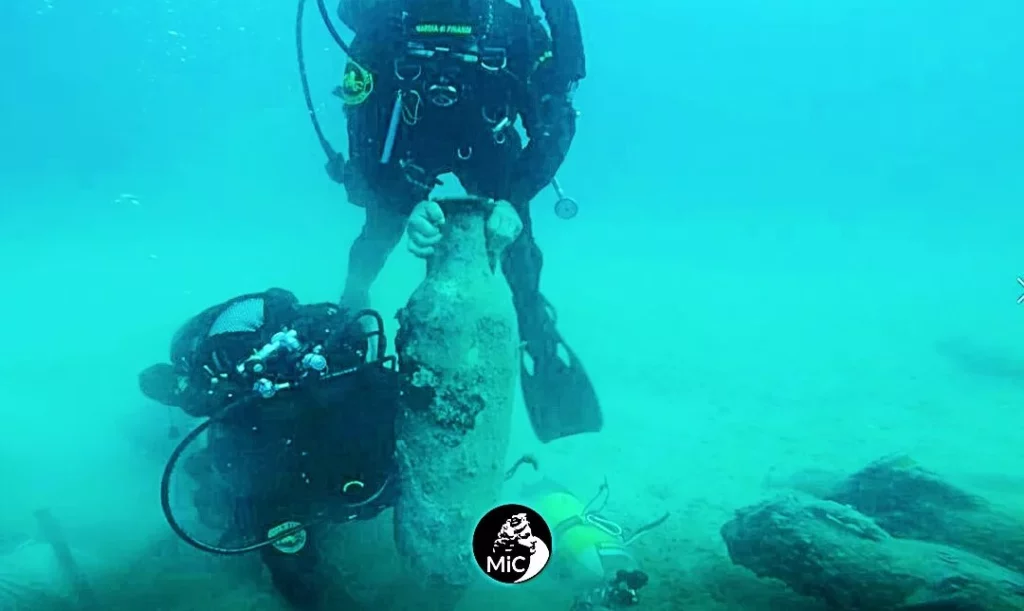
While amphoras are often found on ancient shipwrecks, maritime archaeologists say that the degree of preservation and the clustering in this case makes the discovery exceptional.
Early assessments and archaeological indicators suggest that the ship was likely to have originated in North Africa and would have followed established late-Imperial trade-routes across the Mediterranean.
Site protection
According to a GdF statement, national and regional authorities agreed that confidentiality was essential to protect the site from looting and illicit salvage before a protection and excavation strategy could be put in place, requiring the find to be kept secret until early February.
The area is said to have been constantly monitored by law enforcement agencies. The local Superintendency of Archaeology, Fine Arts & Landscape (SABAP) has co-ordinated with the GdF on planning systematic excavation, documentation and conservation operations.
Italy’s GdF is a military police force with broad jurisdiction over illegal trafficking of cultural property and maritime-law enforcement as well as financial, economic and organised crime.
SABAP has reportedly dedicated several hundred thousand euros-worth of funding to support the archaeological study, secure the wreck and carry out thorough documentation.
Researchers expect that further study will shed light on construction techniques, navigation routes and economic connections across the Roman empire during a period of significant historical transition.
Also on Divernet: 2,000-year-old Roman vessel discovered off Italy