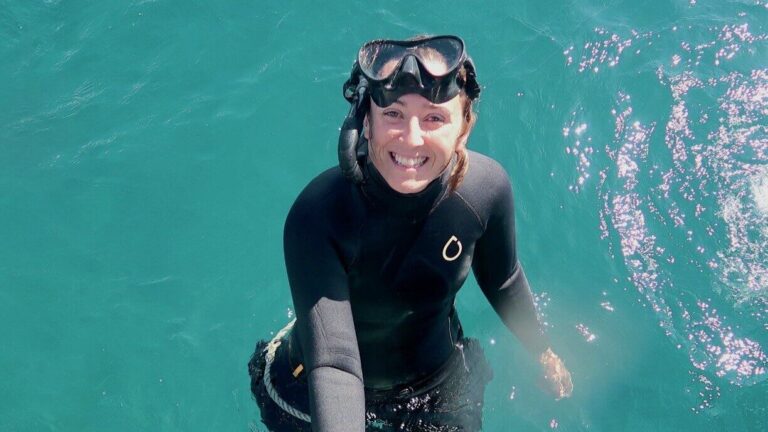

PT Hirschfield chats with shark researcher Sarah Han-de-Beaux about her work with Spot A Shark, channelling citizen science data collection into advocacy and conservation
Photography as credited
Diving with Shark Researcher Sarah Han-de-Beaux
UK-born, Bondi-based Sarah Han-de-Beaux’s life is filled with family, friends, rescued greyhounds and grey nurse sharks. In addition to working full-time in a corporate role, she donates her free time to co-ordinate Spot A Shark, an Australia-based data collection platform that invites participation from anyone who cares about grey nurse sharks.

Sarah’s first shark encounter is distinct in her memory: ‘When I was six, my dad took me to an aquarium. I remember just following a shark that was swimming around the tank, completely mesmerised. From that point, I wanted to read shark books, play shark-related games, collect shark teeth and watch shark movies. I’m one of the few who has known what I wanted to do my whole life: to save sharks’. For her 14th birthday, Sarah’s father booked them both into a PADI course together: ‘My outdoor training was in Stoney Cove, UK, in a quarry, wearing a 7mm wetsuit. The water was only five degrees C, but I loved every moment’.
Diving Highlights from Around the World
Today she rates her local sites Shark Point, Kurnell, Bondi and night diving in Camp Cove highly, and describes South West Rocks as her ‘happy place’: ‘When I meditate, I imagine heading through that cave and seeing the silhouettes of the grey nurse sharks as I come out the other side’.
Further abroad, it’s no surprise that global shark hotspots top her list: ‘Highlights include a dive in Fuvahmulah, Maldives, where at 30m we had several tiger sharks approaching us from multiple angles. They followed us up to the 5m safety stop’.
In addition to Galapagos and Fiji’s Beqa Lagoon, Sarah describes diving Mexico’s Socorro Islands as ‘incredible’. ‘Few dives can beat one at Roco Partida with hundreds of schooling silky, silvertip, whitetip, blacktip, grey reef sharks and hammerheads. Blue sharks in the Azores were also memorable. One rubbed its body along my fins, trying to remove its parasites or scratch an itch’.


Embarking on a shark expedition at age 30 only intensified her life-long passion for shark conservation: ‘I spent ten days sailing the Mediterranean on a research boat to tag sharks. We found none. Not one shark. Seeing the devastation of over-fishing first-hand compels me to spread the word and try my hardest to change the fate for shark populations. We have to save them’.
Sarah is now a driving force behind Spot A Shark: ‘During the pandemic, my friends and I were freediving multiple times a week at Bondi and found an aggregation of grey nurse sharks. Collecting and studying photos of them, I could see some sharks would stay for a week, others would stay for months, while some would come and go’.

The Birth of Spot A Shark
Sarah came across the Spot A Shark website, founded by Sean Barker and Peter Simpson in 2006. They’d helped build software and A.I. algorithms that would assist in identifying individual sharks through unique spot patterns on their flanks. Sarah contacted Sean, asking if she could contribute to their work: ‘Since then Spot A Shark has become my obsession’.
The software design for spot mapping was expensive to create. Shark champion Valerie Taylor (with whom Sarah will soon appear in the documentary ‘How to Save a Shark’ and her late-husband Ron Taylor provided much-needed funding to help launch the project. Sarah explains how Spot A Shark works: ‘We collect and analyse images, identifying individual sharks. This provides foundations for more accurate estimates of population size and migratory patterns. We can study health conditions and can gather better information about important aggregation sites’.
What We’re Learning About Grey Nurse Sharks
‘One shark, Marcus Aurelius, has been seen repeatedly over almost 20 years. Data like this helps us understand how long sharks may survive in the wild. Sharks like Zendaya help us understand their migratory journey, travelling from southern NSW up as far as Wolf Rock in QLD. While Sita grows thinner each month, helping us understand the negative impacts of modern recreational fishing hooks, another shark called Mary reveals the damage that shark nets in QLD and NSW cause’.
The work of Spot A Shark has grown significantly since Sarah’s involvement, alongside Dr Simon Pierce of the Marine Megafauna Foundation (MMF). It’s expanded from being a NSW-based project to supporting shark research in QLD and WA: ‘To date, we have very little data from WA. This is either because the population is severely stressed and low, or because we’ve not yet connected with a very active community there’.

“We collect and analyse images, identifying individual sharks. This helps us get much more accurate estimates of population size and migratory patterns”
Sarah explains why sharks need our help: ‘They play a hugely important role in maintaining the health of ecosystems. There’s ample proof that when sharks are removed, the entire food web breaks down’.
‘In my lifetime alone, there’ been a huge decline in global shark populations. Estimates are that 100 million sharks per year are killed, approximately three per second’.

‘Scientists say that for a species to survive into the future, their population needs to be at least 5,000 individuals. The East Coast population of grey nurse sharks is currently estimated at 2,000 individuals, with the population in the West Coast of Australia only half of that’.
‘This species impresses divers from all over the world, while supporting the health of our ocean. They do no harm to humans, yet they are at threat for survival due to modern recreational fishing practices and poor conservation efforts. Are we really going to sit back and just accept that fate?’. Sarah says ‘I spend 20-30 hours a week curating the database, analysing photos and identifying sharks. We now have a collection of over 16,000 grey nurse shark images in Sharkbook, after combining datasets from iNaturalist, Spot a Shark and the QLD Grey Nurse Shark Watch project. We have photos from as early as 1986’.
Citizen Science and the Diving Community
‘The diving community is an essential part of the project. We have several super keen divers and dive shops helping to collect shark photos. There’s a code of conduct for diving with grey nurse sharks that must be followed. If a diver shares a photo of a new individual grey nurse shark, they get to name it. You’ll hear from us in the future when another diver documents that shark’.
‘The science bit is done by real scientists. They review the data we’re collecting and publish scientific papers from it. There’s also a team at the Made Agency who support us in the brand, marketing, website and social media side’. In terms of funding, Sarah shares that while grant applications have been submitted, so far these have not been successful: ‘This project is currently self-funded, based on favours and pro-bono. A sad truth about conservation is that it mostly relies on volunteers and people with other full-time jobs. This I fear is unsustainable. If we really want to care for our planet, we can’t keep rewarding those who take and destroy. We need to start rewarding those who preserve and care’.
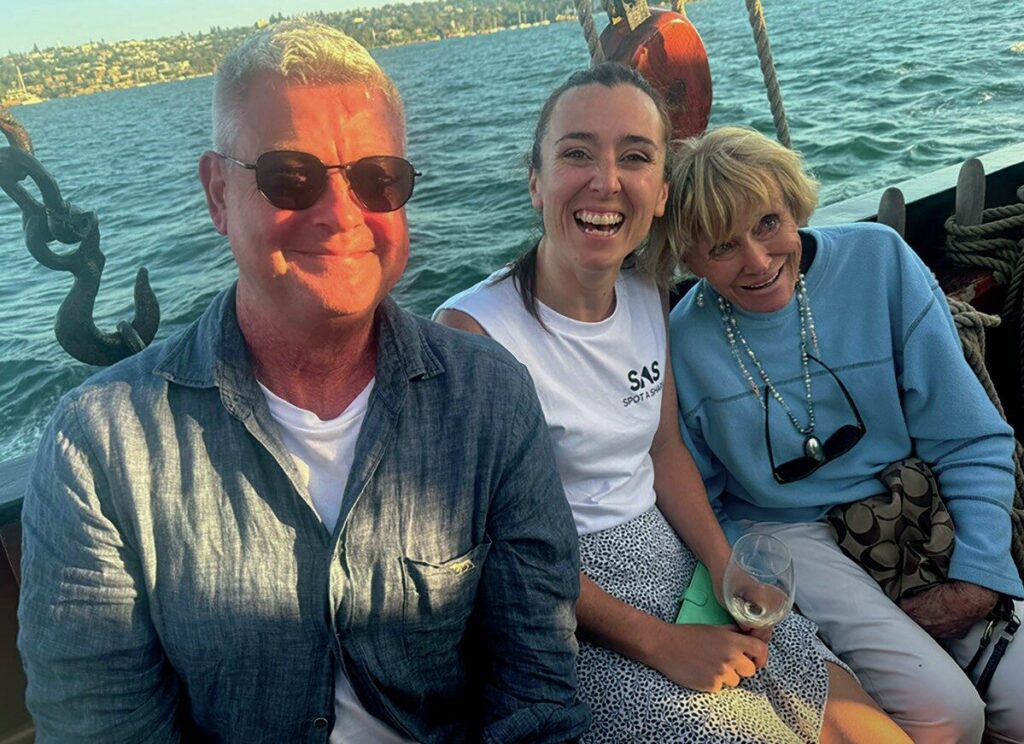
Sarah welcomes anyone who is keen to get involved, either as a ‘Spot A Shark’ citizen science researcher or sponsor: ‘If anybody has the resources to support our work financially, we’d love help with printing costs to get posters and flyers distributed across Australia. And you don’t have to dive with sharks to help spread the word. You could go to a school or event and inspire the next generation of shark advocates. Or contact your MP and let them know that you want more shark and ocean conservation’.
The Future of Spot A Shark
You can connect with Spot A Shark through social media and their website. Also, get involved with the next annual grey nurse shark census on 8 March 2025. Email: spotashark@gmail.com for more info. www.spotashark.com
Frequently Asked Questions
Who is Sarah Han-de-Beaux?
Sarah Han-de-Beaux is a UK-born, Bondi-based shark researcher and conservationist who coordinates Spot A Shark, a citizen science project tracking grey nurse sharks across Australia.
What is Spot A Shark?
Spot A Shark is a community-driven project that uses photo identification and A.I. to monitor individual grey nurse sharks, helping scientists estimate populations and migratory patterns.
Why are grey nurse sharks endangered?
Grey nurse shark numbers have dropped due to overfishing, habitat loss, and incidental capture in shark nets. The East Coast population is estimated at just 2,000 individuals.
How can divers and the public get involved?
Divers can submit shark photos to Spot A Shark, follow the grey nurse shark diving code of conduct, and even name new sharks. Non-divers can volunteer, sponsor, or help spread awareness.
Who supports Spot A Shark?
Spot A Shark collaborates with the Marine Megafauna Foundation and partners like the Made Agency, with early funding from Valerie and Ron Taylor. The project is currently self-funded.
This article was originally published in Scuba Diver Magazine
Subscribe today with promo code DIVE1 — enjoy 12 months for just £1!

I like the statement: “If we really want to care for our planet, we can’t keep rewarding those who take and destroy. We need to start rewarding those who preserve and care’.