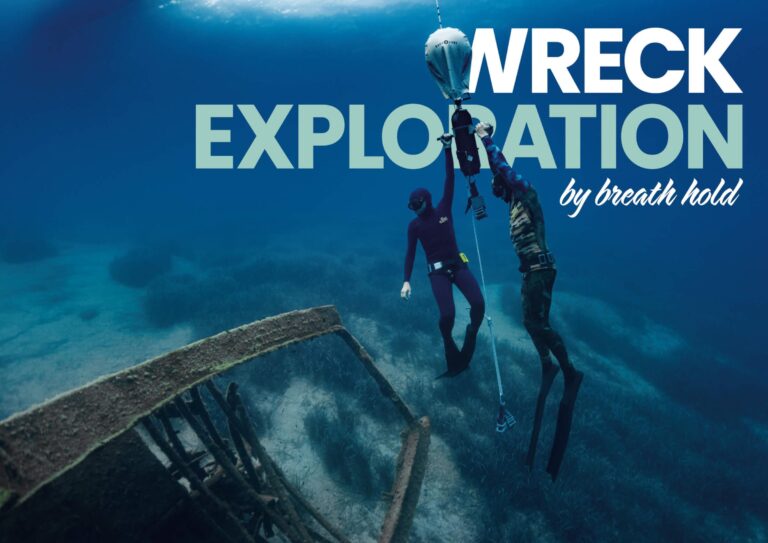
MARCUS GREATWOOD discusses the challenges of searching for shipwrecks using breath-hold techniques, and how technology can help turn the tide in favour of freedivers. He took the photographs
did you know?
The most important safety rule for freediving is to always dive with a qualified buddy who can rescue you. Freediving can be dangerous because holding your breath can cause a rapid drop in oxygen levels, which can lead to a blackout.
Freediving has grown exponentially over the past ten years, with incredible leaps in physical achievements by athletes matched only by the availability of courses around the world. The popularity of the sport alongside standard courses is understandable, as both have the same simple objectives of depth and time -two goals that kids have been competing towards as long as there have been places to swim.
He who goes deepest wins but, at its core, freediving is even more simple than that – it is simply breath hold diving. The objective is actually immaterial, and with this description, the sport now includes photography, exploration, spearfishing or simply for the joy of being underwater.
I have been fairly obsessed with this broadening of inclusiveness for 20 years, encouraging anyone to enjoy the oceans through the sport of freediving by simply removing performance criteria from the mandatory objectives. Over the years this has introduced thousands of people to our sport (and set more than a few noses out of joint from the mainstream freedive community), but more than that it has opened up new opportunities and objectives, including Darkwater (freediving in underground lakes) and wreck hunting.
NoTanx Sled
I was introduced to sled diving by my good friend and freediving legend Löic Leferme at the turn of the century. His sled innovations were ground-breaking, and allowed him to beat several NoLimits World Records or, as he called it, ‘ultimate depth’.
My first design in 2003 was inspired by Löic’s sleds, which had a beautiful simplicity, juxtaposed to those of Herbert Nitsch, with whom I worked on the world record in 2007. Sleds typically consist of a long tube that the rope runs through, a weight, handle and lift bag assembly. Some split in half on accent, whereas some stay as a single unit enabling quick reusability. I realised that the long tube was cumbersome and ultimately unnecessary. Its purpose is to keep the sled running straight on the rope – the longer the tube, the less friction on the rope. However, when I tested how a scuba tank naturally sank (with a weight hung underneath), I found it dropped in a straight line but hung at a 15° angle from vertical.
My first design (featured in Freediver Magazine) allowed the tank to hang at 15° and still drop completely vertically, with the line being simply a guide and providing an end stop. Some 15 years later, my design has changed little but has been used a lot, for teaching, safety and for exploration all around the world.

” We have spent several years exploring the Ionian island of Kefalonia, a breathtaking destination known for its incredible caves and pristine coastline, making it ideal for freedivers of all levels “
Wreck hunting
Over the years, we had experimented with several systems for wreck diving, refining our techniques along the way. The simplest and most-effective method involved tying offa line directly to the wreck. This set-up ensured the line was straight and taut, allowing us to use a small buoy for stability and facilitating easy descents. While this worked well, using a sled in this arrangement was feasible but not ideal.
However, for deeper wrecks – particularly historical sites – tying offdirectly to the wreck is neither practical nor appropriate. As an alternative, we considered tying the line to a heavy weight placed near the wreck. Unfortunately, this solution proved problematic, especially when using a sled. Any swell would shift the bottom weight, introducing dangerous slack and tension in the rope, rendering this method unsafe. At first this was not much of a problem, as we were not diving particularly deep wrecks nor had access to historical sites.
HMS Perseus
We have spent several years exploring the Ionian island of Kefalonia, a breathtaking destination known for its incredible caves and pristine coastline, making it ideal for freedivers of all levels. During one of our many visits in 2018, we came across the remarkable story of HMS Perseus and the miraculous survival of John Capes – a tale worthy of its own dedicated article. HMS Perseus, a British submarine sunk by an Italian mine in 1941, rests upright and intact at a depth of 52m off Kefalonia’s coast. The idea of freediving to the Perseus captured my imagination and quickly became an obsession. I was fortunate to work on several filming projects at the British Navy’s Submarine Escape Training Tower, a 30m-deep tank located in Gosport near Portsmouth. Over the years, I had been invited back occasionally to dive there and maintained contact with the Lieutenant Commander overseeing Submarine Escape and Rescue. When I spoke with him in 2018, he expressed keen interest in HMS Perseus – understandably – and assisted us in gathering valuable information about the submarine. This collaboration ultimately led to our finding of the Perseus in September 2019.
” As we descended, there she was sitting beneath us in stunning detail – jet black against the pale, sandy seabed “
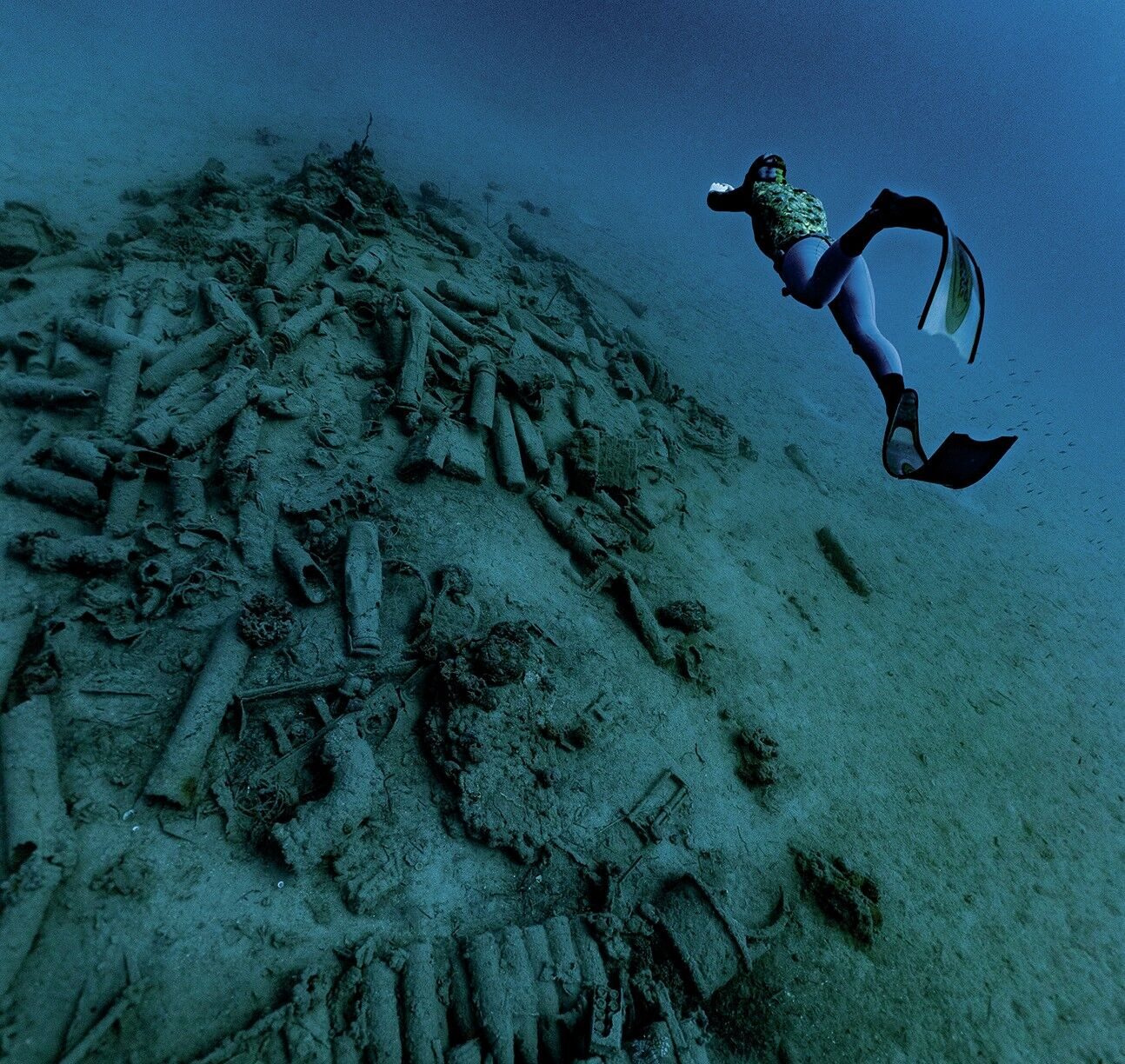
During our research on HMS Perseus, we stumbled upon accounts of a wooden German ammunition supply vessel sunk in 1943 during the evacuation of John Capes. This vessel, likely a commandeered local craft, had been repurposed by the Germans to transport ammunition to Kefalonia following their takeover from the Italians. The ship presented another intriguing prospect. Having remained undiscovered and untouched for over 70 years, it lay at a depth of 36m — an achievable but challenging dive, if we could locate it.
In September 2019, equipped with a few GPS coordinates and a sense of purpose, we chartered a yacht to search for two underwater sites – HMS Perseus and the Ammo Wreck. The challenges were clear from the start. While we only had a general idea of the Ammo Wreck’s location, the three GPS coordinates for the HMS Perseus spanned a distance of over 80 metres. Time at depth is extremely limited when freediving, so accuracy was crucial. Even a slight drift in a 50m rope could lead us away from our target.
To improve our chances, we invested in a new sonar system for the yacht, capable of revealing the seabed’s makeup. During a week of trial and error, we managed to dive the Perseus twice. Our initial dive, however, was plagued by technical setbacks, forcing us to abort. The second attempt we switched from using a buoy to using the tender as a more-stable platform for deploying our sled. This innovative shift allowed a team member to navigate with precision, directing us to the exact GPS coordinates using an iPhone in a waterproof case.
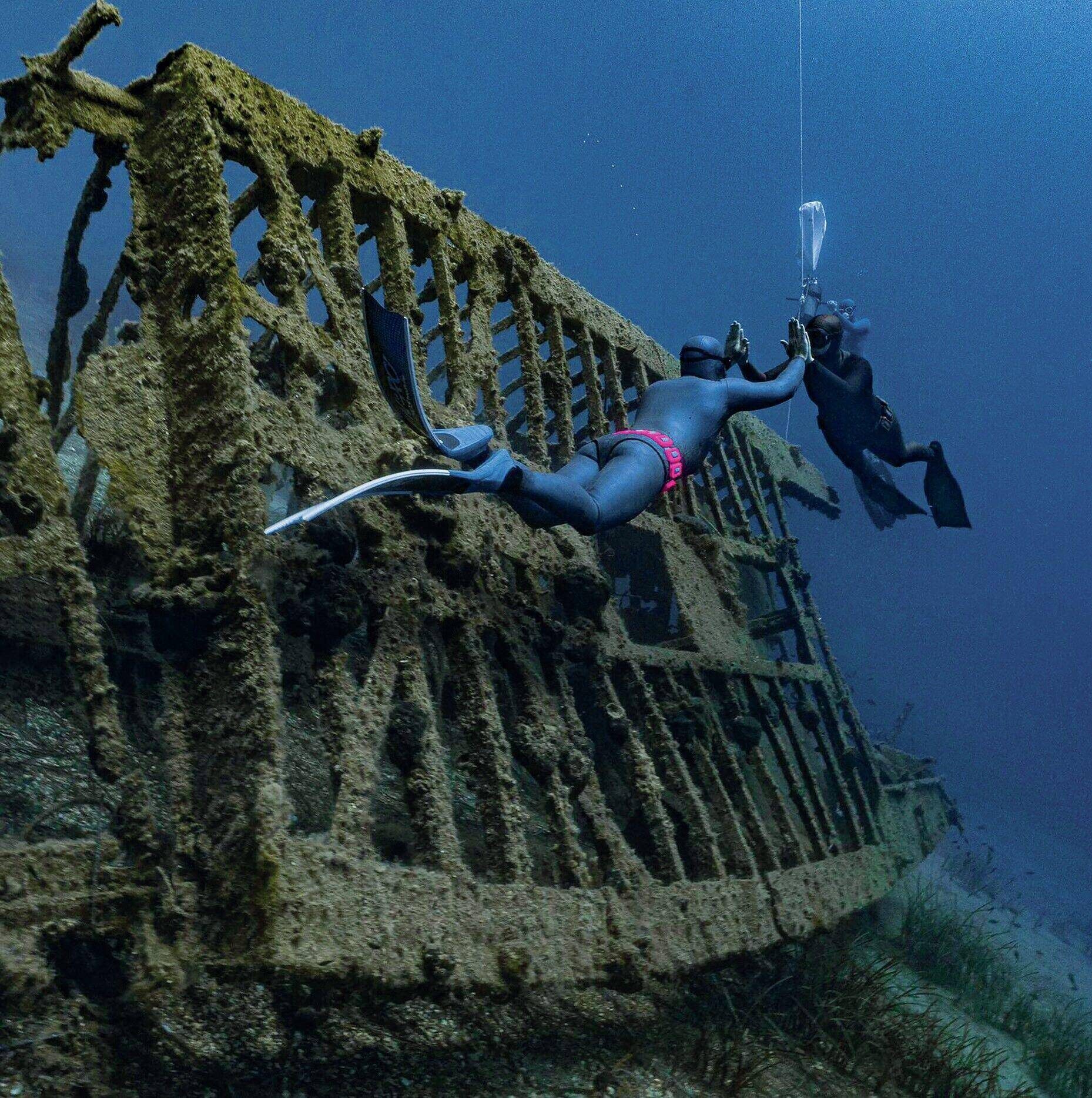
To ensure safety and efficiency, we implemented a rigorous six-person rotation – two divers, two safety divers, and two tasked with manoeuvering the dinghy. This system, developed over years of sled exploration, culminated in the creation of what we now call the ‘Deep Sled Protocol’. This straightforward set of guidelines eliminates decision-making at depth, ensuring every team member knows their role before the descent.
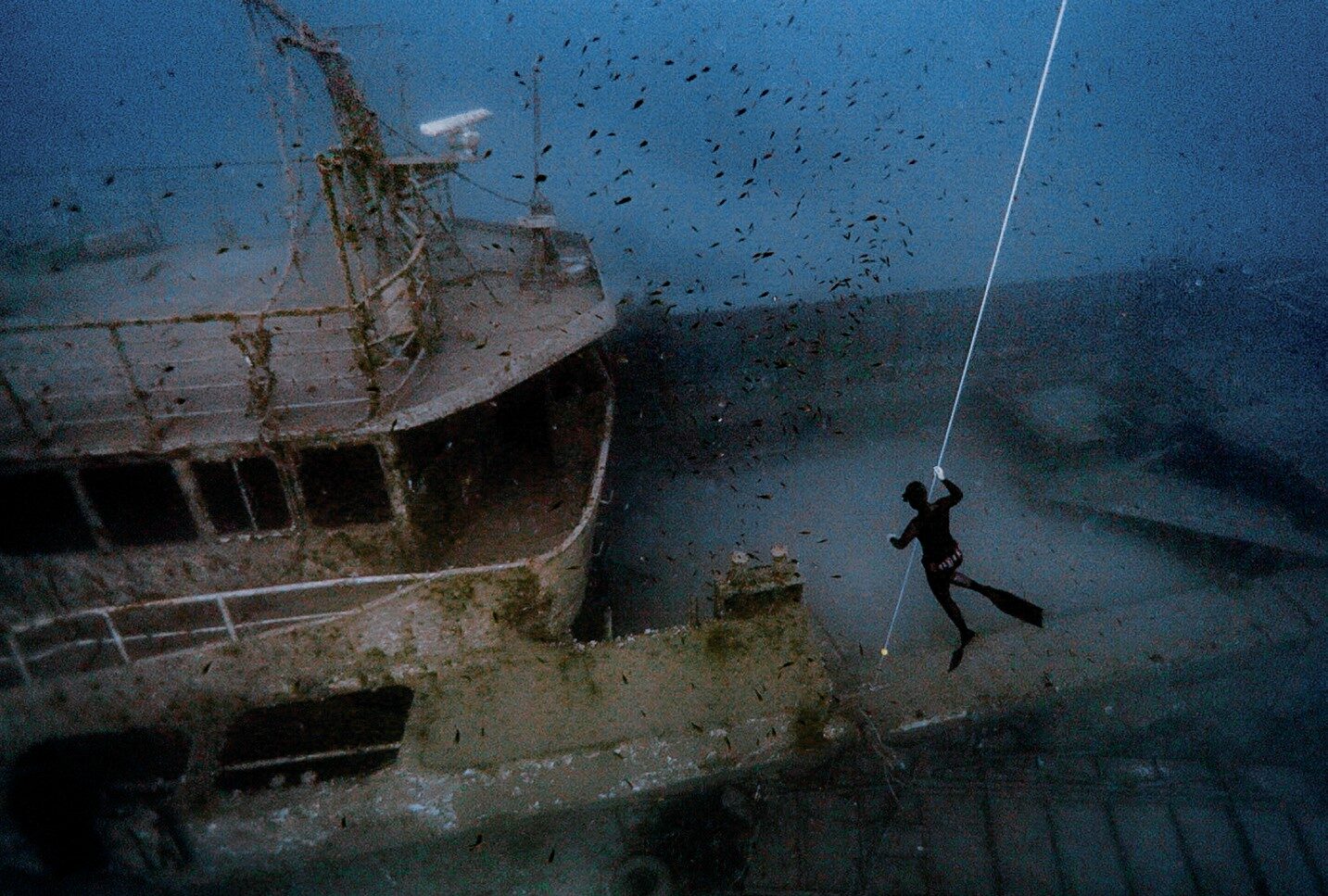
With this system in place, we tackled two of the three co-ordinates and discovered something extraordinary – all three GPS pins were correct! Each of the GPS pins marked a specific spot on the immense 80-metre-long vessel – the bow, stern, and midship. Armed with our new tools and protocols, we managed to capture a few hazy yet undeniable images of this underwater giant. As for the elusive Ammo Wreck, nature kept her secrets from us, heavy currents preventing us from investigating a promising sonar ping. The week of exploration was a culmination of years of preparation and experimentation, refining both our techniques and teamwork. We left Greece with valuable experience and a promising lead for future dives.
GISMO: Revolutionising wreck exploration
By 2023, we had developed and tested a system we named GISMO – a GPS-anchored Set-up mounted on the dinghy, designed to keep the descent line perfectly positioned over a wreck. This innovation proved to be a game-changer.
At the end of the 2023 season, we tested GISMO while diving a World War Two German Junkers 88 bomber. The results were remarkable – the descent line held steady directly above the wreck, allowing for precise and efficient dives.
On the final day of the trip, I suggested using the system to investigate the GPS ping we had for the Ammo Wreck. What followed was nothing short of extraordinary. My first dive was a simple test, descending to 25m to ensure the sled was functioning properly. As I reached the bottom of the rope and opened my eyes, I was stunned. There, perfectly preserved, lay the Ammo Wreck.
In disbelief, I quickly filled the balloon and zipped back to the surface. The dive had been so short that the team was baffled – until I broke into uncontrollable laughter, struggling to explain what I had just seen. Although we managed to dive the wreck that day, the trip wasn’t an exploration mission, and we were limited in what we could achieve. The discovery, however, marked a turning point.

2024: The year of GISMO
Armed with the exact location of the Ammo Wreck and a fully tested system, we entered 2024 with renewed focus and excitement. GISMO had not only transformed how we dived but also set the stage for deeper, more-detailed exploration of one of the most-captivating underwater finds in recent memory.
After a false start in May – when bad weather forced us to abandon our attempt to dive HMS Perseus – we returned to Kefalonia in September, determined to succeed. Early in the week, despite less-than-ideal conditions, we focused on the Ammo Wreck, a More-sheltered site. Using GISMO, we were able to pinpoint various parts of the wreck with remarkable accuracy, allowing us to explore and take photos.
Then, on the final day, everything aligned – the team, the equipment and, at last, the weather. A mile offthe southern coast of Kefalonia, the sea was millpond calm. We set GISMO’s GPS for the conning tower of HMS Perseus and dropped the rope to 30m, allowing us to warm-up and take in the surrounding area. As we descended, there she was sitting beneath us in stunning detail – jet black against the pale, sandy seabed. The sight was breathtaking. We spent the next couple of hours diving on one of the world’s most-iconic and well-preserved wrecks before the weather changed.

” Every detail of HMS Perseus told a story, and the experience was nothing short of life-changing “
Every detail of HMS Perseus told a story, and the experience was nothing short of life-changing. We could see the hatch from which John escaped, the complete 102mm front gun and we could swim around the conning tower, shimmering with fish. The footage we shot was stunning and will remain in my favourites forever as it not only shows the majesty of the wreck, but marks the culmination of a nine-year journey – one of perseverance, innovation, and unwavering determination. To finally stand (or, more aptly, hover) before HMS Perseus was an achievement we’ll never forget.
FAQ
Q: What is the most important safety rule in freediving?
A: Always dive with a qualified buddy. Freediving blackouts can occur suddenly due to low oxygen levels, and only a trained buddy can provide immediate rescue.
Q: What exactly is freediving?
A: Freediving, or breath-hold diving, is diving underwater without breathing apparatus. It can be for depth and time challenges, photography, exploration, spearfishing, or simply the enjoyment of being underwater.
Q: What is sled diving in freediving?
A: Sled diving uses a weighted sled to descend quickly along a rope. A lift bag or similar system helps bring the diver back to the surface. This technique is often used for deep freediving exploration and training.
Q: What is HMS Perseus and why is it significant to freedivers?
A: HMS Perseus was a British submarine sunk in 1941 off Kefalonia. It lies intact at 52m and is linked to the miraculous escape of John Capes, one of WWII’s great survival stories. Its depth and condition make it a challenging but iconic freedive target.
Q: How do freedivers locate wrecks like Perseus or the Ammo Wreck?
A: Freedivers use sonar, GPS coordinates, and custom-built systems like GISMO (GPS-anchored setup mounted on a dinghy) to precisely position descent lines over wrecks, reducing wasted energy and improving safety.
Q: What challenges do freedivers face when wreck hunting?
A: Limited bottom time, strong currents, and the need for pinpoint accuracy make wreck hunting complex. Freedivers mitigate risks with strict protocols, multiple safety divers, and advanced tools like sonar and sled systems.
Q: Can beginners freedive on wrecks like HMS Perseus?
A: No. Wrecks at depths of 36–52m require advanced freediving training, safety systems, and experience. Beginners should start with shallow freedives and certified training before attempting deep exploration.
Q: What is GISMO and why was it a breakthrough?
A: GISMO (GPS-anchored setup) is a system developed by Marcus Greatwood’s team to stabilise and align descent lines over wrecks. It allows safer, more precise exploration of deep sites like HMS Perseus and the Ammo Wreck.
Q: What are some other freediving exploration activities mentioned?
A: Besides wrecks, freedivers explore caves, underground lakes (Darkwater freediving), reefs, and even military escape training facilities to refine safety and endurance.
Q: Why is freediving wreck exploration important?
A: It combines adventure, history, and innovation—bringing WWII wrecks like HMS Perseus and the Ammo Wreck to light, while pushing the boundaries of freediving safety and technology.
This article was originally published in Scuba Diver Magazine
Subscribe today with promo code DIVE1 — enjoy 12 months for just £1!
