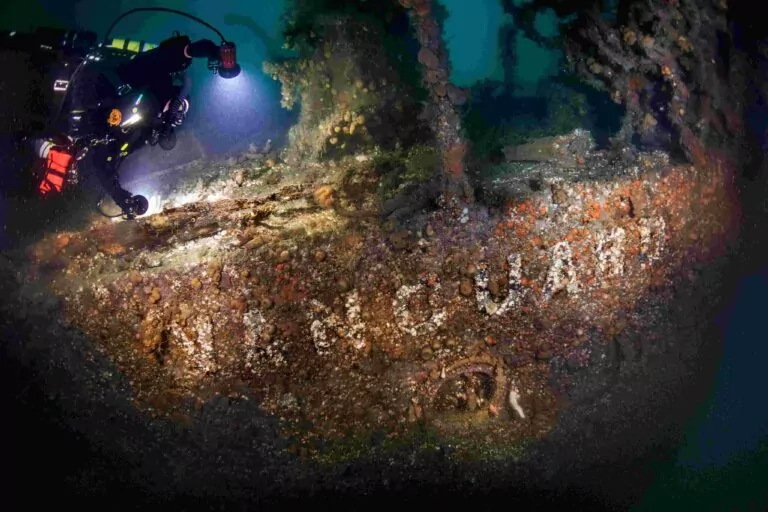
A bell and gun-related artefacts from the WW1 battleship HMS Vanguard have been recovered by scuba divers in Scapa Flow on behalf of the National Museum of the Royal Navy (NMRN).
The ship’s sinking in 1917 is believed to have resulted in the biggest accidental loss of life in a single incident in the Royal Navy’s history.
The objects had been identified eight years ago after a dive-team had marked the centenary of the ship’s sinking in 1917 by spending 500 hours mapping the wreck-site, which was spread over a wide area by the force of the explosions that sank the ship. A further survey was carried out in 2023.
HMS Vanguard was a 19,560-ton Dreadnought launched at Barrow-in-Furness in 1909, and saw action at the Battle of Jutland in 1916.
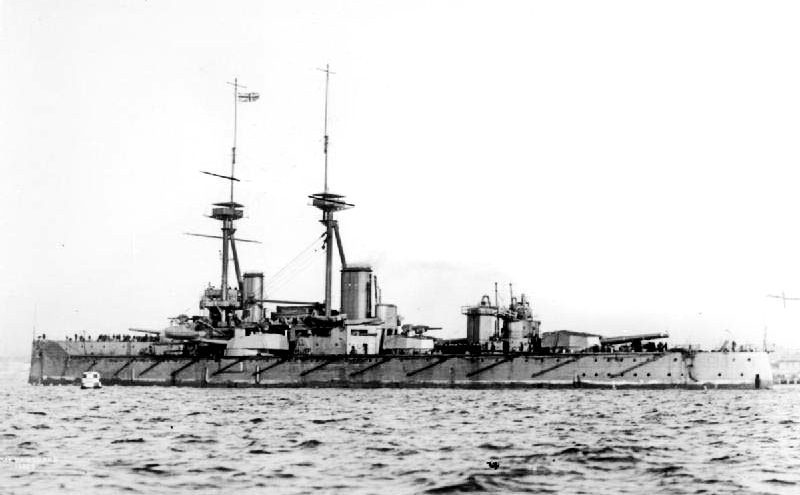
Much of her career was spent on North Sea patrol but on 9 July, 1917, a series of magazine explosions occurred while she was at anchor in Scapa Flow. She sank within minutes, with only two of the 848 officers and crew surviving.
The wreck, which lies in 34m of water, was protected as a war grave only in 1984, by which time it had already been heavily salvaged for non-ferrous metals. Central sections had been raised for scrap, though others including the bow and stern remained intact on the seabed.
HMS Vanguard is a Sovereign Immune Wreck, so diving requires special permission from the Ministry of Defence. The project to raise the artefacts conceived by the NMRN and Scapa Flow Museum was three years in the making.
It was carried out with the full support of the Vanguard Crew Photos Project, which is trying to collect photographs of all the warship’s crew through their descendants, and other bodies including the Receiver of Wreck and MoD.
Six-day window
A volunteer dive-team operating from the Orkney charter-boat Huskyan, as on the previous surveys, had a six-day window from 29 June in which to recover the artefacts, working in an area extending more than 750m from the wreck-site.
The bell, which had been distorted by the explosion that flung it from the ship, lay about 200m from the main site, with a hole on top where a crown would once have been.
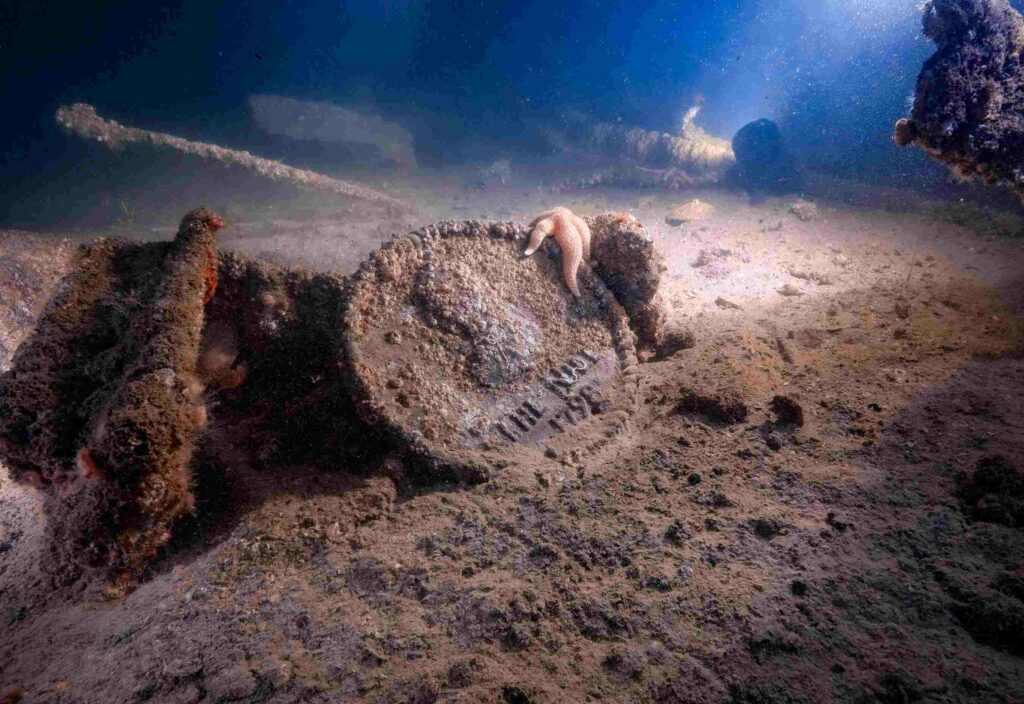
Also brought to the surface were a tampion or gun-barrel plug thought to be made of horse-hair and leather, and a metal badge commemorating the Battle of the Nile from one of the main guns. This displayed a bust of Admiral Lord Nelson, who had captained an earlier Vanguard.
Following conservation by the National Museum of the Royal Navy, the artefacts are set to be loaned to Orkney’s Scapa Flow Museum for display. The main ship’s bell can be seen at the Dock Museum at Barrow-in-Furness.
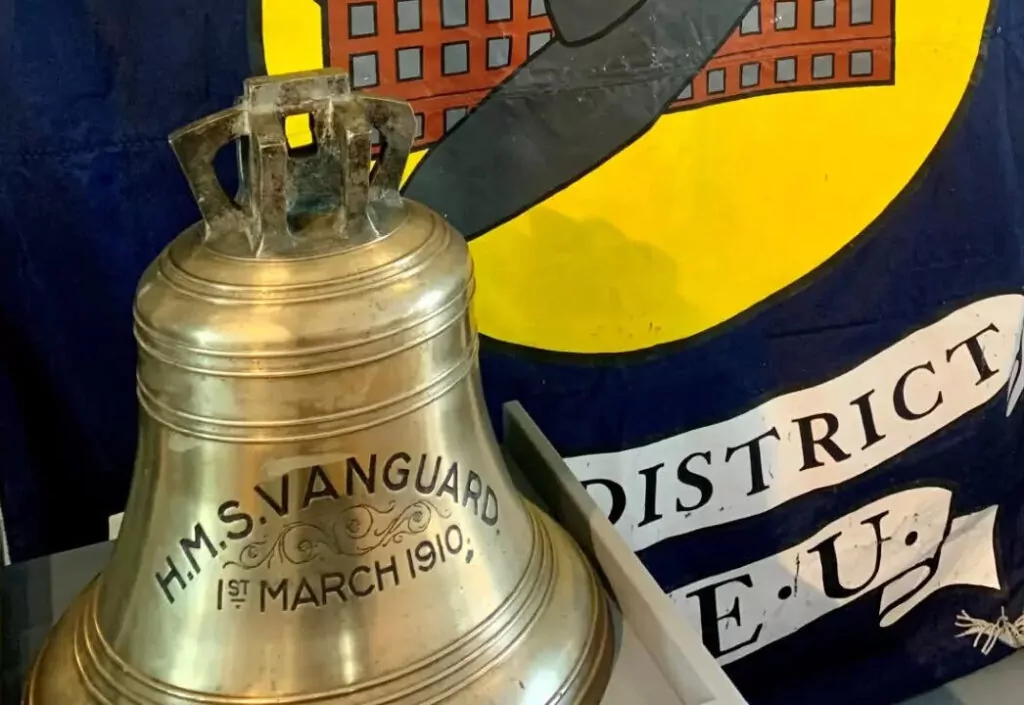
Royal Navy dreadnoughts would have carried three to five bells. Apart from the main ship’s bell there was likely to be a quarterdeck bell, one in the engine-room and smaller ones for each of the ship’s boats and the wardroom.
Also on Divernet: Divers’ new imagery lights up Scapa warships, Scapa Flow 100 History & Wrecks, Dive Scapa Flow, Pilgrimage to Scapa Flow