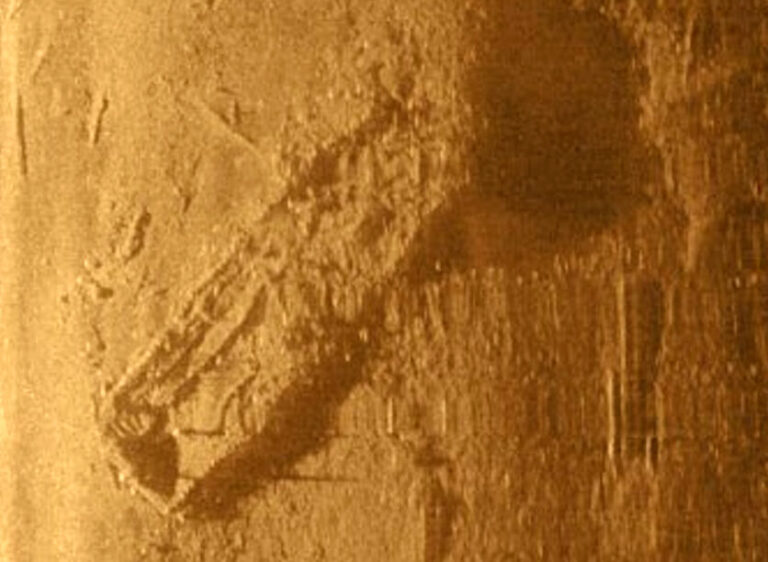
A 19th-century wreck has been discovered in the Fox River at Oshkosh in Wisconsin – not the boat the scanning team had expected to find but one built in the same yards.
Members of the Wisconsin Underwater Archaeology Association (WUAA) were carrying out a five-hour high-resolution sonar survey as part of the Wisconsin Historical Society’s Maritime Preservation Programme.
Previous surveys had been small and localised, so the team were attempting to map all possible wreck-sites in the 4km stretch of the river that empties into Lake Winnebago.
Their DeepVision sonar would allow the entire 150m width of the river to be covered in a single pass, and objects of interest to be imaged at extremely high resolution.

The investigators were hopeful of finding a missing steamer called Berlin City, built in 1856 and known from historical records to have sunk in that stretch of the river. The vessel was used to carry passengers and freight between Berlin and Oshkosh, and was 30m long with a 5.5m beam.
In November 1870 it had been anchored near the Oshkosh boatyard for a winter overhaul when fire broke out onboard. The anchor-chain had to be cut, leaving the Berlin City to drift downriver as it burnt to the waterline before sinking.
Beyond the planned search area, the team found a partly buried hull, but it was about 27m long and 7m wide, with a bow said to resemble that of a Great Lakes scow schooner – a vessel with a flat-bottomed hull and a fore-and-aft rig with at least two masts.
They believe it is the LW Crane, another timber steamer built in the same Berlin boatyards as the Berlin City but in 1865. It too is known to have burnt to the waterline and sunk, at the St Paul Railroad slipway in Oshkosh in 1880.


The slipway was found almost immediately across the river from the location of the wreck, while stone caissons from the St Paul Railroad bridge lay only about 100m away from it.
The team hope to scuba-dive the site, though they say that the visibility is so poor that more detail and scale can probably be gleaned from hi-res sonar surveys.
The river contains large amounts of natural debris such as trees, logs and large rocks as well as sections of boat docks, caissons and small fishing-boats. Another object located during the survey could have been part of an old bridge – or the bow section of early paddle-steamer the Menasha, abandoned in 1861.
The team also investigated a shallow wreck-site found in 2016 and named Kevin’s Wreck after one of the finders, Kevin Cullen. Further eroded, it remains unidentified but is not thought to have been the Berlin City because that steamer was known to have drifted downstream.
In May this year Divernet reported on how the WUAA had dived and identified the JC Ames, one of the most powerful tugboats ever to work in the Great Lakes, in Lake Michigan.