Stuart Philpott boards the luxurious three-masted schooner Dewi Nusantara for an Indonesian liveaboard journey that started in Manokwari Bay and ended at Sorong on the western tip of New Guinea

Dewi Nusantara is no ordinary diving liveaboard. She’s a 58-metre-long by 12-metre beam, three-masted schooner built from iron wood. And what an impressive sight she is under full sail. It’s impossible not to romanticise about pirates and treasure troves. Owner Stefan said: “We also have some working cannons, but we can’t display them as the local authorities might disapprove”.
Dewi Nusantara sails around the Eastern Indonesian islands, offering trips to Raja Ampat, Triton Bay, Ambon and Cenderawasih Bay. Owner Simon suggested I join cruise 2416 to Cenderawasih Bay for ten days’ worth of wrecks, reefs and whale sharks.
The journey to Manokwari Bay took some planning. From the UK there are four flights and three connections outbound to consider. The liveaboard sails from Manokwari Bay back to Sorong, which cuts the journey down to three flights and two connections on the return leg. To avoid any issues arising from delayed flights, etc, Anya from sales suggested that I stay in a hotel the night before we left port. In hindsight, this was a wise move, as there was indeed a flight delay at Heathrow which led to my baggage being temporarily mislaid at Jakarta. Anya said the office staffwere more than happy to arrange all flights, hotels, visas and transfers for a small fee.
Dewi Nusantara luxury liveaboard offers eight state rooms and one master suite. This equates to a maximum of 18 guests serviced by a crew of 24. Most of the trips fill up rapidly and my Cenderawasih Bay cruise was no exception -we had a full contingent travelling in from the UK, Singapore, US and Switzerland. The average age must have been mid50s and most of the guests were transferring to other resorts or liveaboards after the trip had finished. The group from the US were coming back a month later for a second helping. By then the liveaboard would have moved to Raja Ampat’s dive sites. More than 60% of Dewi’s guests are repeaters. The state rooms, all en-suite, were the size of standard hotel rooms with proper beds rather than boat cabins with bunks. Swiss couple Helga and Jack invited everybody over to the master suite for cheese and cocktails one evening and I was very impressed with the room size, which included a bath, sofa, separate walk-in shower and king-sized bed. A row of huge windows swept across the stern giving a 180-degree panoramic view. Helga said one evening they had watched their own private whale shark show.
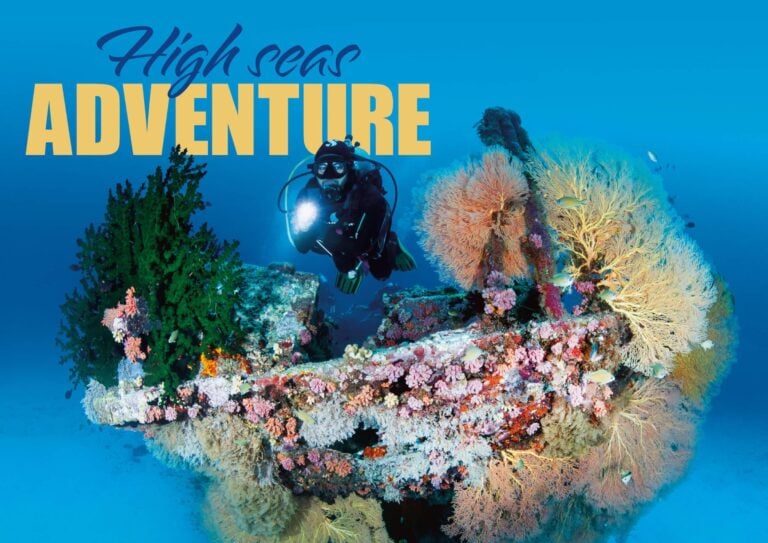
There are five dedicated staffin the diving dept, not accounting for boat tender crews. Jan headed up the liveaboard operation, and on this occasion would be helping me out as guide and model in my pictures, although I don’t think he was overly keen on the job. Wearing a black mask and hood wasn’t going to get the results I wanted, but I was grateful for what I could get.

The highlight of the Cenderawasih Bay itinerary had to be the amazing whale shark encounters. Seeing seven whale sharks on one dive was a truly memorable experience


The diving activities ran like a dream. Four dives a day, every day (this included a night dive). There were absolutely no issues throughout the week. After the initial setting-up phase, dive kit was left on the tenders and cylinders automatically re-filled. Divers just had to look after their own masks. I must have heard the words ‘elbow to elbow’ (being helped on and offthe tenders) more than a hundred times during the week, but safety issues were always at the forefront. This included personal GPS homing beacons being handed out to everyone. The camera room was the biggest I had ever seen. Solid wooden benches with plenty of charging points and reading lights on bendy arms for close-up inspections of housings and strobes. All in all, an extremely well thought out liveaboard operation making everything hassle-free for divers. There were even warm towels waiting when we came back onboard.
The nightmare scenario for any diver is catching a cold during a trip. A lovely, caring individual sneezed in my face during the flight to Manokwari Bay and this was enough to infect me with the dreaded lurgy. My runny nose progressed to blocked-up ears, which inevitably meant no diving for several days, unless of course, there are a group of American divers onboard. John from San Diego had obviously been nominated as ‘drug lord’ for the duration. John had brought along 13.5kg of drugs to cater for every eventuality. Yes, I said 13.5kg! That’s got to be reaching Pablo Escobar levels! But all joking apart, within 24 hours,John had fixed me up with a dose of this, a sniffof that and I was diving again. On the downside I had passed on my man flu to my cabin mate, Pierre, and between us we managed to wipe out half of the boat. I was not popular!
Our check-out dive was at a site called The Zero Plane. The actual type of plane was in dispute as there was also talk of it being a World War Two Kawasaki Ki 61 fighter. When I reached the wreckage, I could see why there had been some confusion as all that was left was a wing section and a few jagged pieces of fuselage, all camouflaged in a thick jungle of soft corals. It could have been anything. Simon had asked me to get some promotional pictures of the plane but there was no chance. He admitted later that he hadn’t seen the plane for a few years. There had obviously been some deterioration during this time!

We didn’t encounter any more wrecks until the last few days of the trip. The three landing craft wrecks were leftovers from World War Two. Again, totally covered in soft corals. I could make out a rectangular shape but otherwise there were no defining features visible. The Cross wreck at Mansinam island was reasonably intact but lying upside down. When I looked inside the hull there was a vast cavernous space. The steel framework rising from the seabed to the keel reminded me of a cathedral. Jan showed me a photogenic red anemone and anemonefish family at the bow, which made the perfect foreground subject for my pictures. The Pill Box wreck came next. It was pretty broken up but still retained a ship shape. The stern was swathed in sea fans and black coral.
Our final dives were at a site called Junkyard. The wreck or wrecks had pretty much been levelled, but the fish life was the best I had seen all week. I was hoping we could visit the PBY Catalina flying boat wreck that I had seen on the website. Mainly built of non-rotting aluminium, it still looked like a plane and was worthy of a photoshoot, but Jan said it wasn’t on our itinerary. I tried all my powers of persuasion, but he just wouldn’t budge.
Whale shark activity peaks around the full moon cycle, which happened to coincide with Day 2 of our liveaboard trip. The local fishing bagans attract the whale sharks. The fish trapped inside the nets secrete eggs and it’s the cloud of egg caviar that attracts the sharks. Jan checked out the local bagans and chose one that had several whale sharks circling below the nets. We split into two groups of nine. The first group would snorkel while the second group used scuba, and then after breakfast, we would all swap over.

When we reached the bagan I could see two gigantic heads breaching the surface. When I ducked underwater there were whale sharks everywhere. I counted at least seven. All were male and varied in size from five metres up to eight metres. Some had GPS trackers attached. The largest dominant male was in prime position in front of the nets. I wanted to get an open mouth shot so positioned myself less than a metre away. Without warning another whale shark appeared and swam right between my legs, its massive dorsal fin almost taking my crown jewels with it! Below me I could see two nurse sharks swimming in formation, which made me wonder what other species of shark were lurking in the depths.

The action was seriously intense. On previous encounters with whale sharks, I only had a few seconds to take pictures before they disappeared into the blue. These sharks stayed around the bagan and were totally unphased by our presence. I had time to think about the composition I wanted and then made several attempts to get it right. Whale sharks are non-aggressive filter feeders that can weigh more than 15,000kg (as a gauge, a family car weighs around 1,600kg). Considering their size they are extremely agile. On most occasions they managed to avoid any physical contact with the group. Swishing tail fins were probably the biggest danger. Altogether we spent two days with the sharks which equated to around six quality in-water hours. I don’t think there are many places in the world where this is possible? We had the entire site to ourselves. There were no other dive boats or liveaboards operating in the area.
We quickly settled in to an eat, sleep, dive regime. Most days we ate together on deck. I noticed that all the seats, tables and sunbeds were wooden. Plastic was definitely a rude word on Dewi Nusantara. We were offered a snack breakfast before the first dive followed by a proper a la carte breakfast. After the second dive we were plied with a buffet lunch and then after dive three there were plate loads of homemade cakes to wolf down. To round of the day a three-course a la carte dinner was usually served around 7pm. Everyone seemed to be happy with the servings and flavours. This varied from local Indonesian to European-style cuisine. The trip included unlimited soft drinks, beer and one glass of wine at dinner.
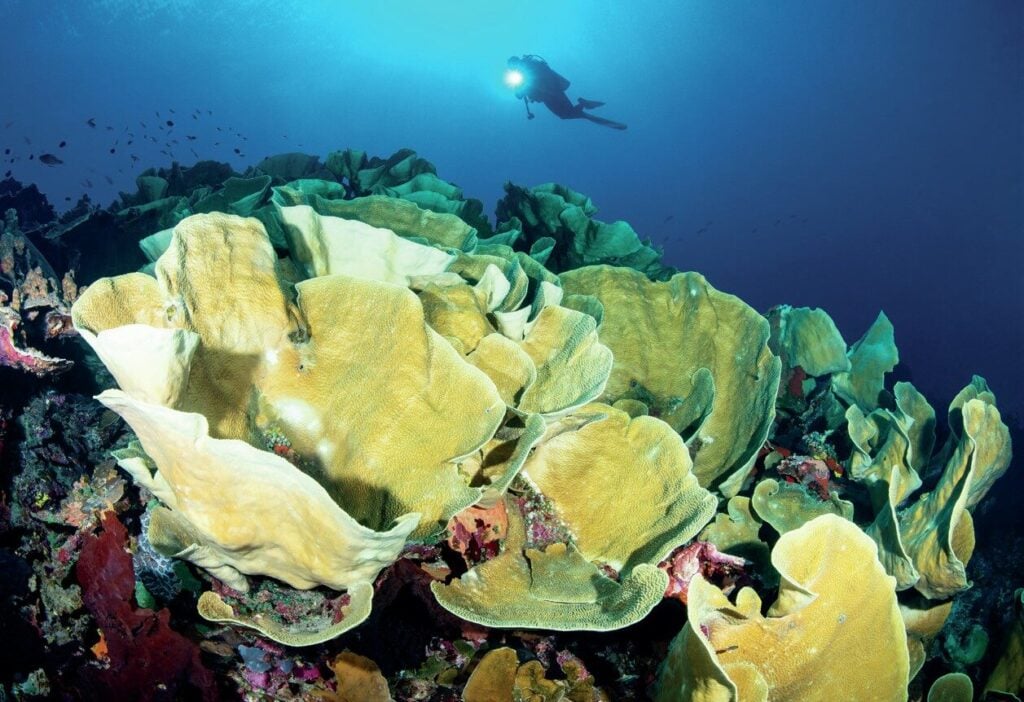
The hard and soft corals were the best I have ever seen. At Tanjung Ayami dive site next to Pulau Auri Island there were hundreds of different varieties of healthy-looking hard corals. Each coral species had its own patch in the garden. They didn’t seem to mix. At Spag Point I tried to get an arty 50/50 shot using my big dome port, but the current was running too fast. I found a group of colourful feather stars sitting on top of a small outcropping at Manim South and with the sun beams shining in the background, the picture looked very atmospheric.


We dropped anchor next to Mansinam island. Tucked away to the right of the beachfront church was a small jetty. Jan suggested we take a quick look before heading out to the main dive site. I was absolutely blown away by the profusion of soft corals growing on the concrete pillars. There were so many hues of green, orange and purple and the macro marine life opportunities were limitless. I chased after a pufferfish and clumsily got spiked by a crown of thorns starfish. I didn’t treat the wounds, and they took several months to heal.
There’s no doubt Dewi Nusantara delivers on quality and service and how often do I get the chance to spend ten days on a three-masted schooner? The whole liveaboard was in tip top condition, no expense had been spared. Stefan said they were just running in two new Caterpillar engines and would be fitting a new main mast at the end of the 2024. The cruises are not cheap, but I really do believe in the saying ‘you get what you pay for’.

The highlight of the Cenderawasih Bay itinerary had to be the amazing whale shark encounters. Seeing seven whale sharks on one dive was a truly memorable experience. The pristine coral reefs came in a close second. There were so many different varieties and colours of soft and hard corals. The wrecks were the only slight disappointment as they were well broken up or camouflaged in soft corals. I also thought for a designated marine park area (300 USD fee) fish life would have been better. The few reef sharks and turtles I did see were skittish and wouldn’t come very close. I guess there’s always the Raja Ampat cruise to try out next time!
FAQ: Dewi Nusantara Liveaboard & Diving Cenderawasih Bay
Q: What is Dewi Nusantara?
A: Dewi Nusantara is a 58-metre luxury three-masted schooner liveaboard, often called the “floating palace of diving.” It offers itineraries around Indonesia, including Raja Ampat, Ambon, Triton Bay, and Cenderawasih Bay.
Q: Where does the Cenderawasih Bay cruise start and end?
A: This itinerary typically begins in Manokwari Bay and ends in Sorong, West Papua, making it more convenient for return flights.
Q: How many guests can Dewi Nusantara accommodate?
A: The vessel has eight deluxe staterooms and one expansive master suite, hosting up to 18 guests with 24 crew members, ensuring a high crew-to-guest ratio.
Q: What makes diving in Cenderawasih Bay special?
A: The region is famous for consistent whale shark encounters around local fishing bagans, often with multiple sharks staying in the area for hours, allowing extended in-water experiences unlike most destinations.
Q: What wrecks can divers explore in Cenderawasih Bay?
A: The area has WWII Japanese wrecks, including landing craft, the Cross Wreck, the Pill Box Wreck, and remnants of planes such as the Zero fighter. Most are covered in colourful soft corals.
Q: How many dives per day are offered on Dewi Nusantara?
A: The schedule allows for four dives a day, including a night dive, supported by professional dive staff, tenders, and full equipment handling.
Q: What marine life can divers expect besides whale sharks?
A: Expect pristine coral gardens, colourful feather stars, macro critters, reef fish, occasional reef sharks, turtles, rays, and large schools of snapper and fusiliers.
Q: What facilities are available onboard Dewi Nusantara?
A: Facilities include spacious cabins, a large dedicated camera room, wooden sun decks, a fine-dining restaurant with à la carte and buffet meals, and eco-conscious operations (plastic-free).
Q: Is Dewi Nusantara suitable for underwater photographers?
A: Yes. The boat is designed with photographers in mind, offering a large, well-equipped camera room with charging stations, lighting, and ample work space.
Q: How much does a trip cost?
A: Dewi Nusantara is a premium liveaboard. While not cheap, the high level of service, comfort, and exclusive diving opportunities make it exceptional value for serious divers and photographers.
This article was originally published in Scuba Diver Magazine
Subscribe today with promo code DIVE1 — enjoy 12 months for just £1!
