
Discovering Mongolia’s Dark Blue Pearl
Diving Lake Khovsgol Mongolia isn’t your first thought for a diving holiday, nor your second. But Steven Schwankert’s team was in a high-altitude lake to notch up a string of firsts – and to track down the ‘underwater deer’.
Photos by Marcel-Kurt Moser

MONGOLIA IS NOT THE WORLD’S most obvious dive spot. Nor, for that matter, is it the world’s most accessible dive site. For both reasons, I couldn’t wait to dive Mongolia.
Lake Khovsgol (pronounced huh-vs-gull – it’s Mongolian for “ocean”) is one of the largest lakes in central Asia, formed between two and five million years ago. Its north-eastern neighbour, Siberia’s Lake Baikal, has been well explored, but Khovsgol has remained ignored by all but a handful of scientists.
Mongolians revere the lake, sometimes called the “Dark Blue Pearl,” and will bless themselves with its water when they visit. Khovsgol’s dimensions make any attempt to explore it daunting. Stretching 85 miles from north to south, with its northern shore close to the Russian border, in places the lake is also 19 miles wide, and 260m deep.
It seems like an inland sea, but Khovsgol sits at an altitude of 1650m, surrounded by 3000m mountains. Its surface spends more time frozen than fluid, so even summer diving requires a drysuit. Bottom temperatures even in shallow areas hit single degrees Celsius.
Expedition Objectives – Discovery, Research, and Exploration
I have learned that for any diving expedition to be effective specific goals are needed, otherwise it devolves quickly into a lot of random diving in uncharted waters.
We had three main objectives. The first was to test the quality of the water, and identify the type and source of any pollutants we discovered.
Many of northern Asia’s inland lakes have been casually despoiled in a way that redefines the phrase “waste dump.”
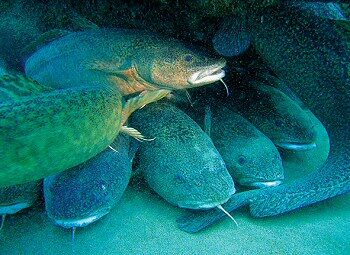
Secondly, we hoped to find, identify, and if possible photograph or film the nine known species of fish that live in the lake and, we hoped, identify a new species or two.
This included a potential encounter with a lake monster that locals refer to as the “underwater deer.” Being charged under water by a fish with a large pair of antlers was rather more than we cared to imagine, but our dedication to science allowed us to overcome any misgivings on this front.
Lastly, we wanted to investigate the impact on the lake of human activity, including diving the two shipwrecks we knew about, and examine the 30-40 cars and trucks that had crashed through the surface ice in winter.
At least one was a fuel truck, posing a potential environmental hazard to this Mongolian national park. We also wanted to look into rumours of Buddhist relics believed to have been thrown into the lake during a period of persecution in the 1930s.

Diving Challenges and First Descents
Diving Lake Khovsgol Mongolia meant starting from scratch. There would be no dive centres, air fills or compressors, and certainly no palm-frond covered shacks serving après-dive rum cocktails or cold beer. This was strictly BYO and DIY.
Our divers came from Mongolia, Australia, Austria, the Czech Republic, the UK and the USA, 10 in all, plus non-diving support personnel and non-diving partners. Each was attracted by the opportunity to dive in a huge body of water that in 2007 had still never been systematically dived, and the consequent potential for discovery.
In addition to cold water and altitude, weather around the lake lurched daily between summer heat and freezing night-time temperatures.
On sunny days we wore shorts when we weren’t suited up for diving, shedding layers after breakfast and putting them back on gradually when the sun set, at around 9pm. We would be swathed in sweaters and winter coats by the time we went to bed.
A FEW DAYS BROUGHT CLOUDS and rain, and we kept our cold-weather gear on throughout. Only a look at the calendar reminded us that it was August.
The expedition was soon racking up some firsts:
- the first dive in Khovsgol by a Mongolian woman, (and probably the first ever dive in Mongolia by a woman)
- the first Khovsgol dives (and probably also the first Mongolian dives) by divers from the other countries (except the Czech Republic);
- the first use of a rebreather in Mongolia.
The early dives indicated what Khovsgol diving would be like: a fair amount of blank bottom; aquatic grass and plant life here and there; and, when we encountered them, big fish, each at least a metre long.
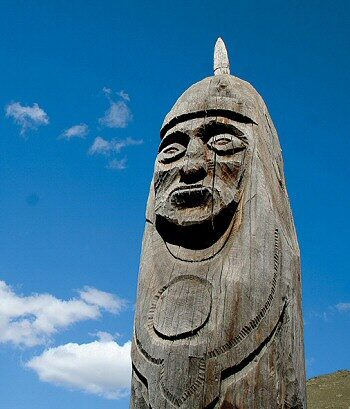
The bottom slope was gradual, at least near our camp, requiring a swim of 100m from shore just to reach 8m depth.
Visibility was good at about 10m, but nothing like the 30m-plus we had expected. Also, temperatures in shallow depths were well into the teens, as high as 16°C at one point. We concluded that the warmer water was leading to increased biological activity, and a commensurate decrease in visibility.
Water-quality testing was carried out at sites along the western and southern shores, both close to and far from pockets of human use.
Ultimately, the news was extremely positive – Khovsgol is as pure a water source as they come. High levels of dissolved oxygen and negligible levels of nitrates and phosphates showed us that the lake was very healthy.
We were exceptionally pleased to see nitrate levels so low because, on arrival, we had seen a previously unanticipated threat – large numbers of domestic animals grazing on the lakeshore.
Mongolian herders were allowed to graze their livestock within the national park boundaries, and may cut down trees for firewood, to build animal enclosures, and also to make frames for the tent-like gers in which they live. Locals may also fish in the lake, though they use only single lines or very small nets.

Wildlife, Wrecks, and Human Impact
Having never seen divers before, Khovsgol’s fish could be approached, even stroked, before they would react. A few of us even petted the most plentiful fish, the Siberian grayling, before they finally swam off. However, one of our greatest disappointments was the lack of biodiversity we saw – only three fish species, perhaps four, including juveniles.
And none of us was charged by the underwater deer, though we may have had an encounter with the great beast nonetheless. We were fortunate to have with us an experienced sonar technician, Gregg Mikolasek, whose skills helped to discover a lost B29 bomber in Nevada’s Lake Mead, and about a week into the trip, while bottom-scanning in 30m, the boat registered a large target.
It was in midwater, at about 25m, and Gregg estimated it to be a single object between 5 and 7m long. It registered again on a second pass, showing similar characteristics. However, the other diver on board declined to go into the water, on the grounds that if the reading were accurate, the thing would be as big or bigger than the boat!
When park officials had the scan interpreted for them, they immediately said that it was the underwater deer.
PERHAPS OUR MOST FRUITFUL INVESTIGATION was into human impact on the lake. Despite investigation of a couple of promising sonar targets, we couldn’t find any of the downed vehicles.
Local police records indicated that most were too deep for recreational diving, and while we had sets of doubles and divers with significant technical experience, the vehicles’ locations could not be pinpointed, and proper hyperbaric treatment was too distant if anything go awry with a deep dive.
However, we did locate and make the first descent on two Russian wooden shipwrecks that burned to the waterline and sank in the 1920s. With Gregg, we were scanning for a wreck mapped near the town of Hatgal, but were unable to find it.
Finally, we asked our boat guide, Dal, if he had heard of any wrecks in the area. “Yes, right over there,” he said, pointing in the direction of a large boiler on the lakeshore.
APPROACHING, WE COULD SEE A DARK shape just beneath the surface. We cruised alongside and could make out the shape of not one but two ships abutting one another, with the bow of each pointing at the other’s amidships.
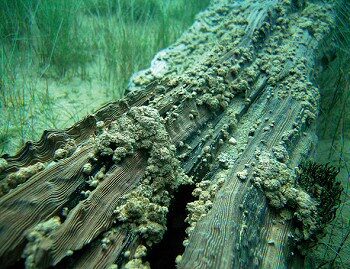
A video clip hastily shot by holding a camera beneath the surface revealed wooden vessels, the bottom parts of their hulls still mostly intact, and with large nails protruding in places.
Despite the fire that destroyed them, and more than 80 years of ice freezing and thawing around them, the wood was in excellent condition. The driveshafts of both engines were in place and intact.
One vessel was slightly longer than the other, and had a four-blade propeller; the other’s was double-bladed. Although they would have been snapped up by salvors or collectors decades ago in other parts of the world, the props remained in place, resting softly in the sediment.
Nearby, the wreck of the Sukhbataar (named after modern Mongolia’s founding hero) is well-known and easy to find, its steel hull barely breaking the surface just in front of an abandoned Russian installation at the north end of Hatgal. It was an easy and exhilarating shore dive to this 40m-long freighter, which sank shortly after being launched in 1983.
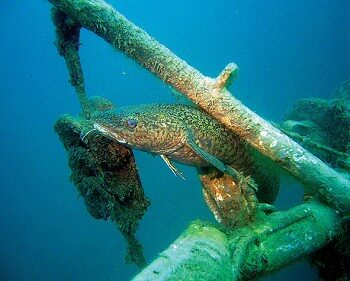
The wreck rests in about 15m, heeled over at a precarious 60°. Its wooden helm remains in place, with Siberian grayling slithering in and around its masts and wheelhouse. It was possible to penetrate the hold from the wheelhouse, and other open doors led into compartments on the top deck.
The wreck was also one of the few places where we saw juvenile fish in any number, demonstrating the value of fish habitats to the lake’s eco-system.
Reflections and Future Research
EVEN AFTER TWO WEEKS of exploration by an experienced team, it is difficult to say that we captured more than the barest glimpse of what lies within this enormous lake.
We raised a lot of new questions for future researchers to answer. What are all the smaller fish that the large Siberian grayling are eating? Where are all the other fish? We suspect that warmer surface temperatures are driving the lake’s inhabitants, which spend months under ice every year, into deeper, colder water. Sonar images of the lake’s deepest parts, using our scanning unit’s fishfinder setting, revealed many biological targets, even at that depth.
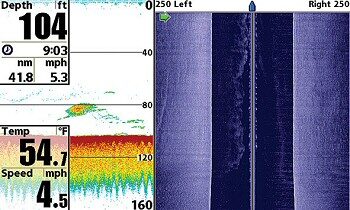
In addition to our diving firsts and discovery of the Russian shipwrecks, we brought back the first photos and video ever taken of Mongolia’s underwater environment. During our last three days we were visited and interviewed by the country’s best-known TV journalist.
A week after our return, thanks to the work of our videographer Steffan Schulz, the Mongolian people saw beneath the surface of their greatest body of water for the first time, when the program was aired on national TV.
Our data, images and video will also be shared with research scientists working in the Khovsgol region. In a world where the number of genuine discovery and exploration opportunities is declining, the chance to make first descents in a remote body of water was a rare blessing.
And having written the introduction to exploration in Khovsgol, we can only hope that others return to contribute more to the story.
FAQs
Can you go scuba diving in Mongolia?
Yes. Mongolia’s Lake Khovsgol, known as the “Dark Blue Pearl,” offers high-altitude diving with pristine waters, unique fish species and historic wrecks.
What makes Lake Khovsgol special for divers?
It’s one of Asia’s largest, purest lakes with depths of 260 m, dramatic scenery, cold clear water and first-ever recorded dives and shipwreck explorations.
Is diving Lake Khovsgol Mongolia difficult?
Yes. Divers must contend with altitude, cold water, no local dive centres and a full self-support expedition, but the rewards are unmatched.
What is the ‘underwater deer’ of Lake Khovsgol?
Locals describe a mysterious large fish nicknamed the “underwater deer.” Divers have seen sonar readings but no confirmed images yet.
Are there shipwrecks in Lake Khovsgol?
Yes. The team located two 1920s wooden Russian vessels and dove the steel freighter Sukhbataar, providing rare glimpses of Mongolia’s underwater history.
Subscribe today with promo code DIVE1 — enjoy 12 months for just £1!
