Nigel Marsh and Helen Rose embark on an epic adventure in the renowned Poor Knights Islands of New Zealand
Discovering Moray Manor: First Impressions of the Poor Knights Islands
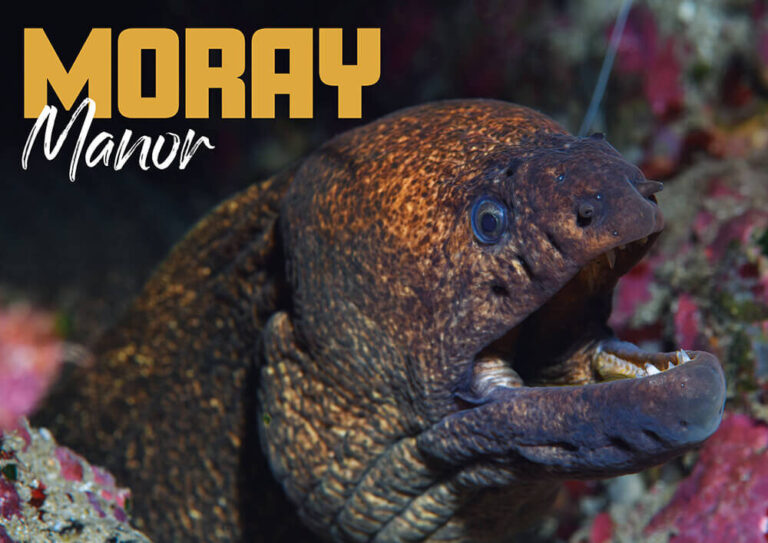
We had been told to look out for moray eels, but never expected them to be so abundant. From our first dive the morays quickly became a feature. We saw their heads poking out of cracks, others were sitting out in the open, some were hiding among the kelp and a few were swimming about. We even found one curled up around a scorpionfish. We hadn’t expected New Zealand’s Poor Knights Islands to be a moray manor!

The Poor Knights Islands are located north of Auckland, off the small coastal town of Tutukaka. Washed by the warm blue waters of the East Australian Current (EAC), made famous in the film Finding Nemo, the Poor Knights Islands may sit in a temperate zone but feel more like a subtropical destination. While the rocky reefs are covered in temperate kelp and sponges, the fish life is a fascinating mix of temperate and subtropical species, with much of the marine life unique to the area. For these reasons the islands were declared a marine reserve in 1981, and they have since become New Zealand’s number one dive attraction.
Diving with Dive! Tutukaka: Boats, Briefings and Daily Adventures
While it is possible to dive these wonderful islands on a weekend liveaboard trip, for our week-long stay we booked daily boat dives with Dive! Tutukaka. Established in 1999, they have a well set-up dive center and operate a fleet of five dive boats to the Poor Knights Islands. We were impressed by the staff, boats and whole operation of Dive! Tutukaka from day one. They had our gear and forms sorted quickly, and after a quick briefing by the skipper we were off on the hour-long trip to the Poor Knights Islands.

That first crossing took well over an hour, as we got slightly side tracked by a large pod of common dolphins. The crew explained this happens often and is one of the reasons that the day often runs a bit longer than planned. Over the week we saw thousands of sea birds, numerous flying fish, more dolphins and even sunbaking hammerhead sharks. However, we missed the whales, seals, sunfish and manta rays they sometimes see. Finally arriving on the sheltered western side of the island, we anchored up at our first dive site, the legendary Northern Arch. This giant swim-through cuts through a rocky point, with the top of the arch rising 125 feet above its base below.
Northern Arch: A Cathedral of Sponges, Fish and Morays
We jumped into the water to find the visibility 50 feet and the water was a pleasant 66°F. We were diving in February, and unfortunately, the EAC was sitting a few miles wide of the islands, so the visibility and water temperature were a little lower than normal. Descending on a rocky wall covered in kelp, we headed towards the arch, but found many distractions on the way.
Did you know?
Moray eels have poor eyesight but their sense of smell is superior to most fish species, allowing them to locate prey in the dark. They ambush their prey in reef crevices, using their strong jaws and sharp teeth to capture and swallow them.
For a start there were all the fish – snapper, trevally and yellowtail kingfish in midwater, and swimming among the kelp demoiselles, leatherjackets and wrasse.
The Colour Explosion: Sponges, Kelp Forests and Reef Life
Then there were the colors, as each rock was encrusted with sponges, algae, anemones, hydroids and bryozoans. An incredible artist’s palette of reds, pinks, purples, yellows, greens, blues and oranges. Among these colorful growths were also nudibranchs and cute little blennies, sea perch and triplefins. However, it was the moray eels that got us excited. Within minutes we had seen three species of moray, the plain-colored yellow and gray morays, but also a spectacular mosaic moray. This wonderfully patterned eel, with an equally impressive set of dentures, is only found in northern New Zealand and in the subtropical waters off eastern Australia. Before we even reached the arch we had shot dozens of photos of the morays, the colorful sponges and the fishes.


Then we reached the arch and it took our breath away. The structure itself was remarkable, around 20 feet wide and 100 foot long, with its walls covered in colorful sponges. However, it was the fish life swarming between the walls that left a lasting impression. Here were dense schools of pink maomao and blue maomao, and swimming among these brightly colored fish were larger yellowtail kingfish, snapper and moki. A closer inspection of the walls revealed many cracks and crevasses, home to more moray eels, Lord Howe coralfish, toadstool groper, butterfly perch and numerous large scorpionfish. Exploring Northern Arch was an incredible start to a week of diving the Poor Knights Islands. Between dives, enjoying hot drinks, food and chocolates, we consulted the guidebook to the Poor Knights and were surprised to discover that five species of moray eel are found around the islands, as most morays are considered a tropical species. With a love of morays, we set a goal to photograph every moray species at this very special dive destination.
Middle Arch and the Giant Short-Tailed Stingrays
For our next dive we anchored at another arch structure called Middle Arch. This one also breaks the surface, with its rocky bottom 50ft deep. Before reaching the arch, we explored a bay full of kelp-covered boulders. Here we found more wonderful reef fish and moray eels, including a pair of mosaic morays sharing a lair. This dive also introduced us to another feature of the Poor Knights Islands – stingrays.
Resting between the boulders we found two large short-tailed stingrays. The largest stingray species in the world, reaching a width of over six feet, the short-tailed stingray is found in the temperate waters of New Zealand, South Africa and Australia (where it is called the smooth stingray). A large population of these stingrays are found at the Poor Knights Islands, but they have been known to disappear when orca are seen in the area. Leaving the rays, we headed into the arch, and it was once again spectacular; colored by sponges and overflowing with fish. There were also several short-tailed stingrays cruising about. We also found more moray eels, including the fourth species we were looking for, the lowfin moray.

Each day we explored walls, caves, arches and reefs, and each site was home to abundant marine life and a few special surprises. At Jan’s Tunnel it was a slipper lobster, at Dutch Cove we saw a giant boarfish, at Ngoio Reef we photographed a conger eel, at Blue Moamao Arch we were overwhelmed by masses of blue maomao, and at Mary’s Wall we even found a paper nautilus shell. We also returned to Middle Arch and encountered a longfin boarfish, and Northern Arch to see a bronze whaler shark.
Another special site we enjoyed was Cleanerfish Bay. Because we hadn’t seen as many stingrays as normal, the skipper suggested this dive site. Almost as soon as we jumped in the water, we found a short-tailed stingray resting between two boulders. But after that nothing. We were starting to think maybe a pod of orca had recently visited the islands.
We continued to explore the kelp-covered boulders, finding many caves and ledges, and a good variety of moray eels, reef fish and nudibranchs, but no more rays. Then towards the end of the dive we found a large cave, and inside it four stingrays swimming around. Were they hiding here from the orca?
The Hunt for All Five Moray Species
On each dive we continued our quest for morays, determined to find the final species that had eluded us, the mottled moray. Heading to a site called Brady’s Corner, a popular spot with snorkelers, we didn’t have high hopes. But our guide explained that there is a wall nearby that drops to 100ft and it’s a great spot for morays. He wasn’t kidding as on the way to the wall we found a dozen moray eels among the kelp and boulders. But that wasn’t all, as we also saw schools of trevally, snapper, yellowtail kingfish and a giant boarfish. Finding a southern eagle ray resting on the bottom was also a great surprise, as the ray was quite content having us closely inspect it with our cameras.
A Rare Discovery: The Unexpected Y-Patterned Moray
Reaching the wall, it lived up to its promise, being home to not only several moray eels, but also numerous nudibranchs and a cute sharpnosed pufferfish. We photographed a strange-looking mosaic moray, whiter in colour than any we had seen, but we didn’t get to study it for long before it disappeared into its lair.
On the way back to the boat our guide started waving frantically and pointing down. Looking into the gutter we could see a tail of an orange-colored moray covered in white spots. It was the rare, mottled moray. We finally got the fifth moray!


Returning to the dive shop we mentioned to Kate, the owner manager of Dive! Tutukaka, that we were very excited as we had photographed all five local moray species. Kate then informed us that there are six species at the Poor Knights Islands, with the Lord Howe moray also occasionally seen, but missing from the guidebook. This was unexpected news to us, but then we remembered the funny, white-colored moray. We showed Kate the image and she said it wasn’t a Lord Howe moray, but it was one she had never seen before. She emailed it to a local fish expert and quickly got a reply, it was a Y-patterned moray, a species normally found in deep water and a new record for the Poor Knights.
Why the Poor Knights Islands Are a Moray Photographer’s Dream
We had an incredible time exploring the Poor Knights Islands. There were many highlights – the graceful stingrays, the masses of fish and the colourful arches and caves. But for us, this special dive destination will always be remembered for its amazing morays.
Frequently Asked Questions
Why are moray eels so common at the Poor Knights Islands?
The islands sit in the warm East Australian Current, attracting both temperate and subtropical species. This unique mix creates ideal habitats for multiple moray eel species, including rare and deep-water varieties.
How many species of moray eels can divers see at the Poor Knights?
Five species are regularly recorded, with occasional sightings of a sixth. Rare encounters include the mosaic moray, mottled moray, and the recently documented Y-patterned moray.
What makes the Northern Arch such a popular dive site?
Northern Arch offers towering walls coated in colourful sponges, dense schools of maomao, and countless cracks harbouring morays, scorpionfish and reef species. It’s iconic, dramatic and filled with life.
What other marine life can divers expect beyond moray eels?
Expect short-tailed stingrays, trevally, kingfish, snapper, nudibranchs, blennies, boarfish, eagle rays and the occasional shark. Surface intervals also bring dolphins, seabirds and sometimes manta rays.
When is the best time to dive the Poor Knights Islands?
Summer months offer warmer water and better visibility, though wildlife is abundant year-round. The East Australian Current strongly influences water clarity and seasonal species visitors.
This article was originally published in Scuba Diver Magazine
Subscribe today with promo code DIVE1 — enjoy 12 months for just £1!
