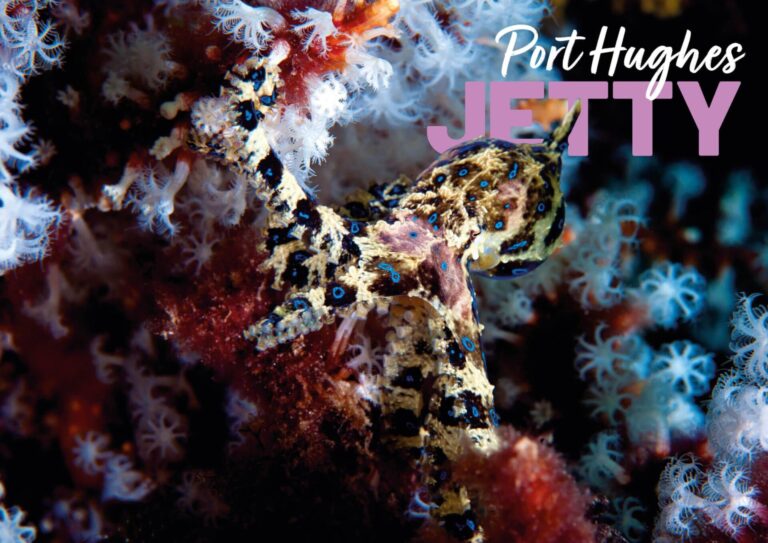
Port Hughes jetty is a spectacular dive site and arguably among the top three jetty dives in South Australia. The shade cover from the jetty, and the jetty-related bottom structure, provides homes for many amazing and cryptic marine animals. Paul Macdonald takes a closer look at a popular dive site that very nearly never was…
The History Behind Port Hughes Jetty
Port Hughes jetty almost didn’t get built. The whole area was surveyed in 1863 with the original intention that would become a port for exporting ore from the nearby Moonta copper mines. Because the nearby (3km away) Moonta Bay jetty didn’t provide sufficient depth for ketches of the day to load and unload cargo, calls for the construction of a jetty at Port Hughes persisted. It wasn’t until 1909 that a decision to build a deeper water jetty (7m) at Port Hughes was finally made. The first pile was driven in December 1911. But construction of the jetty was hampered by costly over runs and the underlying hard rock substrate that made driving of the piles difficult. Thankfully for divers and especially macro underwater photographers, construction continued, with the jetty opening in May 1913.
Originally the jetty was 430 metres long but was later shortened to its present length of 417 metres. Port Hughes jetty predominately serviced the local farming community for the export of grain. While it was also expected that the jetty would service the nearby Moonta copper mines, there was difficulty laying a rail track across the several kilometres of sand between the mines and the jetty.
The commercial use of the jetty ended in 1927 when the Wallaroo jetty was built that offered much deeper water.
Now this jetty is a very underrated dive site. Don’t be fooled by the shallow depths. In fact, the shallow depth allows for extended bottom time to explore the incredible marine life to be found and photographed here.
Did you know?
Due to its relatively shallow waters (depth of 6-7m) and predictable conditions, the jetty can be enjoyed by beginners as well as and experienced divers, underwater photographers, snorkellers and freedivers.


“Take your time to fossick among the bottom debris and you might find an anglerfish or blue ringed octopus. Prickly, smooth and tasselled anglerfish are regularly sighted under the jetty”
Why Port Hughes Jetty Is a Top Dive Site
This site is suitable for divers of all levels. It is a simple and relatively easy dive for a novice diver, and diving heaven for an underwater macro photographer. The maximum depth at the end of the jetty is between 6m and 7m depending on the tide. The best weather conditions to dive the jetty are when the wind has ‘east’ in it. That said it can be dived in almost any winds providing they are not too strong. Water temperature can be as low as 13 degrees C in winter and around 24 degrees C in the height of summer. At Port Hughes there is usually no current (gentle at worst) and with vis greater than ten metres most of the time, this is a very easy and relaxing site to dive.
The Port Hughes jetty is very popular with fishermen too, so it is best to stay under the jetty on your dive to avoid entanglement in fishing gear, which is the only real hazard.
Entry and exit is via a set of steps on the northern side about one third of the way up the jetty. At the steps the depth is around 2.5m. Almost immediately after you descend, the inquisitive cowfish swim up to you to introduce themselves and welcome you to the dive site. At the steps the bottom has a healthy cover of seaweed that extends all the way out to where the jetty widens.
Marine Life and Macro Photography Highlights
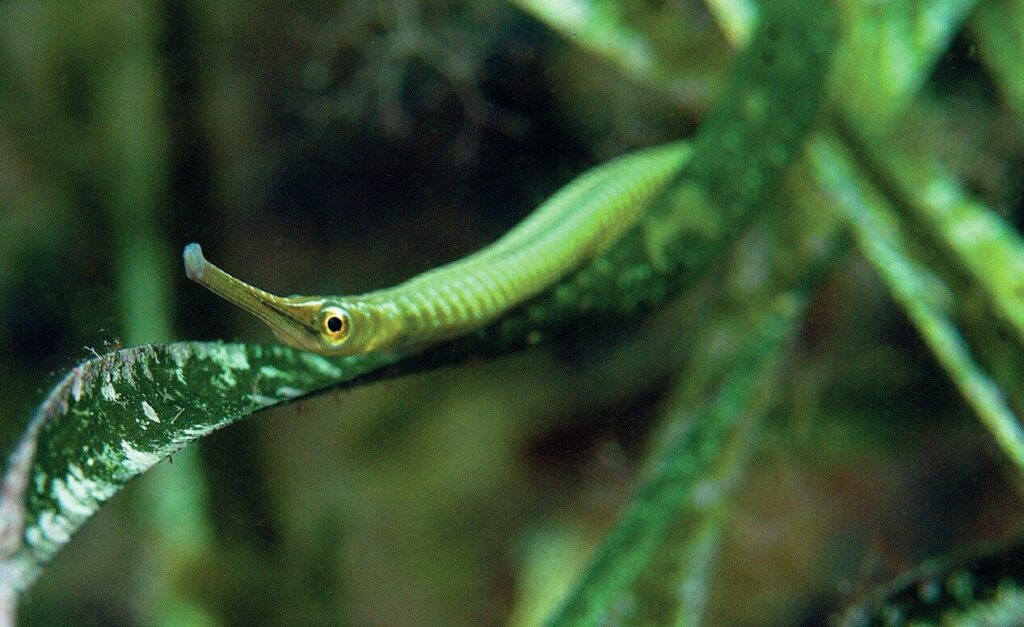
As you head out towards the end, look closely in the seaweed for the numerous and well-camouflaged pipefish. Several varieties may be found as they gently sway with the weed while feeding. And watch out for the blue crabs that regularly raise their claws at divers that come too close before swimming away into the distance. If you are lucky, among the weed you may also find weedy seadragons and short-headed seahorses.
As you are transiting to the end, don’t forget to look at the jetty piles. They are spectacular in colour and marine life with each one offering its own micro ecosystem. They make for great wide-angle photographs with the contrasting blue water in the background. And there are many cool things to be found on the piles like glass shrimps, nudibranchs and blue ring octopus to name a few.
Very soon you get to the wider section at the end of the jetty. The weed gives way to a sandy bottom littered with fallen jetty piles and the debris from many years of storms.



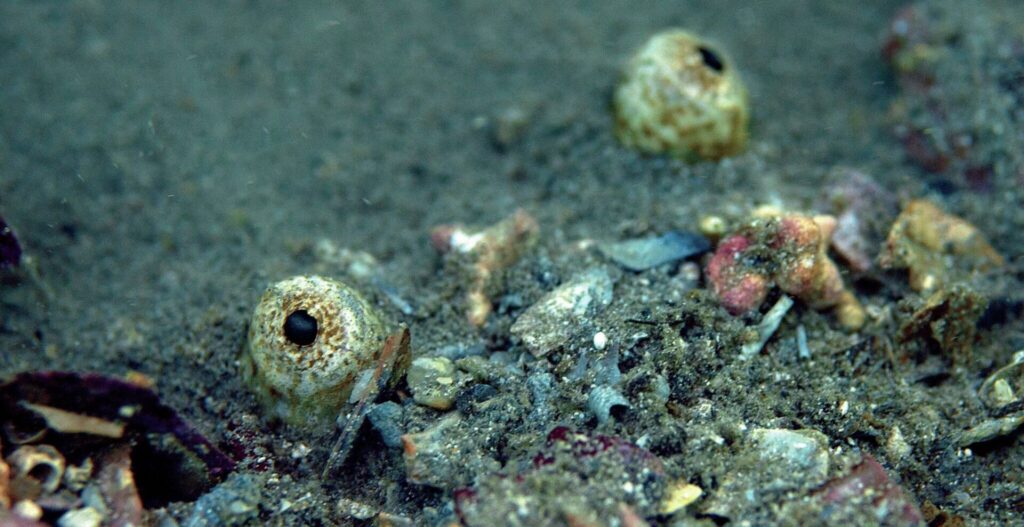
The debris is overgrown with marine life. And poking out of the sand are numerous razorfish shells. There are also many varieties of nudibranchs to be seen on the dive.
Take your time to fossick among the bottom debris and you might find an anglerfish or blue ringed octopus. Prickly, smooth and tasselled anglerfish are regularly sighted under the jetty. If you look closely, you may also find one of the warty prowfishes that hide up against the bottom structure. They are well camouflaged and difficult to find. And watch out for the eyes in the sand. Here stargazers lay buried in the sand with just their eyes protruding waiting for prey to swim over them. And check out the dead razorfish shells, often there will be the head of a Tasmanian blenny or the eyes of an octopus poking out the top of the shell watching the world go by.
In the area at the end of the jetty the fish life is usually prolific with a huge school of yellow tail scad swirling about the pylons that sometimes rapidly swims rapidly away when chased by kingfish looking for a feed. Being in the middle of this massive school, with fish all the way around you, can be quite eerie and dark but it is an incredible experience.
And remember to look out into the blue from time to time. There are often squid around. If you don’t chase them, they become quite curious and playful.

They will come so close that you have to move backwards to photograph them as they swim inside the focal distance of your camera lens. And sometimes they interact with divers using their tentacles to gently stroke camera strobes and lights as well as divers’ outstretched hands. And Port Hughes isn’t all about macro, look around on the dive for bull and eagle rays, wobbegongs, Port Jackson sharks and the occasional dolphin or seal that may swim past.
The shallow depths offer plenty of natural light for wide angle under water photography. But wide angle is difficult to undertake at Port Hughes. The bottom around the jetty has a very healthy covering of green seagrass. And for wide angle, the green is reflected back to the camera such that images tend to have a green cast to them. It is difficult to get a blue water background, even when the water is blue.
Night Diving at Port Hughes Jetty
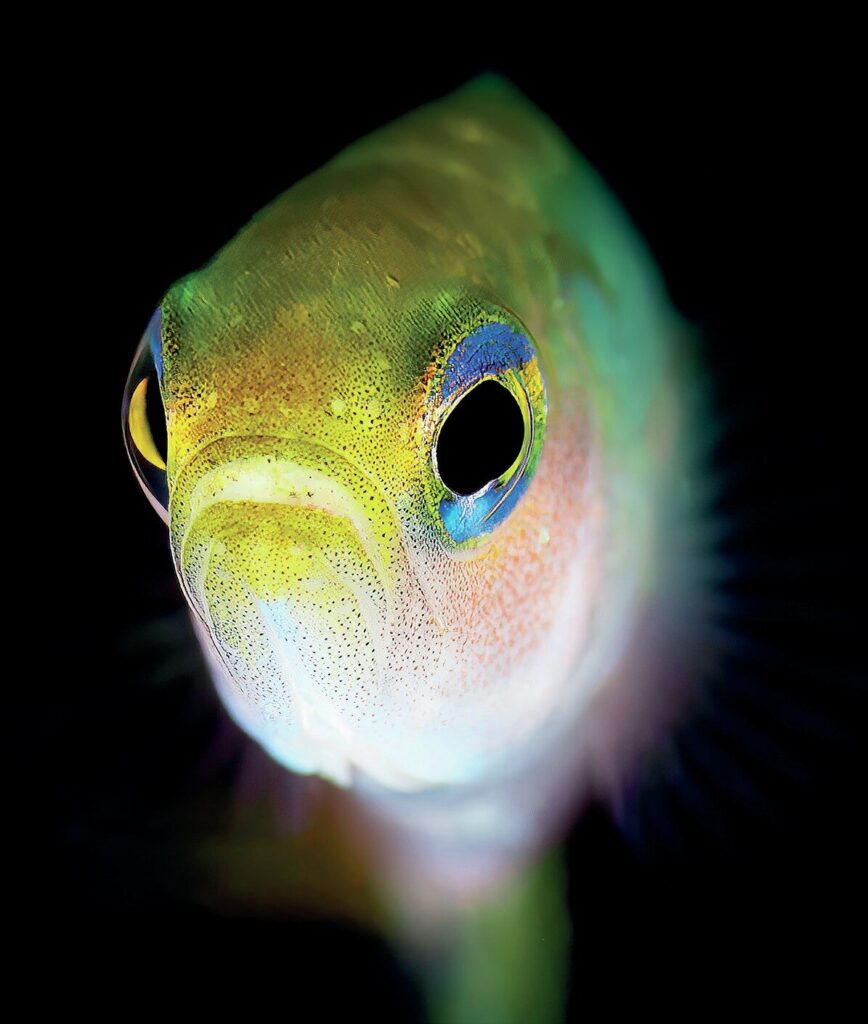
Now it’s at night that the jetty comes alive – all those weird and wonderful critters that hide and are so difficult to find during the day come out to play. The colours on the jetty piles are striking in the white torch light. The seahorses sit up in the top of the weed feeding. Squid become even more playful as they are attracted to your lights. Estuarine cobblers with their large eyes and golden speckled heads can be seen poking around with their feelers for something to eat. Octopus are out, crawling over the bottom looking for their next meal.
It is absolutely worth it to drive the 170km from Adelaide to dive Port Hughes jetty. It is close enough to Adelaide to be done as a day trip and there is enough to see under the jetty to stay over in the nearby caravan park or one of the many BNBs to make it a multiple day, multiple dive trip. There is ample parking near the jetty with toilets and showers nearby. Adjacent to the jetty there is a general store, take away shop and a tavern.
So, when you are planning your next macro underwater photography trip, put Port Hughes jetty on the list for consideration. And may be even include the equally amazing Edithburgh jetty on the list. The two jetties are around 120km apart and can be easily combined into the one trip to South Australia’s beautiful Yorke Peninsula. You will not be disappointed, I promise.
Did you know?
The blue-ringed octopus is one of the world’s most venomous marine animals. Despite their small size and relatively docile nature, they are very dangerous if provoked or handled because their venom contains a powerful neurotoxin called tetrodotoxin.
Frequently Asked Questions
Where is the Port Hughes Jetty dive site located?
Port Hughes Jetty is on South Australia’s Yorke Peninsula, about 170km west of Adelaide, making it an easy day or weekend dive trip.
How deep is the Port Hughes Jetty dive?
The jetty’s maximum depth is between 6 and 7 metres, making it perfect for beginners, snorkellers, and macro underwater photographers.
What marine life can divers expect to see at Port Hughes Jetty?
Expect anglerfish, blue-ringed octopus, weedy seadragons, seahorses, nudibranchs, stargazers, cowfish, and even visiting rays and seals.
When is the best time to dive Port Hughes Jetty?
You can dive year-round, but summer offers warmer water (around 24°C). Winds with ‘east’ in them bring the calmest surface conditions.
Is Port Hughes Jetty suitable for night diving?
Absolutely. At night, the jetty comes alive with octopus, squid, cobblers, and other nocturnal critters that emerge from the shadows.
This article was originally published in Scuba Diver Magazine
Subscribe today with promo code DIVE1 — enjoy 12 months for just £1!
