Nays Baghai embarks on a month-long adventure to Queensland’s Stradbroke Island in search of epic animal encounters – and he is not disappointed. All in all, this trip to Stradbroke Island was definitely one of the most-auspicious, satisfying diving adventures he´s undertaken since he first learned to dive .

The Strategy: Planning a “Galápagos” Trip at Home
If you were to ask any diver either which places would be at the top of their bucket list, or what were among the best places they’ve dived in, the answer to both of those questions would include the Galapagos Islands without fail. The top reason for Galapagos’ impeccable reputation is almost always the intense biodiversity that few places can match. This is among the many reasons that divers who visit the Galapagos often struggle to find subsequent destinations that come close to the experience of diving there. I say this because I am one of those divers -guilty as charged -and for many years, I wondered whether any of the destinations I would travel to in the future would ever come close, if not surpass it.
While researching the obvious contenders in the Pacific Ocean (i.e. Socorro, Malpelo, Cocos, French Polynesia, Palau), an unexpected contender got added to the list when I made friends with a fellow tech diver, Daniel Fitzgerald, who serves as the manager of the Manta Lodge and Scuba Centre on Stradbroke Island, in Queensland, Australia.
Dan had already regaled me with stories of some marine life encounters he had experienced on the island, but it wasn’t until we caught up during a dive conference we were both speaking at where I finally realised he wasn’t exaggerating. While on stage, Dan presented footage from his GoPro that chronicled encounters with humpback whales, bull sharks, grey nurse sharks, leopard sharks, spinner sharks, shovel nose sharks, manta rays, cownose rays, eagle rays, marble rays, bowmouth guitarfish, turtles and too many species of fish to count – all in crystal-clear blue water. Rarer visitors to the island also include hammerheads, great whites and whale sharks.
The final cherry on top was how Dan described how the dive centre caters to rebreather divers as much as it does scuba divers. As soon as he concluded his presentation, I immediately knew that I had found another contender for Galapagos level-diving within my own country, and wasted no time hatching a plan to visit the island.
Most divers who visit Stradbroke Island are either residents from southeast Queensland who come for the weekend, or tourists flying from other states and countries that come for no more than a few days. But I decided to go for nearly the whole month, which initially seemed like a highly impulsive, fiscally irresponsible move. However, there was a logic underpinning that decision in a few key ways.
Firstly, I decided to drive all the way up from Sydney in my own car rather than fly to Brisbane and rent a car for the whole month. Not only did this dodge the horrendous costs associated with flights, excess baggage fees and a rental car, but it also allowed me to pack as much dive kit as I wanted.
My second move was to work remotely during normal office hours on weekdays, not take any annual leave, and keep weekends strictly for diving. Although it would have been nice to dive everyday, the truth is that tech diving (let alone in Australian waters) can be very tiring, so having adequate rest between dives is crucial.
Finally, I strategically chose a month that had the perfect combination of low numbers of tourists, high numbers of animals present, and a lack of in-person commitments for my day job, and August was the month that ticked the boxes, with a bonus it was during the middle of the humpback whale season.
With everything all set, I packed my car and drove all the way up from Sydney. After settling into my home for the month, I promptly drove to Manta Lodge. Whenever I travel for diving, I always like to get to know the staff at the dive shop the day before my first dive, and to also get a feel of where everything is so that I know my way around when things get busy. This is especially relevant if you’re a rebreather diver, given how the assembly and cleaning processes are more complex, and also because of how there are more failure points with the equipment.
Did you know?
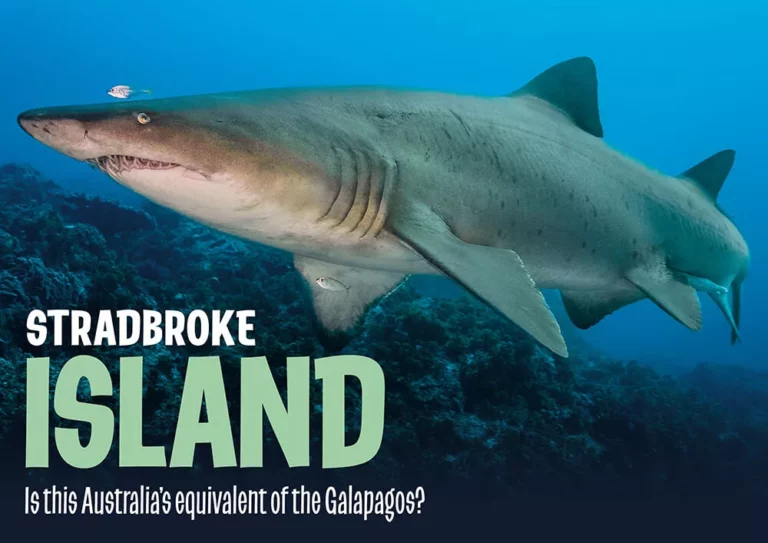
Depsite their rows of menacing looking teeth constantly on show, grey nurse sharks are not very aggressive and are considered among the most dosile of sharks. Weighing up to 350 pounds, they hunt at night in shallow waters.
Base Camp: Manta Lodge and Scuba Centre
Fortunately, Manta Lodge is one of the best rebreather-friendly dive shops in the country, and not only did they have a whole tech room dedicated just for rebreathers, but their staff were all familiar with the technology to help me out with anything I asked for. Sure enough, during my orientation, I had a problem with the regulator for my bailout tank, and the resident technician, Luca, swiftly solved the problem within minutes.
Another thing that makes Manta such a fantastic operation is how all their staff members have the ideal combination of balancing laidback friendliness with detailed professionalism, experience and protocols. Not only does this result in a safe and fun experience for customers, but it allows them to cater to every level of experience amongst visiting divers. The lodge is also well known for its hostel above the dive shop, which is definitely one of the safest and cleanest hostels I’ve seen, and is a good budget-friendly option for visitors staying for only a few days.
Launching from the Beach: The Journey to Flat Rock
On the day of my first dive, my excitement bubbled up as the minutes ticked. I wasn’t bothered by the fact I was the only rebreather-diving customer on the boat – I was just too eager to see how the diving would manifest. The briefing was led by James Griffith, the owner of the shop and the Divemaster for the day, who brought a level of animated enthusiasm and playfulness that reminded me a lot of my guide from Galapagos.
From the beach near the dive centre, it took their RIBs only a few minutes to reach Flat Rock, a sea mount that is the most popular dive site on the island. Although a full boat can get quite crowded when divers are kitting up, the skipper and Divemasters were all highly attentive, and ready to help me out as much as they were the other customers.
Sitting on the edge of the RIB, clad with nearly 80kg of gear (JJ-CCR, bailout, camera, Jet fins, etc), I was slightly anxious, partly due to the swell that comes from the surge that builds up towards Flat Rock, and partly not knowing how warm or cold the water would be compared to the air temperature. But once I backrolled into the water, everything became clear, literally and figuratively. Not only was the visibility exceptional, but the 20 degree C water was quite pleasant (so much so, I promptly removed the 5mm hood I was wearing), and the surge and current weren’t as bad underwater. Strangely, the first thought that popped into my head once I hit the water and swam towards the mooring line was, “Huh, this temp is just like Galapagos! What a pleasant surprise.” Little did I know that that was just the beginning of comparisons to come during the dive.

Did you know?
A cow nose ray uses electroreception to search sandy seafloors for burrowed prey, like clams. Once the ray locates its prey, it uses its pectoral fins to stir up sediment, while at the same time sucking water and sediment out through its gills and away from the seafloor.
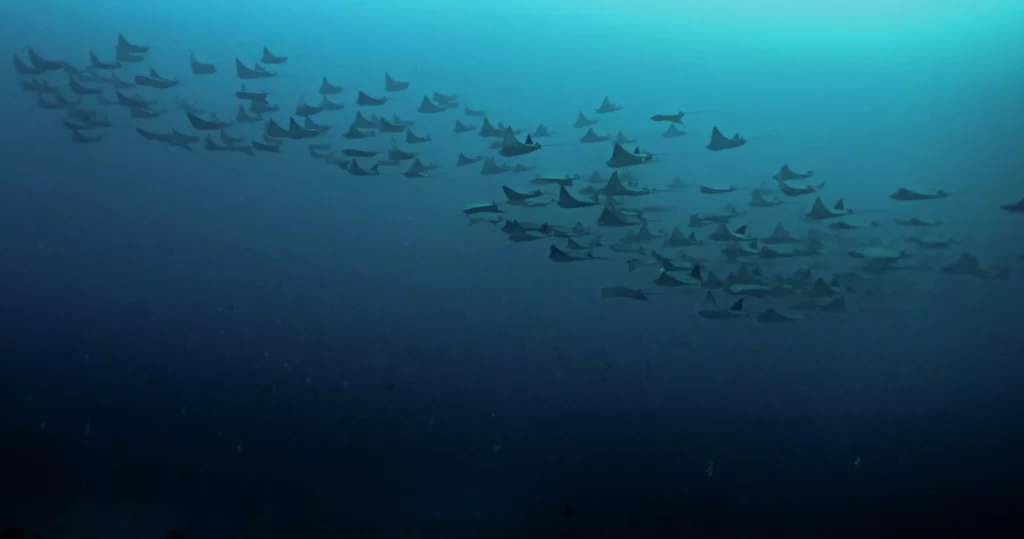
As I was getting caught up by both of these sharks, James yelled through his rebreather to look up. Tilting my head up, I could not believe my eyes -it was an absolutely humungous fever of cownose rays
Underwater Intensity: Sharks, Turtles, and Giants
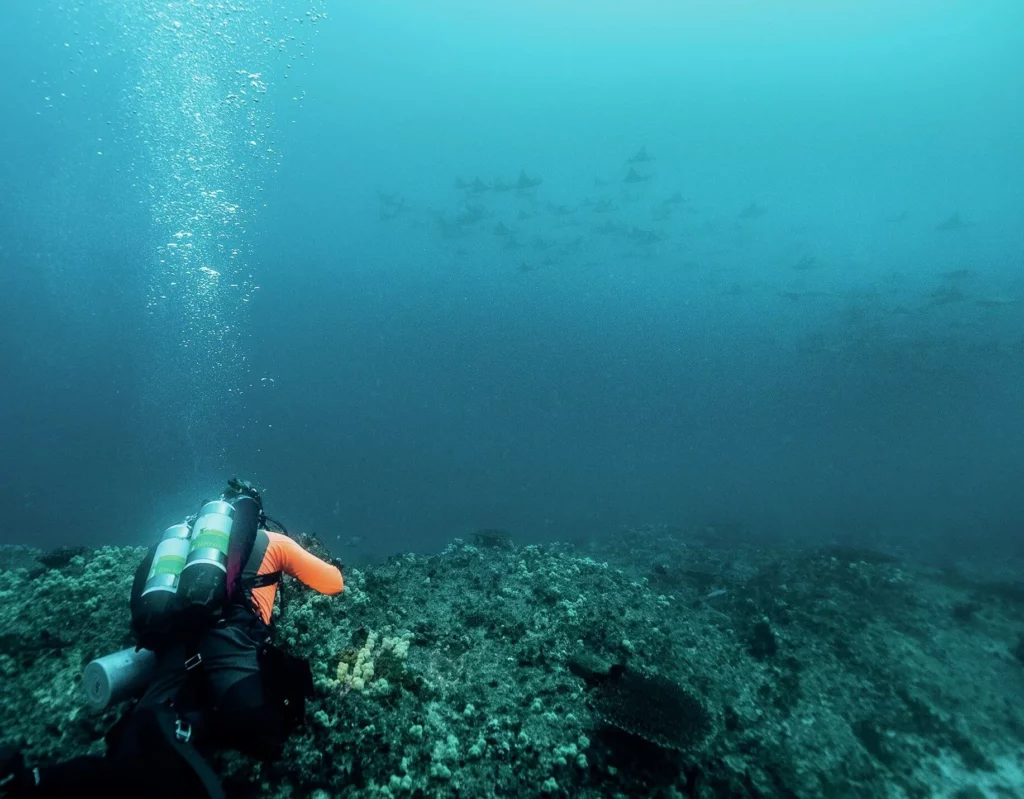
As soon as we descended to 20m, the action was intense – in fact, it was exhausting keeping up with all the animals surrounding me. Within five minutes, I saw eagle rays, striped snapper, a green sea turtle, fish schools, and a grey nurse shark. Then, in the distance, we saw bull sharks swimming through their usual routes, but showing no signs of aggression whatsoever, along with a leopard shark.
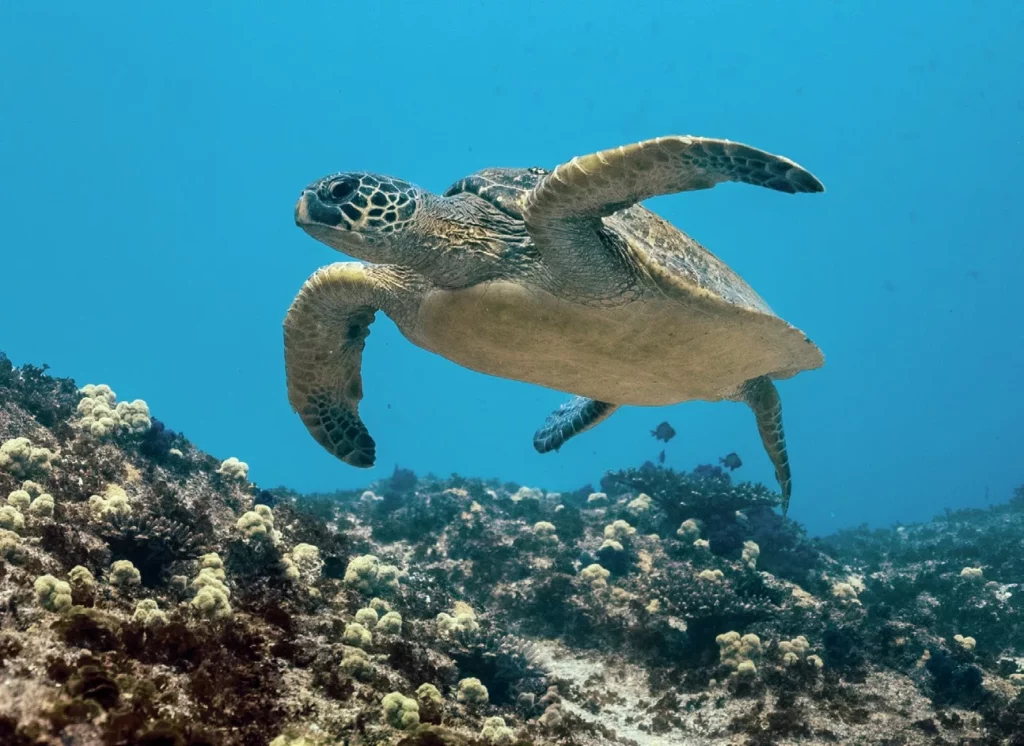
The “Fever” Moment: A Sky Full of Rays
As I was getting caught up by both of these sharks, James yelled through his rebreather to look up. Tilting my head up, I could not believe my eyes – it was an absolutely humungous fever of cownose rays. At first, the rays were too far away to get a close enough shot, and vanished into the blue. But then they reappeared – almost like they were playing a game of hide and seek – and slowly came closer. Seeing their shadows lit up by the sun made us feel like we were flying in among majestic birds. This first dive set the tone for the rest of my trip and Straddie certainly lived up to expectations.
Did you know
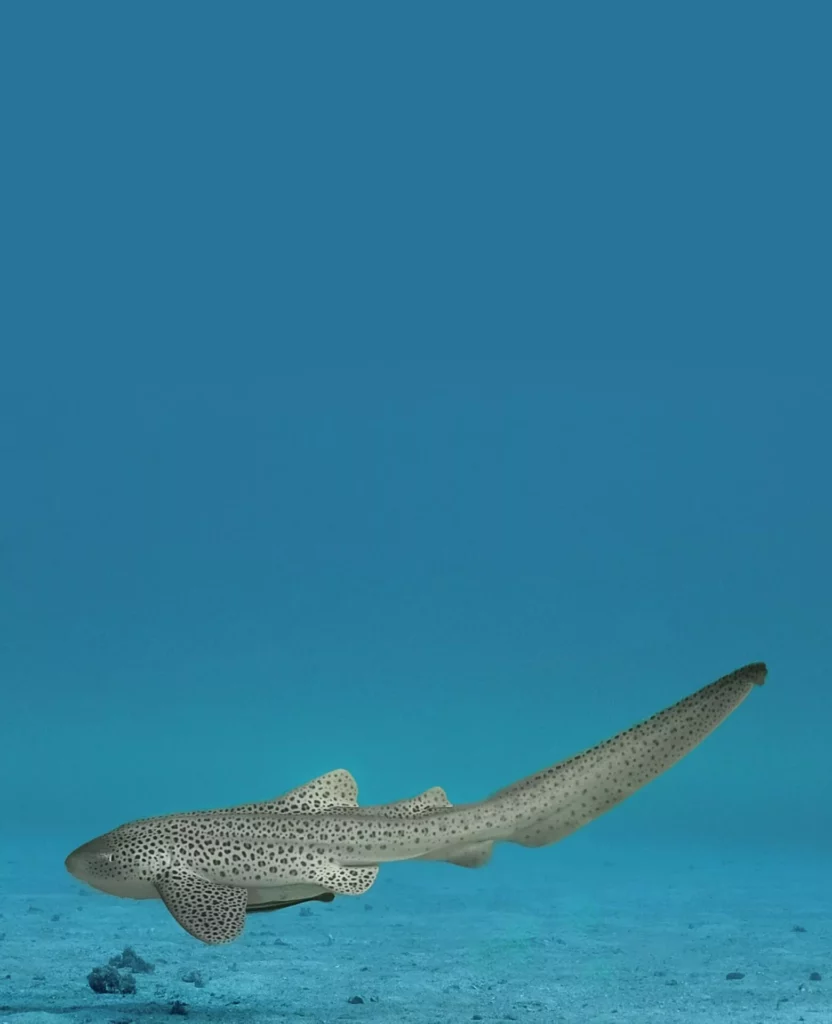
The zebra shark is a slow-moving, bottom-dwelling species known for its striking transformation in appearance as they age. Despite their name, adult zebra sharks don’t have stripes – instead, they lose their stripes and form dark spot patterns.
As soon as he concluded his presentation, I immediately knew that I had found another contender for Galapagos level-diving.
Conclusion: Is Stradbroke Island the New Galápagos?
All in all, this trip was definitely one of the most-auspicious, satisfying diving adventures I’ve undertaken since I first learned to dive, and one that all but confirmed my suspicions that Straddie is one of the closest equivalents, if not the closest equivalent, of Galapagos-level diving within Australia. Although no hammerheads and whale sharks were sighted during this particular trip, the fact that they have been previously sighted gives me an excuse to come back, and I most certainly will. You know it’s a really special place when there is simply too much to see underwater as far as big animals go, and it is impossible not to feel like you are part of a big blue ocean thriving with life when you are submerged beneath the waters of Stradbroke Island.

About the author: Nays Baghai
Nays Baghai is a professional filmmaker, underwater photographer and technical diver based in Sydney, Australia. A graduate of Australia’s national film school AFTRS, both of Nays’ documentary feature films, Descent and Diving Into The Darkness, have won dozens of Oscar- qualifying film festivals, and are available on Apple TV and Amazon Prime. A self-taught underwater photographer and cinematographer, Nays’ past clients include Sony, Rolex, Tourism Australia, RED Digital Cinema, SBS, Channel 9, and many more. In addition to extensive expertise in scuba diving and freediving, Nays is also a passionate technical diver and advocate for closed circuit rebreathers, especially in regards to marine life encounters and conservation. In between diving adventures and projects, Nays is the Head of Design Studio at Future Secure AI.
FAQs
Where is the best scuba diving on Stradbroke Island?
The most popular and iconic dive site is Flat Rock. This seamount is famous for its exceptional visibility and frequent encounters with grey nurse sharks, bull sharks, and massive fevers of rays.
When is the best time to see humpback whales at Stradbroke Island?
Humpback whale season typically runs from June to November. Visiting in August is ideal, as it offers a high concentration of whales alongside resident shark species and calmer winter conditions.
Can I do technical or rebreather diving on Stradbroke Island?
Yes. Manta Lodge and Scuba Centre is a renowned rebreather-friendly facility, offering dedicated tech rooms, oxygen fills, and staff experienced in supporting JJ-CCR and other closed-circuit systems.
What kind of sharks can you see at Stradbroke Island?
Stradbroke Island is a shark hotspot. Divers frequently encounter grey nurse sharks, leopard (zebra) sharks, and bull sharks. On rarer occasions, hammerheads and great whites have also been spotted.
How do I get to Stradbroke Island from Brisbane or Sydney?
Straddie is easily accessible from Brisbane via a vehicle ferry or water taxi from Cleveland. For those traveling from Sydney, it is a scenic 10-hour drive to the ferry terminal, allowing divers to bring their own heavy tech gear.
This article was originally published in Scuba Diver Magazine
Subscribe today with promo code DIVE1 — enjoy 12 months for just £1!
