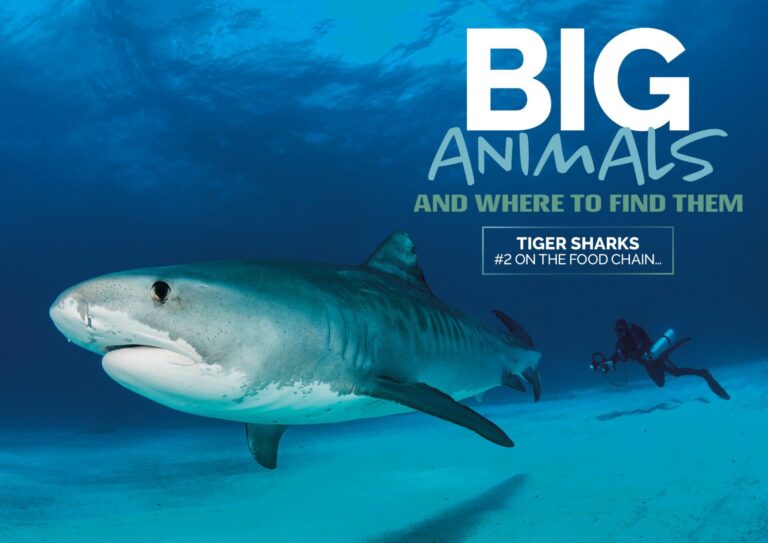
The tiger shark (Galeocerdo cuvier) is the largest predatory fish encountered in tropical seas and take its name from the dark, vertical stripes found mainly on juveniles. Their large blunt-nose and significant girth gives them a truly commanding presence, particularly so given their reputation as man-eaters – second only to great whites in attacking humans.
Tiger sharks are found in tropical and sub-tropical waters throughout the world, with the largest specimens reaching as much as six metres in length and weighing in at more than 800kg.
Their low repopulation rates and long gestation periods make them highly susceptible to fishing pressure and as a result are listed as ‘Near Threatened’ throughout their range.
In-water encounters
Over the last 20 years in-water encounters with them have gone from something akin to ‘are you crazy?’ to almost an Instagram meme, mainly because of Tiger Beach in the Bahamas, and more recently Tiger Zoo at Fuvahmulah in the Maldives.
Most of my experience with tiger sharks has been at Tiger Beach, which I have been to twice – once with Jim Abernathy, and the other with Scott Smith, both of whom claim to have started the whole thing back in 2003.
I have also dived with tigers at the Protea Banks in South Africa and the difference in those experiences provide some salient clues to the real behavior of these creatures, as opposed to the common perception that settles after a trip to the Bahamas or the Maldives.
Greatly misunderstood?
Personally, it has taken me many years to overcome my tabloid media induced fear of sharks – a journey that started with my first great white shark trip in South Australia back in 1996.
All these years later, and many shark trips under my belt, I still remember the intense fear of getting in the shark cage for the first time. Over time, my experience on subsequent trips to South Australia plus a lot of reading and research, I began to develop a basic understanding of the great white.
I can summarize most of that learning into this one-liner: magnificent but greatly misunderstood creatures that are potentially very dangerous and can never be taken for granted.
So how is it that divers regularly get in the water in both the Bahamas and the Maldives to swim with tiger sharks without a cage?
How can it be that the most dangerous shark in the world can only be encountered from the safety of a cage and yet the second most dangerous one seems like a pussycat?
It’s all about the location…
There are over 500 species of sharks and their basic role in the oceans is to clean up the dead, the dumb and the dying. In true Darwinian fashion, the fittest and healthiest species either outwit, or outmanoeuvre, the sharks that prey upon them – until they don’t.
Thus, the fine balance of the oceans is maintained and life under the water goes on. Tiger sharks are notorious for eating almost anything, but their food of choice seems to be turtles which they strike at speed from below and typically bite in half with their large and incredible powerful jaws.
In essence, a hungry tiger shark – much like their terrestrial namesakes – are stealthy and very dangerous predators.
The Bahamas is a famously picturesque location which has, in many ways, led the world in marine conservation when it established the first marine protected area (MPA) in 1959.
Since then, another 26 national parks covering one million acres of land and sea, have been added. And in 2011, the government went one step further and became the fourth country in the world to establish a shark sanctuary by formally protecting all sharks in Bahamian waters.
Essentially this protection has created a safe haven for shark populations to recover, something that is immediately evident the first time you get in the water at Tiger Beach as there seem to be sharks everywhere!!!
Open water encounters
To understand the behaviour of tigers in safe havens like Tiger Beach, it’s important to understand how they behave in open water environments like South Africa’s Protea Banks, the series of offshore underwater ridges about 100km south of Durban.
The area is known for sharks in general and at least six species are encountered throughout the year, either at depth or on the baited dives at around 10m.
April is high season for tigers, and they will often approach divers arranged around the bait box drifting with the mighty Agulas Current that runs down the east coast of South Africa.
Rarely do you see them coming though and often the first indication of their presence is when the other sharks, usually oceanic blacktips, move out of the way…
Approaching from behind is something they excel at and it’s a tense moment when a large tiger suddenly appears besides you.
Their body language in open water is subtly, but significantly different to how they behave at Tiger Beach. Gone is the generally relaxed posture… instead they are distinctly sneaky and decidedly predatory.
Where to do it?
Tiger Beach in the Bahamas is a great place to experience tiger sharks in the open water for the first time and there are several very experienced operators to choose from.
Tiger Zoo in the Maldives is increasingly popular as a closer and cheaper option, but I have yet to go there so cannot judge the overall quality and safety of the operations.
Should you do it?
Tiger sharks are intelligent, curious animals that know their place in the food chain. They move slowly and carefully, checking out what is happening and other sharks clearly defer to them.
Being in the open water with them is an incredible experience, but not one to take lightly as they are an apex predator and just an exploratory nip from their powerful jaws is potentially life-threatening.
Basically, if you can, you should – but remember one thing… it’s not a petting zoo, so choose your operator and location carefully based on reputation, not cost!
Don Silcock
Don is Scuba Diver’s Senior Travel Editor and is based from Bali in Indonesia. His website has extensive location guides, articles and images on some of the best diving locations in the Indo-Pacific region and ‘big animal’ experiences globally.
FAQ: Diving with Tiger Sharks
What are tiger sharks and where are they found?
Tiger sharks (Galeocerdo cuvier) are large apex predators named for their juvenile stripes. They are found in tropical and subtropical waters worldwide and can grow up to six metres long.
Are tiger sharks dangerous to humans?
Tiger sharks are the second most frequently implicated shark in human attacks, after great whites. However, in controlled environments like Tiger Beach, divers regularly swim with them safely under expert guidance.
Why are tiger sharks considered “near threatened”?
Due to low reproductive rates and long gestation periods, tiger sharks are highly vulnerable to fishing pressure. Overexploitation has led to their classification as Near Threatened by the IUCN.
Where are the best places to dive with tiger sharks?
Top locations include Tiger Beach in the Bahamas, Tiger Zoo in the Maldives, and Protea Banks in South Africa. Each offers very different experiences and behaviours from the sharks.
How do tiger sharks behave differently in various locations?
At protected sites like Tiger Beach, they appear calm and curious. In open-water sites such as Protea Banks, they display more predatory behaviour, often approaching stealthily from behind.
Is it safe to dive with tiger sharks?
While tiger sharks are powerful predators, dives with reputable operators in established locations can be conducted safely. Choosing
What do tiger sharks eat
Tiger sharks are opportunistic feeders known to consume a wide variety of prey. Their preferred food source is sea turtles, which they ambush from below, using their powerful jaws to bite through shells.
This article was originally published in Scuba Diver Magazine
Subscribe today with promo code DIVE1 — enjoy 12 months for just £1!