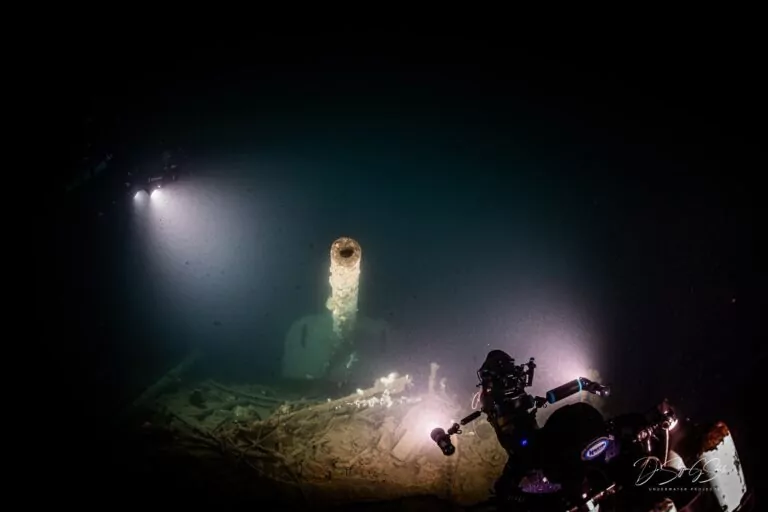
The last undiscovered Royal Navy cruiser of World War One has been found “remarkably intact” in the North Sea and dived by the ProjectXplore international team.
The technical divers, from the UK, Germany, the Netherlands, Poland and Spain, were able to positively identify HMS Nottingham almost 100km off England’s north-east coast at a depth of 82m. This followed extensive research into archival material in the UK and Germany.

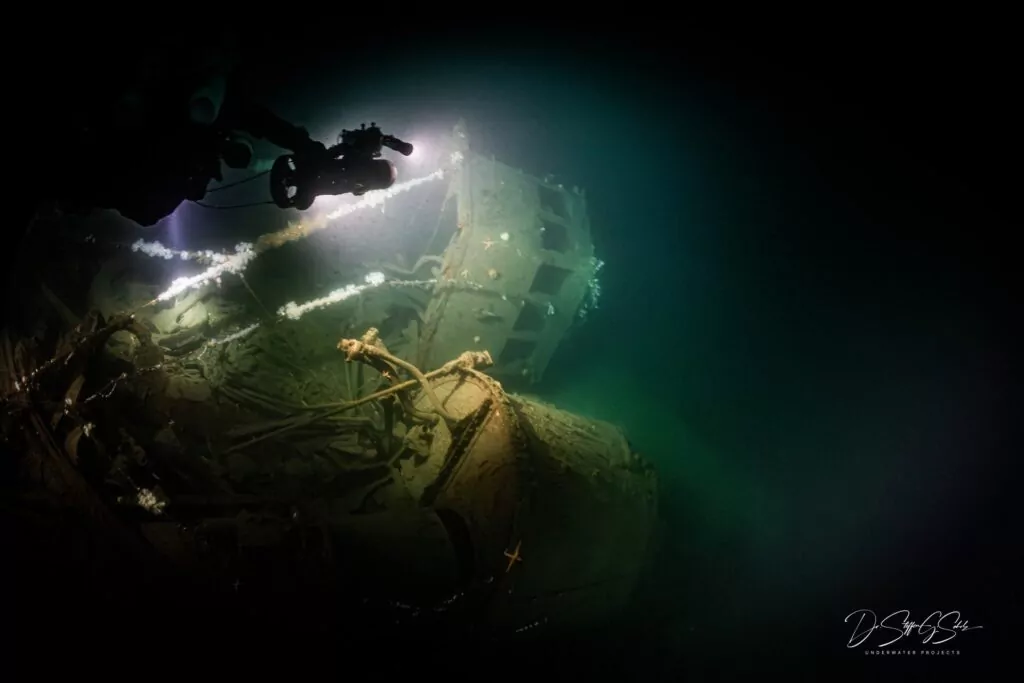
The cruiser wreck is turned 45° to port with its bow facing north, rising in places 8-10m off the seabed. The guns and much of the superstructure remain in place and the general state of preservation is described as ’excellent’, with the exception of the damaged bow.
The warship was one of a number of Royal Navy Town-class light cruisers, designed for long-range independent deployment and often serving as scouts ahead of the battleships of the Grand Fleet.

A veteran of key WW1 battles at Heligoland Bight, Dogger Bank and Jutland, HMS Nottingham was torpedoed and sunk by the submarine U-52 on 19 August, 1916, during the German High Seas Fleet’s final attempt to push across the North Sea to England.
Thirty-eight seamen were lost during the encounter. The captain, 20 officers and 357 crew were rescued by destroyers.
Months of preparation
ProjectXplore says that numerous unsuccessful attempts had been made to find the wreck over the past century.
Following some eight months of preparation the team, using the charter-boat Jacob George skippered by Iain Easingwood of MarineQuest out of Eyemouth, located the wreck on 22 April this year, going on to carry out a follow-up survey two days later. They were using front- and side-scan sonar and a single-beam echo-sounder.

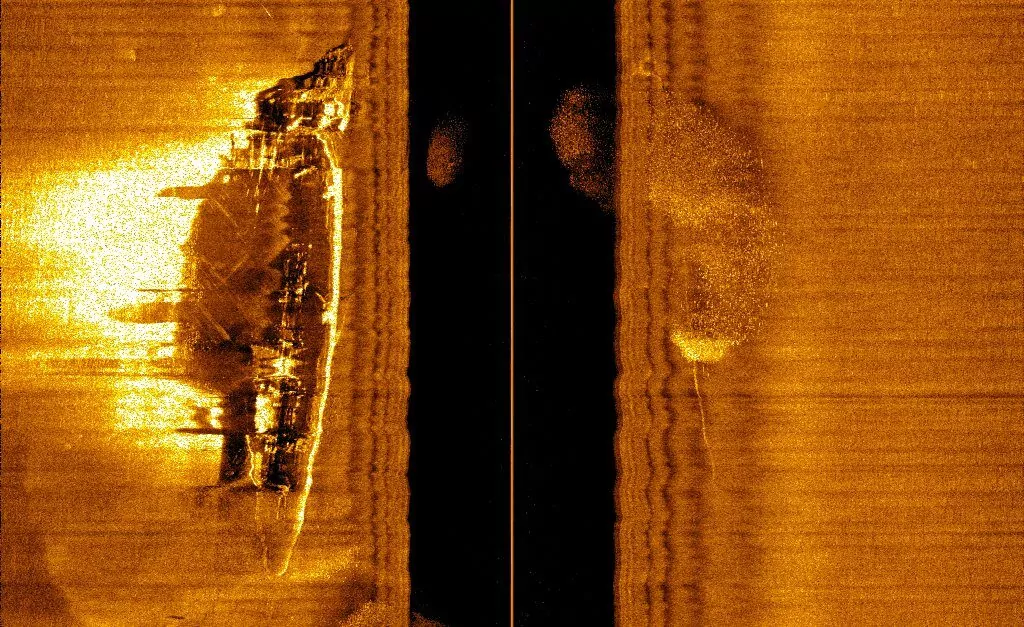
The ship’s dimensions could be seen to match Nottingham’s 139m length and 15m beam. A clear break was apparent forward of the bridge, and the four funnels and stern derrick were visible as well as the nine 7m-long 6in guns.
The wreck lay far closer to the kill position reported by U-52 than it did to British accounts of the sinking position.
Rebreather dive
On 16 July, the team of 10 dived the wreck to document it using photography, photogrammetry, video and line survey. The divers were using GUE-configured JJ-CCR rebreathers and DPVs.
They found the ship’s name embossed across the top of the stern, beside a porthole with a view into the captain’s day-cabin.


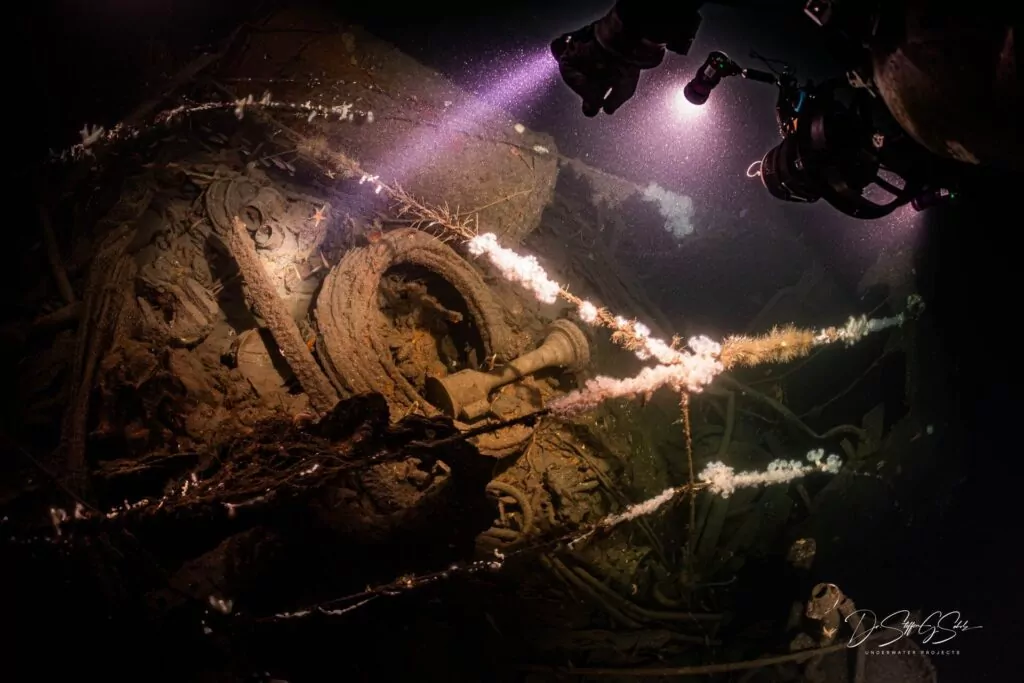
Timber decking remained in place astern and amidships, with davits lying across the deck and capstans and chains still in place. The 6in guns could be seen with unused munitions stacked beside them.
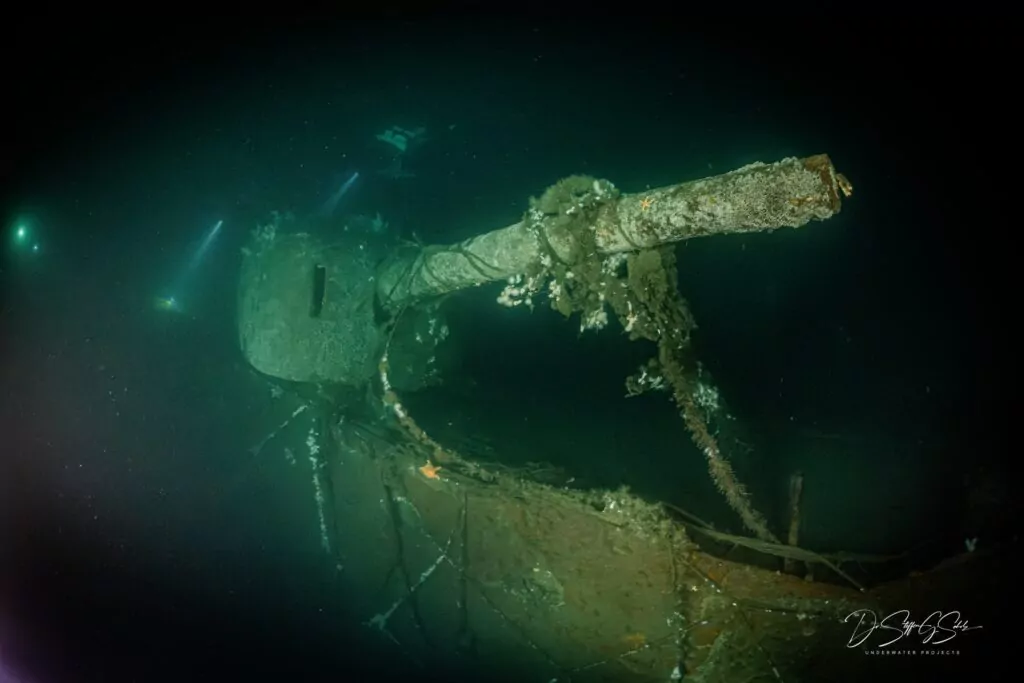
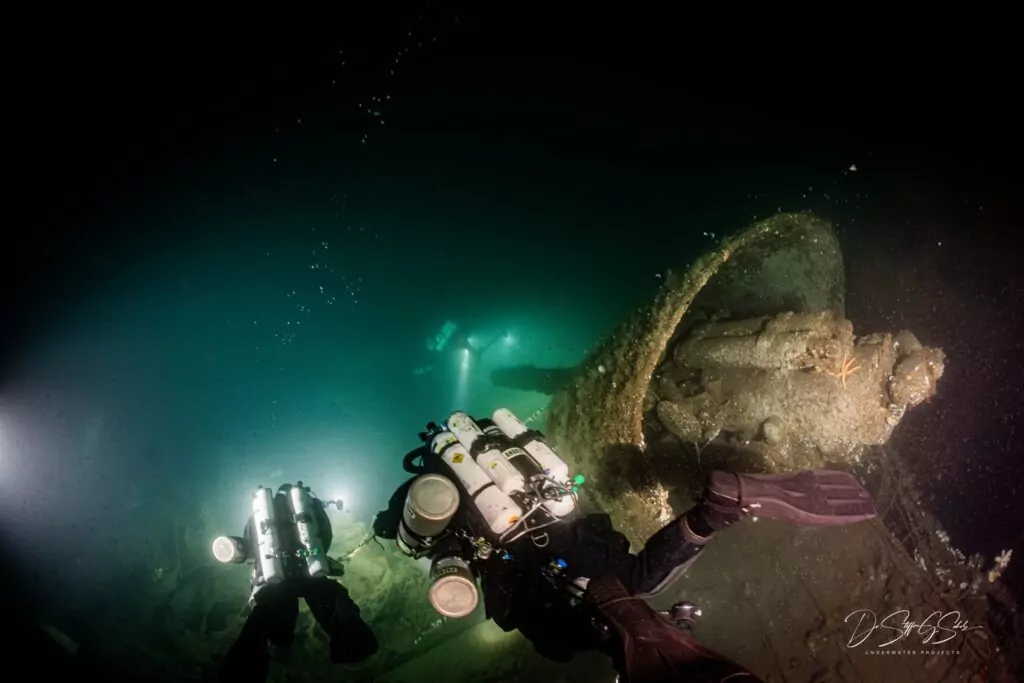

At the stern the three hawse-pipes could be seen, and a kedge anchor lay on the seabed with its chain extended. On the port side behind the bridge the divers came across white plates bearing a Royal Navy blue crown emblem and stern and sail motifs.
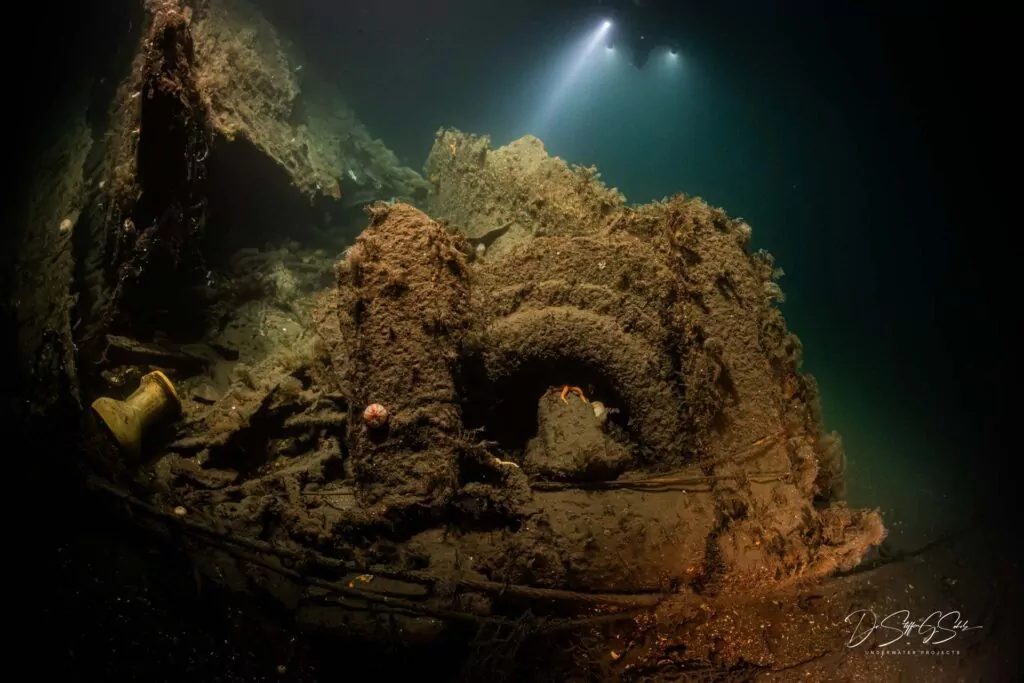

The bridge had fallen forward and to port, and the team were able to locate the engine-revolution telegraph in this area. The four funnels in their distinctive ‘Town’ configuration were also located.
Three torpedoes
A clear break forward of the bridge matched reports of the initial two explosions on the port side between watertight bulkheads that knocked out all the power on the ship.
Captain Charles Miller had been quick to shore up one of the bulkheads to keep the ship afloat and buy time for most of the crew to get clear.

A third torpedo had struck on the port side 25 minutes after the first two strikes, causing the ship to heel heavily to port and sink stern-first. Nottingham’s gunners had reportedly continued firing at U-52 until she sank.
“HMS Nottingham is without question the best-preserved ‘Town’-class cruiser in the world,” states the divers’ report. Most of the other vessels in the class had been sold off and broken up by the 1940s.
“Her state of preservation is testament to her robust construction, and the fact that the torpedoes struck a broadly similar area, as well as to the relative depth and undisturbed nature of the site.”
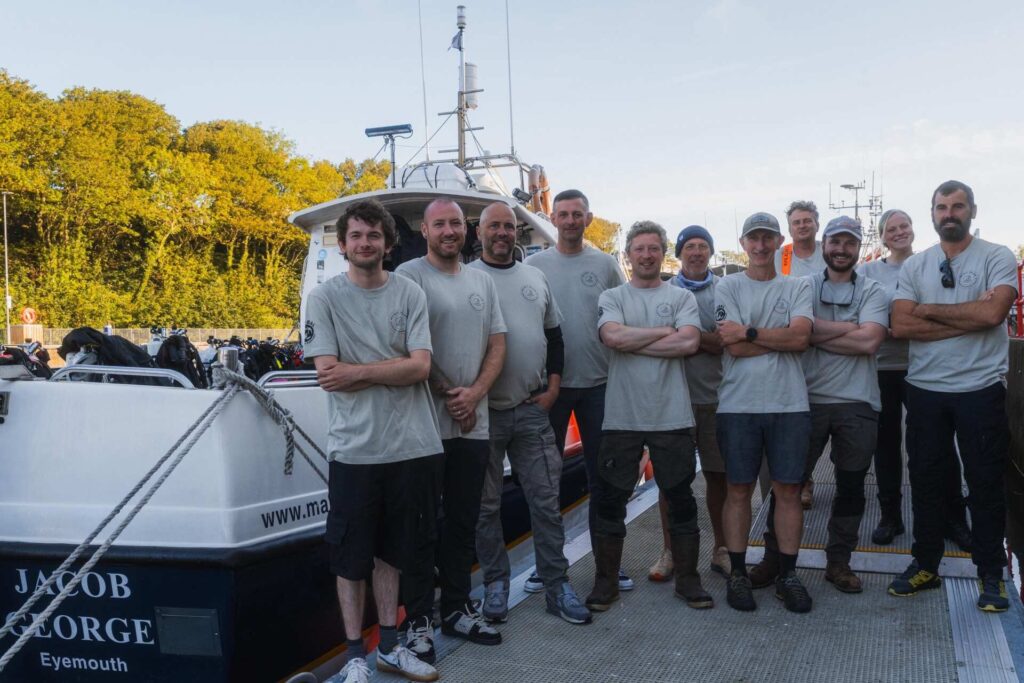
The project divers were Dan McMullen and Leo Fielding, who co-ordinated the project, Dominic Willis, Joe Colls-Burnett, Steffen Scholz, Joe Robinson, Alexandra Pischyna, Rogier Visser, James Sanderson and Andrzej Sidorow.
Fielding and McMullen have prepared a detailed report on the discovery, and the Royal Navy has been notified. Follow ProjectXplore on Instagram or Facebook.
Also on Divernet: WW2 Japanese destroyer wreck find rewrites history, Iconic WW2 cruiser’s bow found in Solomons, Dive-team finds notable WW1 warship at 110m, Destroyer wreck dive-quest in Brunei

Nope, we still have the Armoured Cruisers from the Battle of Coronel to be found. They are the HMS Good Hope and Monmouth.