Table of Contents:
Origins and Evolution
Appearance and Characteristics
Development and Life Cycle
Breeding Behaviour
Diet and Feeding
Predators and Survival
Life Span and Location
Fun Facts about Trumpetfish
- They can grow up to 80 cm (nearly a metre) in length, yet their bodies are barely wider than a finger.
- Their snout alone can account for up to a third of their total body length.
- They possess a tiny chin barbel, a fleshy filament under the jaw, whose exact function is still debated by scientists.
- They can change colour in seconds, cycling between vivid yellow, mottled brown, and blue-grey to match their surroundings.
- Their feeding strike takes less than five milliseconds; the mouth opens, and prey is sucked in before it can react.
- When resting among sea fans, they hover perfectly vertical, head-down, impersonating a coral branch.
- They belong to the same order as seahorses and pipefish, making them distant reef cousins.
- They are a year-round resident in Raja Ampat and spotted on virtually every reef dive in the archipelago.
Origins and Evolution
The trumpetfish belongs to the family Aulostomidae within Syngnathiformes, which also includes seahorses, pipefish, and cornetfish. This order has fused jaw bones forming a pipette-shaped snout, ideal for ambush predation.
Fossil evidence shows syngnathiform ancestors were prominent by the Eocene, around 50 million years ago. The modern genus Aulostomus, including trumpetfish, diversified more recently as reef systems expanded across the Indo-Pacific. Today, three species are recognized: the Atlantic trumpetfish, the Chinese trumpetfish of the Indo-Pacific (most likely seen in Raja Ampat), and a third in the Red Sea.
Appearance and Characteristics
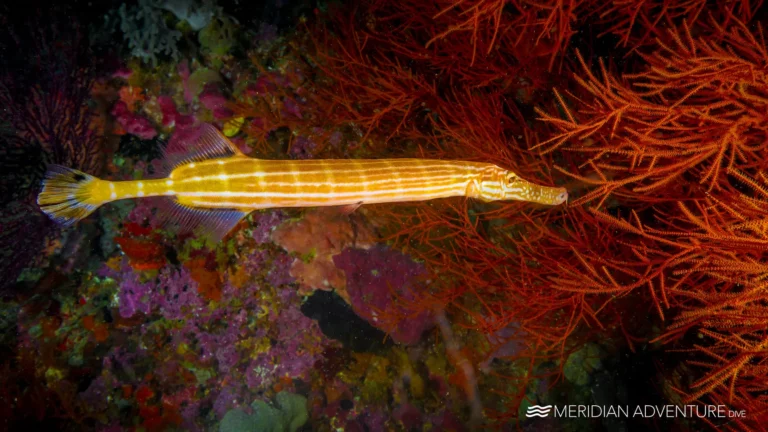
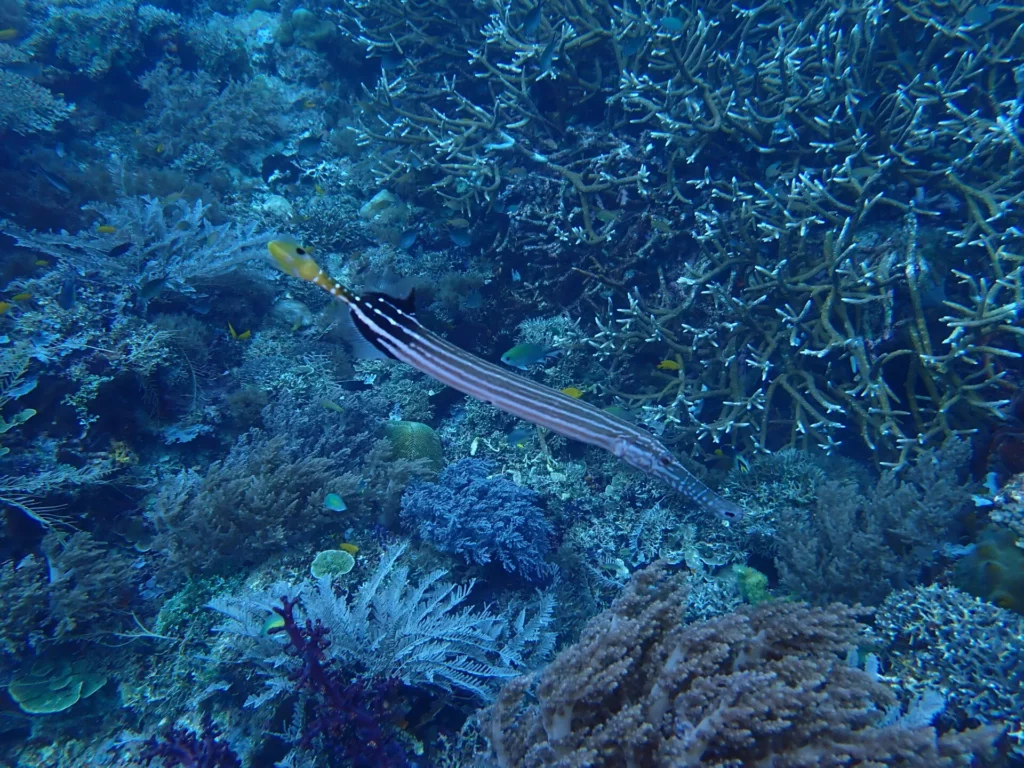
Trumpetfish are easily identified by their elongated, slender bodies and tubular snouts, reaching up to 80 cm in length. Their small mouths are located at the end of a long, trumpet-shaped snout, which they utilise to generate a quick suction to catch prey.
Their colouration varies widely, from green and yellow to brown or bluish hues, helping them blend into their environment. This colour-changing ability improves their camouflage, making them almost invisible to predators and prey.
A single chin barbel hangs beneath the lower jaw, its function debated. Dorsal spines are spike-like and widely spaced. The soft dorsal fin is far back near the tail, opposite the anal fin, aiding slow-speed control without revealing movements. Pectoral fins are small, paddle-shaped, mainly for precise hovering adjustments.
Development and Life Cycle
Like many reef fish, trumpetfish begin life as pelagic eggs released into the open water, where they drift within the plankton community.
Egg & Larva: Pelagic eggs hatch into larvae within a few days. Early larvae are transparent, with a disproportionately large head. They feed on zooplankton drifting in the water column.
Juvenile: As juveniles settle onto the reef, the characteristic elongated snout begins to develop. Juveniles are often pale brown or yellowish and prefer shallow seagrass beds and soft-coral zones where cover is abundant.
Sub-adults: Growing rapidly, sub-adults begin to practise shadow-riding and other hunting behaviours. Their colour flexibility becomes more noticeable as they expand their camouflage repertoire.
Adults: Fully grown adults are mostly solitary and highly territorial over their preferred hunting routes. They can reach high speeds in short bursts when attacking prey but tend to choose patience over pursuit.
Breeding Behaviour
Documentation on trumpetfish courtship behaviour is limited. Spawning is pelagic and broadcast: pairs or small groups ascend in the water column at dusk, releasing eggs and sperm simultaneously into the current. There is no nest construction and no parental care after spawning.
Spawning in tropical Indo-Pacific populations seems to happen throughout the year, potentially peaking in relation to lunar cycles and warm-water upwelling events. These events boost the planktonic food supply that larvae depend on during their initial weeks.
Diet and Feeding
Trumpetfish are carnivorous ambush predators that primarily feed on small fish and crustaceans. Their elongated snout acts like a precision pipette: when they open their mouths, a quick expansion of the buccal cavity causes a strong rush of water that pulls prey in before it has a chance to escape. This rapid strike, occurring in less than five milliseconds, is one of the fastest feeding movements observed in reef fish.
The shadow-riding technique is a remarkable feeding behaviour on reefs. The trumpetfish aligns with a large herbivore, such as a parrotfish, goatfish, or surgeonfish, and uses it as a visual shield. Prey that ignore these grazers don’t notice the threat until the trumpetfish strikes.
When shadow-riding isn’t possible, trumpetfish use their colour-change ability to mimic soft corals or sea fans, remaining motionless, sometimes vertical, until prey comes within range.
Predators and Survival
Despite its hunting skills, the trumpetfish falls prey to larger predators like grouper, sea bass, moray eels, and reef sharks on the Raja Ampat reef. Its elongated shape hampers quick escape, risking capture if spotted.
The primary defence strategy is therefore prevention rather than flight. Rapid colour-matching to the background helps resting trumpetfish avoid predators. The fish aligns vertically among sea fans or corals, mimics a coral branch, and blends into the reef. When threatened, trumpetfish can quickly sprint by undulating their dorsal and anal fins to hide among corals. Younger trumpetfish sometimes join mixed-species schools, using the confusion effect to reduce predation risk.
Life Span and Location
Precise lifespan data for wild trumpetfish is limited, but studies suggest they live 5–10 years under good conditions. They grow quickly in the first two years, reaching sexual maturity at 25–30 cm. Growth then slows as energy is used for reproduction.
At Raja Ampat dive sites such as Cape Kri, Sardine Reef, Blue Magic, and Mioskon, virtually every dive site has healthy coral. Trumpetfish are a year-round sight on nearly every reef dive. The archipelago’s rich coral, strong plankton-rich currents, and diverse reef communities offer ideal conditions: ample cover for ambush and many small fish and crustaceans for trumpetfish to feed on.
Website: https://raja.meridianadventuredive.com/
Meridian Adventure Dive Resort is a PADI 5-Star Eco and IDC Dive Resort situated in the heart of Raja Ampat. It provides expert-led diving at world-renowned sites with eco-friendly boats. The resort offers comfortable, air-conditioned accommodations, high-quality equipment, and outstanding hospitality, catering to divers of all levels in one of the world’s most biodiverse marine areas.
