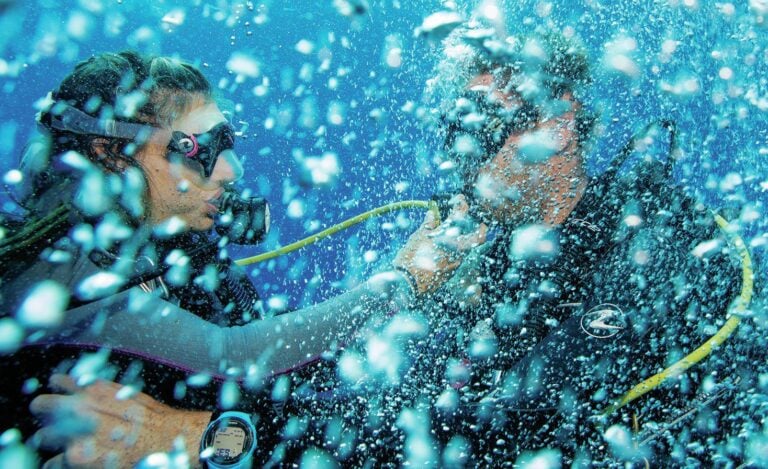
When his regulator hose burst during a dive, Rob not only lost his primary air source, he also was engulfed by a cloud of bubbles that made it nearly impossible to see or hear
I was on a 22-person dive boat off Pompano Beach, Florida, with Jan, my buddy-in-life and underwater adventures. Jan and I have more than 700 dives each; she is a Divemaster, and I am an instructor.
We descended onto the reef and moments later ,my regulator hose popped dramatically, splitting near the second-stage connector.
The rubber hose was severed almost completely, and breathing gas rushed out in a maelstrom of loud and blinding bubbles.
I was stunned by the sudden flood of bubbles, and my first thought was I’m not going to die today. I started grasping for my octopus but fumbled amid all the bubbles.
I keep my octopus on the right side of my BCD with a quickrelease clip, but it was a challenge to grab it while using my right hand to try to hold together the burst hose.
Bringing both hands back to the flailing regulator hose, I held it together, which seemed to direct just enough air into the second stage to allow me to draw a decent breath.
Though I couldn’t see her through the cloud of bubbles, Jan pushed her octopus into my hand. After dragging another quick breath out of my failing regulator, I successfully grasped Jan’s spare regulator and put it in my mouth.
The blizzard of bubbles still gushed violently from my burst hose. Amid the chaos I reminded myself to keep breathing.
I couldn’t see my wrist-mounted computer to monitor my depth or ascent rate, so I prepared for our ascent by making a point to exhale more than I inhaled. Jan and I began ascending, holding onto each other’s BCDs to stay together.
I kept breathing from her octopus instead of securing my own, as my cylinder was rapidly losing air.
I don’t know for sure how much time passed, but Jan and I broke the surface about 30 or 40 seconds later. She shut off my tank, and from 45 metres away the captain motored the boat over and asked why we were up so soon.
I held up my regulator, which was barely still attached to the rubber hose. Only a thread of rubber held them together. “My reg hose burst,” I said. While the captain swung the stern around to us, I took a quick inventory of my body. Thankfully nothing physical seemed out of the ordinary.
Lessons learned
Following this incident, I exchanged my octopus’ plastic quick-release clip for a rubber ring that loosely holds the mouthpiece for easy one-handed release. I also considered the value of a totally redundant air source such as a pony bottle or a side-slung tank and regulator.
Having a bailout bottle mounted on the front of my BCD within easy reach could have allowed me to resume breathing quicker.
Have your equipment serviced regularly and inspect your hoses often to be sure they’re not cracking, drying out or rotting around the metal connector.
Refresh your air-sharing skills from time to time while diving — it may not be as simple as you remember. My open-water training was 33 years ago, and that’s a long time to go without practicing sharing air.
Finally, I can’t overstate the value of a competent and well-trained buddy. Jan’s quick and calm offer of her octopus and guidance to the surface were lifesaving.
Thank goodness she and I have many hundreds of dives together, good awareness of each other underwater and the inclination to stay close while exploring the depths. Jan is the best buddy I’ve ever had the privilege to dive with.
For an extensive range of diving health and safety information and downloadable resources, research studies, incident summaries, and free e-Learning courses, take the time to explore DAN World’s new website.

This article was originally published in Scuba Diver ANZ #65
Subscribe today with promo code DIVE1 — enjoy 12 months for just £1!

I’m a bit surprised, once you had her octopus,that you didn’t get her (or she thought) to turn off your cylinder which would have stopped the cloud of bubbles. Was this just a case of not thinking of it under pressure or was that a decision for some reason?