UK-based charity the Shark Trust has chosen Shark Awareness Day (14 July) to announce the winners of its 2025 Shark Photographer of the Year competition.
Entries from 34 countries represented 76 of the 1,200 species of shark, ray, skate and chimera, and an exhibition of the finalists’ images will be on display for the remainder of the “Shark Month” of July in Plymouth, home of the Shark Trust.
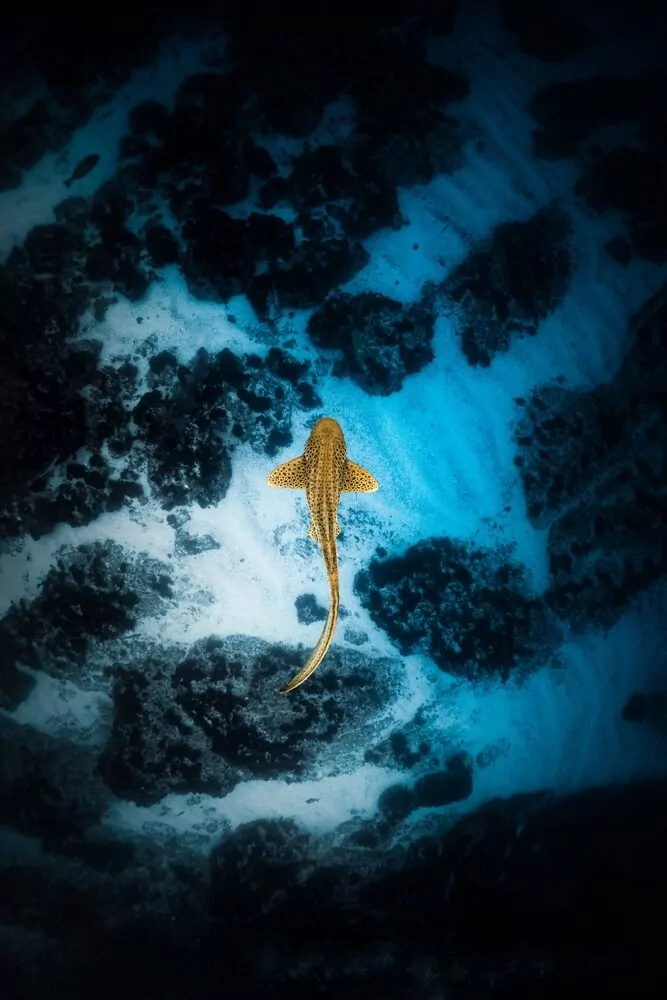
The Shark Photographer of the Year 2025 title went to Julian Hebenstreit for his shot of a leopard shark, taken at a popular dive-site off Byron Bay in New South Wales, Australia.
“I remember the stark contrast between the wild and uncomfortable outside and the calm and quiet world below the water,” he said of the image. “I was freediving that day, and the shark passed me at about 15m deep, which is when I decided to try and capture the beauty of this animal to the best of my ability.
“I selected this image because it reminds me why I do what I do… It’s not just about documenting wildlife; it’s about conveying the fragile beauty of the ocean in a way that makes people care.”
“This photograph is at first glance quite simple, but with a depth that rewards repeated views,” commented Simon Rogerson who, with Charles Hood and Nick Robertson-Brown, was one of the three judges.
“The golden form of the Indo-Pacific leopard shark stands in vivid contrast to the dark rock and the white sand. Placing it small in the frame creates a sense of drama rather than distance. For me, it suggests the precarious existence of our remaining sharks, this golden species representing treasure in dark times.”
Hebenstreit won a shark dive-and-stay package in the Bahamas from the islands’ tourism ministry and Diverse Travel, along with a trophy.
British Isles winner
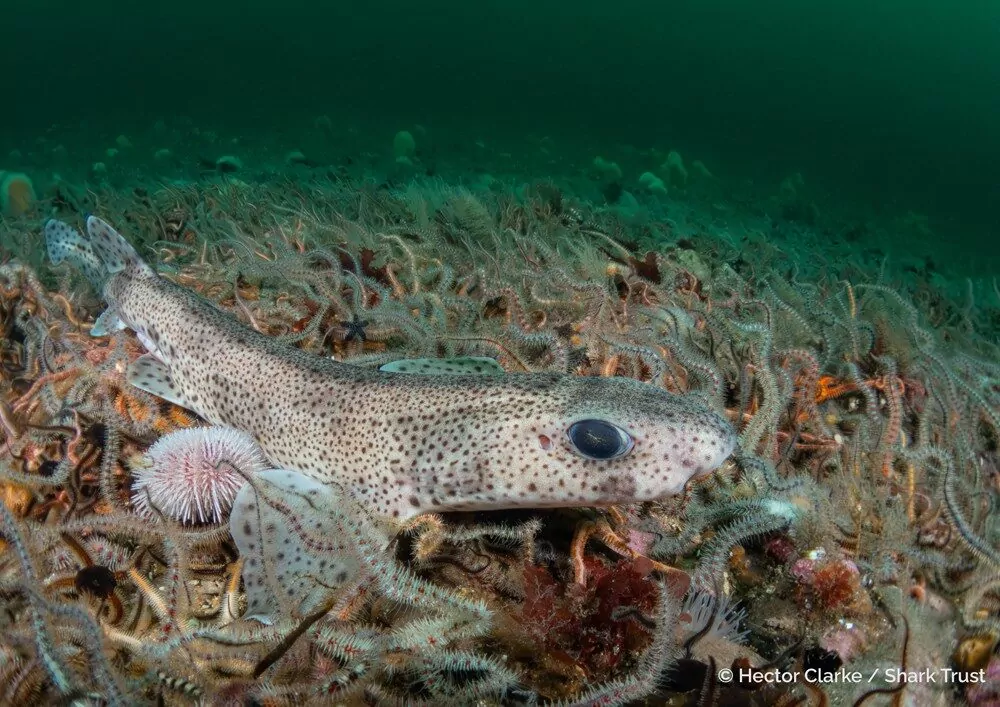
Hector Clarke topped the British Isles category with his photograph of a small spotter catshark lying on a mass of brittlestars at a depth of 20m in Loch Carron in Scotland.
“It seemed very comfortable with my presence, allowing me to get exceptionally close,” he said. “I like how this image captures the density and diversity of life in this area, all the way from the multi-coloured brittlestars to the exquisitely patterned catshark.”
The narrowing of the loch near its junction with the Atlantic forces huge amounts of nutrient-rich water through a small channel. “Despite the fierce tidal currents, these narrows are my favourite place in the UK to encounter small-spotted catsharks,” said Clarke.
Overseas winner
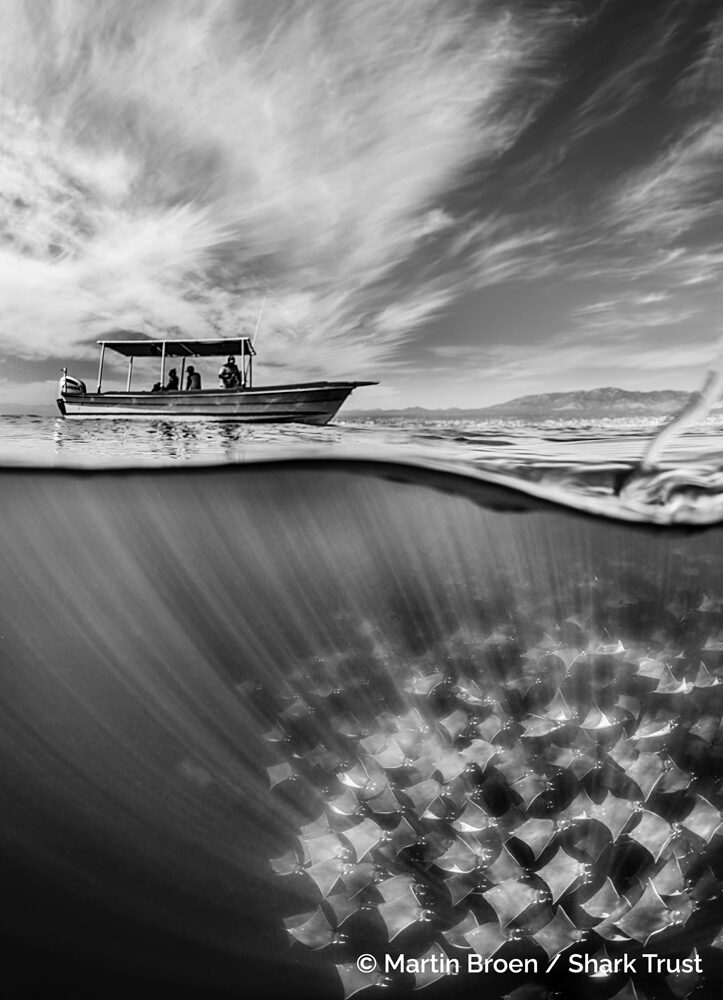
Clarke and Overseas category winner Martin Broen each won Mares dive-computers for their efforts. Broen’s mono split-shot depicts the mobula ray migration in Mexico.
Each year, thousands of the rays, known for their synchronized swimming and aerial leaps, gather in the nutrient-rich Gulf of California. The migration is regarded as a vital ecological event and, in recent years, conservation efforts have intensified to curb bycatch, protect critical habitats and regulate tourism practices.
“Below the surface, a dense school of rays forms a luminous, geometric ballet, their bodies catching shafts of sunlight filtering through the ocean,” was how Broen described his image. “Above, a small boat with observers floats quietly, a silent witness to one of nature’s most graceful spectacles.”
Oceanics Programme winner

The Shark Trust works globally to improve the conservation status of sharks, skates and rays and additional accolades were awarded to entries that closely aligned with its current projects.
Its Oceanics Programme targets the conservation of oceanic sharks and rays, which it describes as among the most iconic and functionally important species, yet exceptionally threatened by overfishing.
Byron Conway, who won this category with a shot of silky sharks at the surface in Cuba’s Jardines de la Reina national park, used a slow shutter-speed to get natural movement into the image.
“This also allowed me to use Snell’s window at sunset to burn in some beautiful colours from the sunset above and show the relationship these sharks have with the surface,” he said. “A memorable experience, among the best large animal encounters I have had.”
Living With Sharks winner

Living With Sharks is a new cross-disciplinary Shark Trust project that it says seeks to identify emerging issues and co-create equitable solutions with affected communities, focusing on beachgoers, recreational anglers and participants in shark and ray eco-tourism activities such as scuba diving or snorkelling.
The winning image, by Gillian Marsh, showed a blue shark far off the coast of Cornwall with an underwater photographer. The natural-light image was taken while snorkelling.
“The blue sharks were bold and curious, and we four snorkellers had a lot of good interactions with them, but I particularly like the interaction in this image,” she explaained. “It’s tempting to imagine the shark is asking the photographer: ‘Have you got my best side?’”
Mediterranean Programme winner
The Mediterranean Sea is home to nearly 80 shark and ray species of which at least 53% are at risk of extinction, says the Shark Trust. Surrounded by 22 countries across three continents and with more than 77,000 small boats, it is subject to a broad range of diverse fisheries pressures.
Working through a network of regional partners, the trust says that its Mediterranean Programme spans policy engagement, species-specific recovery programmes and community engagement.
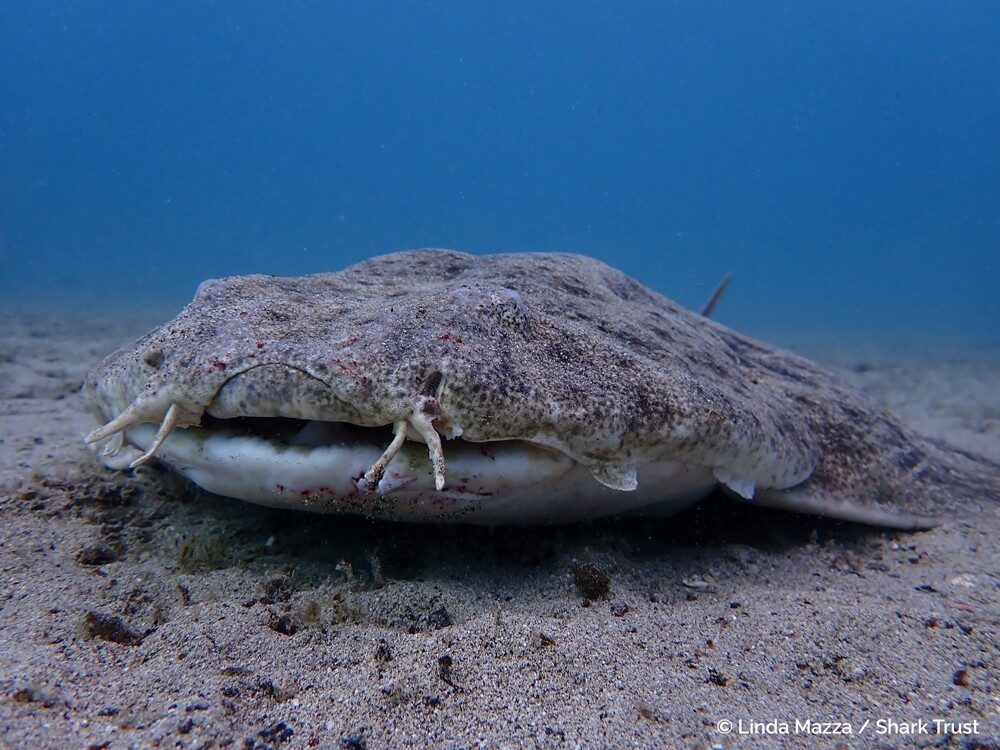
Category winner Linda Mazza did not in fact capture her image of a Critically Endangered catshark in the Mediterranean, because finding them there has become so difficult, but rightly gambled that making that point might impress the judges.
She found this specimen off a tiny island north of Lanzarote in the Canary Islands, and hoped that her raw portrayal would highlight both their vulnerability and their misunderstood nature.
“Living in the Canary Islands, I see angel sharks on most of my dives, but I had never been face-to-face with one like this. It was a truly special moment,” she explained.
“What I love about this photo is that it doesn’t capture the classic, angel-shaped silhouette most commonly seen – usually taken from above to show their unique markings, camouflage and evolutionary perfection. Instead, this is a close-up portrait, taken purely by chance.
“I was observing another shark when I suddenly found myself face-to-face with this one. Luckily, I had my camera ready. I quickly zoomed in and captured the moment before quietly moving away so as not to disturb it.
“The resulting image shows an unusual and perhaps less-flattering perspective. It reveals the flattened head, eyes, slightly open mouth, barbels and skin texture in vivid detail – even the wounds and imperfections.
“For me, this photo breaks the usual barrier between viewer and shark. It creates an unexpected intimacy. At that moment, I felt incredibly privileged – I could sense the shark’s sentience and quiet expressiveness.”
The Great Eggcase Hunt winner
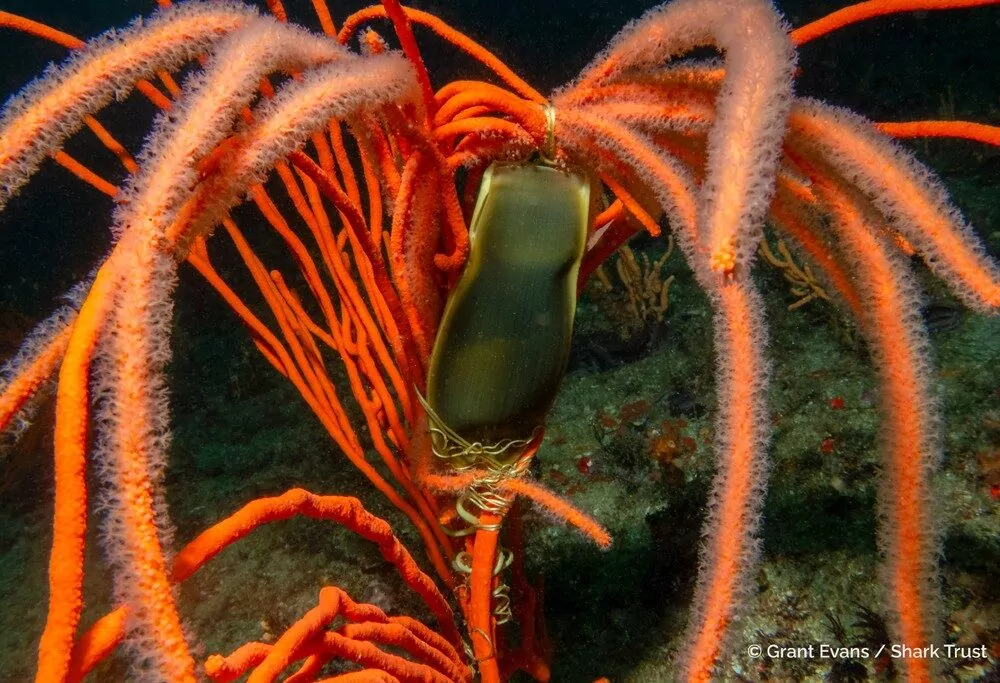
The Great Eggcase Hunt is the Shark Trust’s flagship citizen-science project, calling on people’s vigilance as they walk on beaches around the world and also, critically, divers and snorkellers looking out for live, developing eggcases under water.
Grant Evans shot this pyjama shark eggcase wrapped around a seafan in Cape Town, South Africa on the wreck of the HMSAS Pietermaritzburg, a warship scuttled in False Bay in 1994 as an artificial reef.
“I took this picture as I found it a curious sight, and it is important to acknowledge the sharks’ life stages before it is a fully formed shark that is so often seen gliding through the nearby kelp forests,” he said.
“It also highlights the importance of the sea floor for these animals, as they need these seafans to secure their eggcases safely. Bottom-trawling threatens these corals and the egg-depositing sites of catsharks in South Africa.”
Young Shark Photographer Of The Year winner
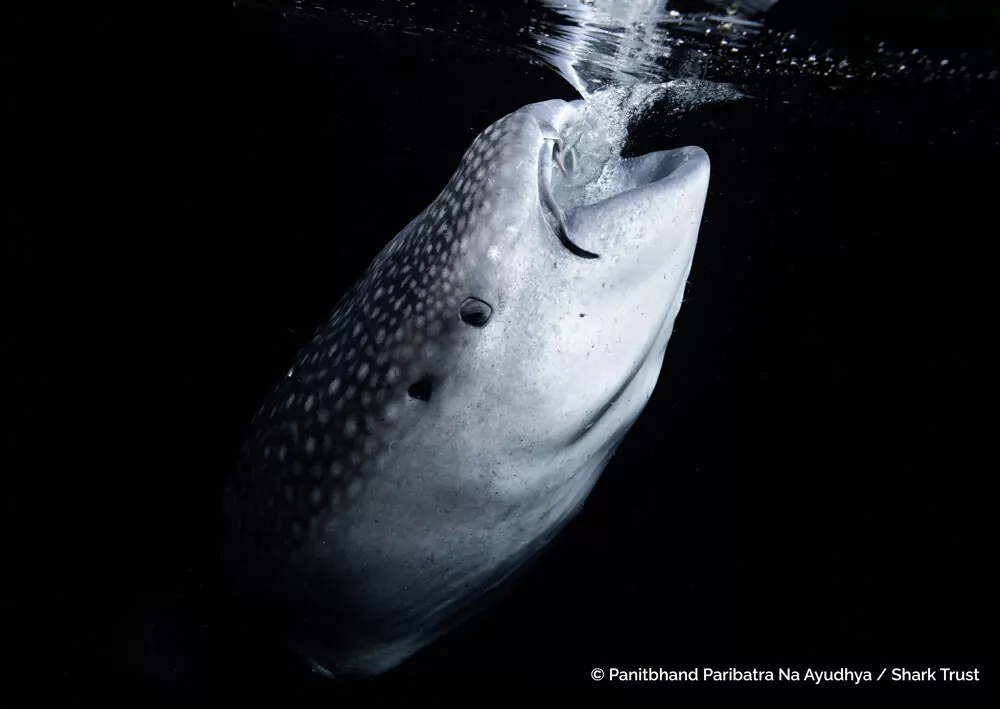
Finally, the Young Shark Photographer of the Year 2025 title was awarded to 14-year-old Panitbhand Paribatra Na Ayudhya for an image of a whale shark feeding at the surface in the Maldives earlier this year.
This was Panitbhand’s first encounter with the species: ”I was very excited to see with my own eyes the largest fish in the world feeding on some of the smallest living creatures in the ocean. For me, enjoying this moment is not all there is; we must take action to help ensure these incredible, gentle giants of the sea survive.
“I believe that together we can help whale sharks live and swim freely in their ocean home, allowing them to share this planet with us for years to come.”
These winning photographs along with runner-up and Highly Commended entries can be seen online at the Shark Trust site, while the free print exhibition remains at Ocean Studios in Plymouth’s Royal William Yard until 31 July.
The images will be used to support shark and ray conservation efforts “for years to come”, says the charity.
Also on Divernet: GREAT SHARK SNAPSHOT MEETS SHARK WEEK + JAWS, SHARK TRUST LAUNCHES FREE-ENTRY PHOTO CONTEST, DIVERSE TRAVEL BECOMES SHARK TRUST PATRON