In the concluding part of his series looking at challenging extreme underwater filming, Andy Torbet recalls lighting the HMHS Britannic with with submersibles, tackling cold waters, complex lighting, and multi-person setups in Ojamo Mine and much more.-cold/time/people needed to to light the space, France (Cat) – Only 2.
First Cave and Mine Filming Experiences
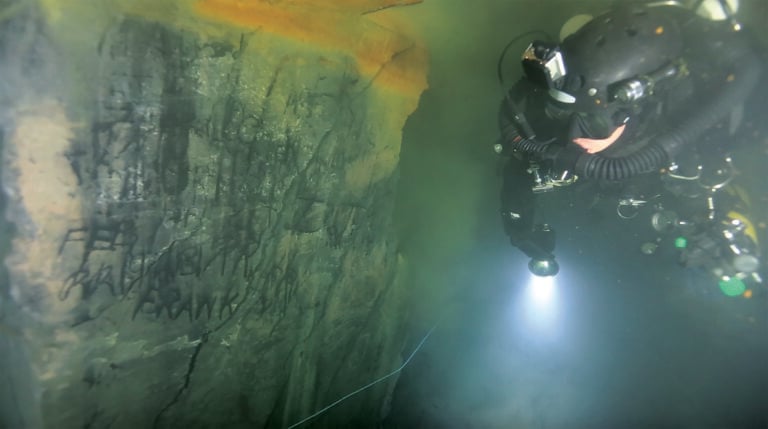
The first significant piece of filming I did in a real cave-diving situation was back in 2013. The BBC had asked me to dive a partially explored (some of it by me on solo projects) flooded mine system near Llangollen in Wales. We were using the dive to film some of the artefacts, machinery and even graffiti left by the miners in the late-1930s before the mine was closed, the pumps disabled and the lower levels flooded. The diving footage would become a vehicle to look at pre-World War Two mining in Britain and the decline of the industry nationally.
In these situations you can’t follow the usual practices for media diving operations. Careful consideration had to be given to the personnel, where we’d site them and what equipment we’d use to both capture the footage we needed in the single, two-hour dive we had and to make sure we were safe and adhered to all the Health and Safety At Work criteria.

It’s often more complicated doing these types of dives for work than recreationally as there is a duty of care over everyone being employed. You’re there to get the right shots but it’s more important that no one gets injured or killed. After all, and I’ve had to remind people of this in the past, it’s only telly and it’s just not worth dying for.
In cave diving, sometimes less is more, and inserting extra divers into a confined space is not necessarily safer. The cameraman, Rich Stevenson, and I have been cave-diving and filming together for years so we work well as a buddy pair. It helps, when you only have one dive to capture all the footage in some testing conditions, to be in tune with your partner. And these were testing conditions. The depth was only 30m so we were only using air as our diluent gas on our rebreather. We chose to use rebreathers as they’d not only give us maximum filming time on our one-and-only dive but also the lack of bubbles was an advantage.
There have been cases where the bubbles from the exhaled breath of a diver on scuba has caused the fragile roof of a mine, supported by the relatively dense water, to collapse. The visibility was generally good and the water was a balmy 9 degrees C.
Lighting Challenges in Caves and Mines
But in the absolute darkness the biggest problem we had was light. In the utter blackness of a cave or mine, it is easy to bring a torch or three, but when filming it can be difficult to deal with the extreme contrast of the bright light against the utter dark.
Even the best camera can’t deal with contrasts in light as well as the human eye, but by dropping lights in specific places, me keeping my personal torch on the lowest setting and Rich using two specialised underwater filming lights with extremely wide beams on a low power setting we – and by we, I really mean he – managed to pull off some stunning images.
The images were augmented by GoPros mounted on my helmet and wrist. When you are constrained to a single dive and only one cameraman, you need to take every opportunity to grab footage, even if some of it is relatively low quality.
Multi-Person Operations and Technical Dive Filming
Since that first cave-diving filming dive, we’ve shot a huge amount of material underground both in the UK and abroad. But one of the most intense and technical shoots was for an independent sci-fi short called Dive Odyssey. The film itself is a beautiful, cinematic experience and available. It was the brainchild of Janne Suhonen and was shot in Finland.
Although the closing scenes were all done in a nice warm swimming pool in Helsinki, the main action was shot deep in Ojamo Mine at Hell’s Gate and Lucifer’s Pillar.
Unlike the dive in Llangollen, this was a big team operation. At one time we had two ‘actors’, myself and Gemma Smith, two cameramen, and as many as seven support divers carrying equipment and lights to illuminate the huge underwater scenes.

Hell’s Gate is the entrance through the megalithic concrete wall built by the miners to support the roof. As they burrowed beneath the earth, they realised they had under-mined the lake above and the roof would need supporting in order to prevent a catastrophic breakthrough of lake water.
The wall stretches across a huge chamber, cutting it in two and is over 16 metres high. Through Hell’s Gate and down deeper into the mine lies Lucifer’s Pillar, a gigantic concrete column designed to support the roof and prevent the same disasters as Hell’s Gate.
The problem with illuminating these locations were not simply the darkness but the vast spaces in which it existed. Often the problem with lighting a tight limestone cave is the torch-beam bounces off the white walls and over-lights become hard to manage, blowing out the shot and making certain parts over-exposed.

We had the opposite problem, which is why such a large crew of divers were required. So before each dive Janne would go through a long, detailed and often necessarily complicated brief to ensure every one of the team knew where they had to be, where their lights had to be pointed and on which power setting there lights had to be.
Even myself and Gemma carried two torches to self-light or, if only one of us was required for the scene, act as another ‘underwater light stand’.
It was difficult but engaging work to take part in and watch as the team tried to ensure all the areas were lit correctly, some with just a hint of shadow and others in more detail, and the main focus of the action, usually the ‘actors’, were fully lit to ensure that was where the viewer was focused on. The results were spectacular, and the full film can be viewed at: ?????????????
Deep Wreck Filming: HMHS Britannic
Of course, the necessity to overcome darkness in technical diving doesn’t only come when you enter the subterranean world. Sometimes submerging beneath the surface is all you have to do… provided you go deep enough.
In 2016 we produced a documentary for BBC2 to mark the 100th anniversary of the sinking of HMHS Britannic, twin sister of Titanic and seconded into service as a hospital ship in World War One. The wreck lies, beautifully preserved and almost entirely intact apart from some damage near the bow where she struck a German sea-mine, 120m below the surface of the Aegean Sea. We dived the Britannic near midday on a bright, cloudless day typical of Greece in the summer.


We stepped off our palatial research vessel and dropped into the azure blue. But as we drifted down, freefalling through the water column, the abundance of natural light diminished. But the combination of the clarity of the water, with almost 30 metres visibility, and the over-head sun meant we could easily make out the shipwreck as we touched down on her port side. But this ambient light, although sufficient to navigate the remains of this giant vessel as she stretched out almost 300 metres in length, was not enough to discern the details, colours and textures we need to film.
We had known this would be the case and Evan Kovacs, the cameraman on this trip, had mounted huge, twin filming lamps to his camera. But we had another ace in the hole. To be able to light up huge sections of the ship, to really capture the vast metallic landscape, we need to floodlight whole areas.
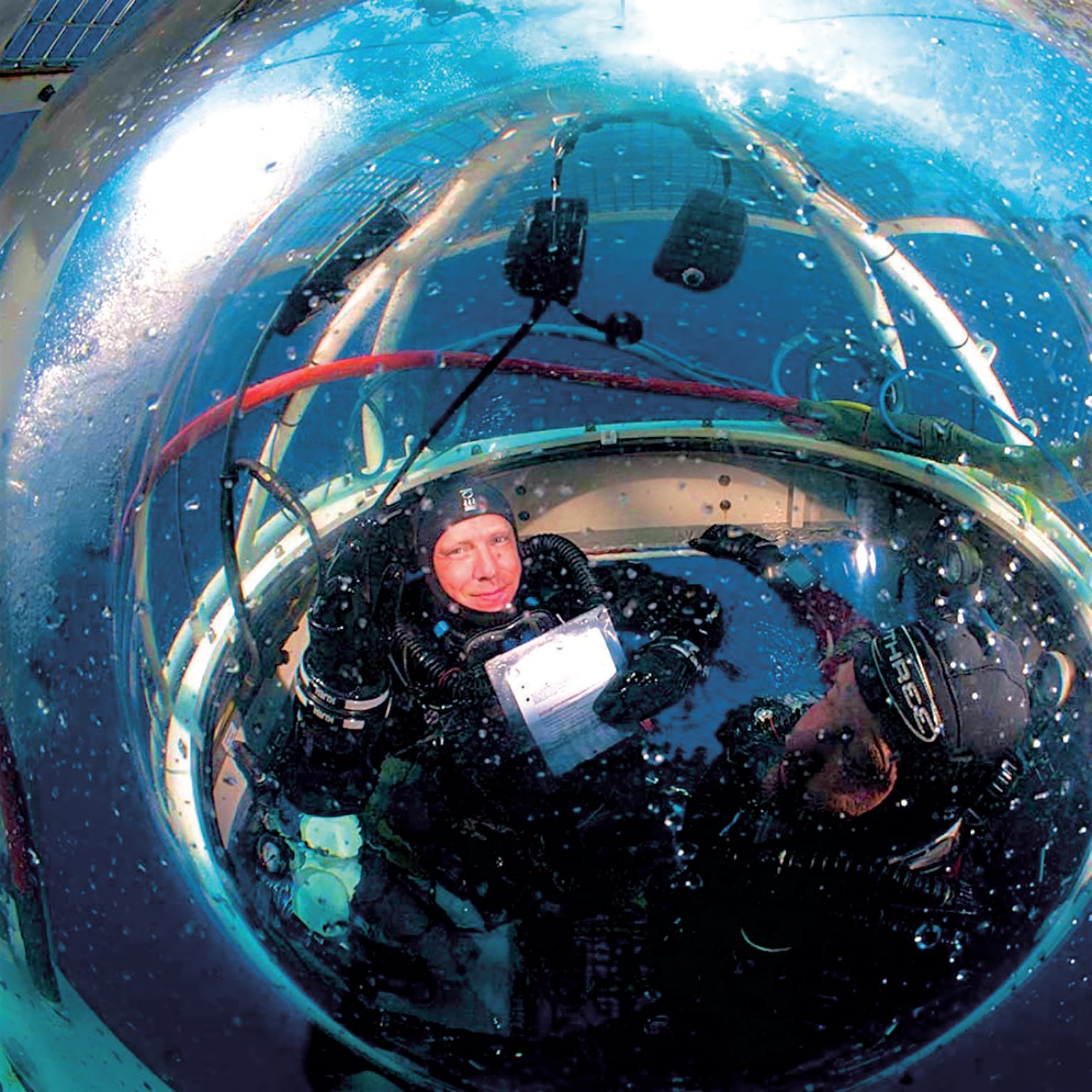
Fortunately, our dive boat was better equipped than any I’d ever been on. The crew deployed a large ROV and a three-man submersible, the latter of which had huge flood-lights, to illuminate panoramic shots of the ship with the tiny divers among the wreckage to give true scale to the scene.
There is a lot to think about when deep diving or cave diving. Add to this the tasks of operating a camera, lights, presenting to camera underwater, keeping track of shot lists and scripts, improvising shots and scripts if the situation underwater is not as expected or something interesting happens, and you have a lot to think about.
But you are there to do a job, the diving is merely the vehicle to get you to your place of work. But when that place of work is in darkness, the job becomes all the more necessary and often the lighting plan, regardless of how technical and difficult the diving may appear, will become the most in-depth part of the brief. If you can’t come back with the right shots, then there was no point going in the first place.
“In the utter blackness of a cave or mine, it is easy to bring a torch or three, but when filming it can be difficult to deal with the extreme contrast of the bright light against the utter dark”
“If you can’t come back with the right shots, then there was no point going in the first place”
FAQs
What are the biggest challenges in extreme underwater filming?
Darkness, confined spaces, and extreme light contrasts make filming in caves, mines, and deep wrecks technically demanding.
How do divers light caves and mines for filming?
Divers use low-power wide-beam lights, helmet-mounted GoPros, and carefully positioned torches to manage shadows and prevent overexposure.
Why are rebreathers important for technical dive filming?
Rebreathers reduce bubbles, extend dive time, and avoid disturbing fragile cave or mine structures, ensuring both safety and shot quality.
How is large wreck filming achieved underwater?
Floodlights from ROVs and submersibles illuminate vast sections, allowing cameras to capture scale, color, and detail alongside divers.
What safety measures are critical during underwater filming?
Clear dive plans, proper crew positioning, risk assessments, and adherence to health and safety standards are essential in confined or deep dives.
Can natural light be enough for filming underwater?
While ambient light can help in shallow, clear water, artificial lighting is needed for deep wrecks, caves, or mine systems to capture colors and textures.
Subscribe today with promo code DIVE1 — enjoy 12 months for just £1!