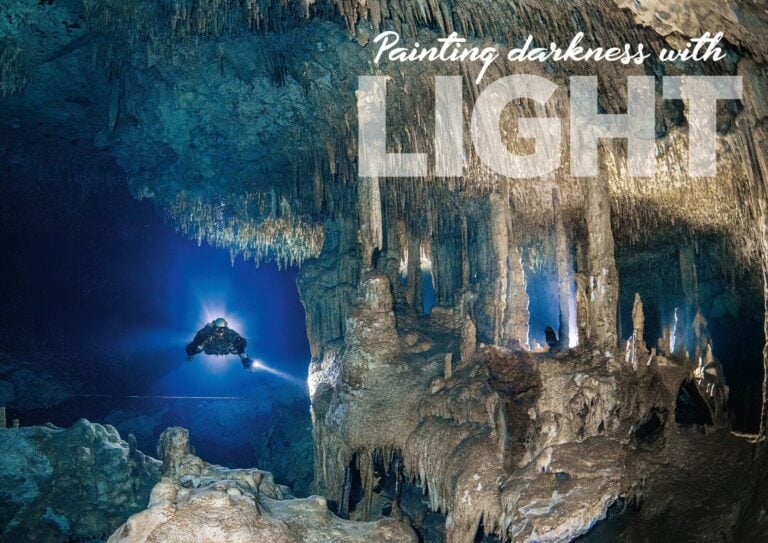
Kerrie Burow travels to Mexico’s Yucatan Peninsula for the 2023 Under the Jungle cave photography workshop
Photographs by Kerrie Burow
Beneath the Yucatan Peninsula in Mexico lies an intricate network of underwater caves, a realm of hidden beauty that attracts cave divers from around the globe.
Under the Jungle is a dive shop and training centre nestled in the heart of the Riviera Maya on the eastern side of the Yucatan Peninsula. It’s become a go-to centre for cave diving training, cave guiding, citizen science, exploration and the annual Under the Jungle cave photography workshop.
In May 2023, I travelled to Mexico for the 2023 Under the Jungle cave photography workshop, and also signed up for pre-workshop skills refinement in the week before.
The Under the Jungle Photography Workshop
Over the last couple of years, I’ve been focused on improving my cave diving skills. I’ve also been keen to improve my cave photography and, along with travelling to Mount Gambier, South Australia, quite a number of times to dive, I’ve also attended cave photography workshops in Italy and France.
I’ve found that these workshops have been an excellent way for me to be introduced to the local caves by the divers who dive them frequently and photograph them the best – as well as a chance to improve my own cave diving and cave images.
When I heard about the 2023 Under the Jungle Workshop, being led by Natalie Gibb, I jumped at the chance to both dive the Mexican caves and learn cave photography from one of the best in the business.
Along with signing up to the week-long main workshop, I committed to arriving a week early so I could do a number of days of one-on-one dives with Natalie, a renowned cave diving instructor and explorer who not only imparts expert training, but also captures the enchantment of cave diving through her unique photography.
I wanted to hone my cave diving skills, get used to the local cylinders, and work on photography skills specific to cave diving photography with the intention of being ready to hit the water running for the main workshop.
Under the Jungle and Natalie Gibb
Natalie Gibb’s list of accomplishments in the diving industry are extraordinary: she’s a TDI Instructor Trainer and cave and sidemount instructor, she’s co-owner of Under the Jungle with exploration partner Vincent Rouquette-Cathala, she’s one of the most-renowned cave diving explorers in the world and a 2022 inductee into the Women Divers Hall of Fame (WDHOF).
As well as her cave diving accomplishments, Natalie’s growing contributions to cave diving photography cannot be understated. Her images illuminate the hidden world found deep within underwater caves. One of the moststriking aspects of her photography is the sense of depth and ambience she captures.
The caves she explores are a challenging environment to photograph, but her photos manage to convey both the serenity and the haunting beauty of these spaces.
Being a relatively new cave diver, I was eager to soak up as much knowledge and skills as possible from this master of light and shadows. After a long journey from Sydney, Australia, I arrived at my villa accommodation in Puerto Aventuras – just a five-minute drive from Under the Jungle – eager to start diving.
Did you know?
As most cave diving is done in an environment where there is no free surface with breathable air allowing an above-water exit, it is critically important to ensure the use of a continuous guideline between the dive team and the point of entry.
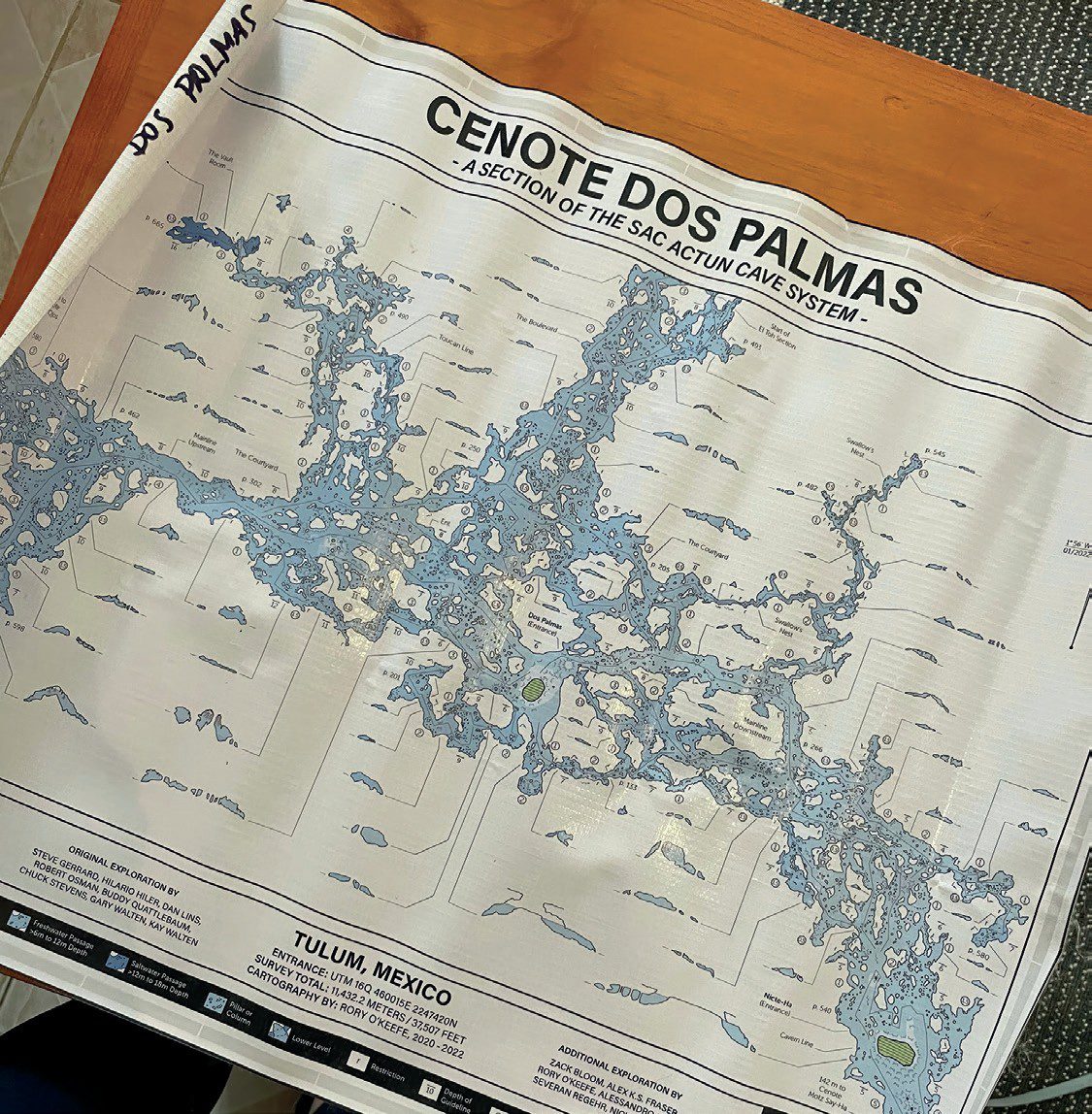
Safety first
The immediate focus of our training was on safety with the ultimate goal being to explore the Yucatan caverns and caves with confidence while minimising risks.
We planned to review dive planning (including gas management), line laying, protocols in Mexico, emergency procedures and skills specific to taking photographs in the caves.
Natalie and I started out on day one with a ‘shake down’ dive – or a ‘test run’ – in Cenote Jardin Del Eden (also known as Cenote Ponderosa), a stunning lagoon with crystal-clear waters, nestled amid a dense rainforest which also provides access to a large cavern system.
The shake down dive was a chance for me to test my equipment to see if it was functioning well after the flights from Australia, and it was also a chance for Natalie to assess my diving skills before we ventured into overhead environments.
After performing a number of drills and skills to Natalie’s satisfaction – including various finning techniques, emergency gas shutdowns and out of gas donations I was ready for my first cavern dive in Mexico! Ponderosa, with it’s incredible light display of diffraction appearing at the cavern end of the cave line, did not disappoint!
We followed up our day in the water with some theory back at Under the Jungle, a review of navigation pitched at my level of qualification (including jumps, Ts and gaps scenarios) as well as problem and emergency situation management.
Cave diving protocols can differ depending on the country where you’re diving, and this was an excellent way for me to quickly get up to speed with what was accepted in Mexico compared to the training I’d completed in other countries.
It was a very satisfying first day, and I returned to my accommodation that night buzzing at the thought of all of the other beautiful caverns and caves I would be diving during the rest of my stay in the Yucatan.

Building skills
Over the following week, I dived in a number of beautiful caves under the one-on-one tutelage of Natalie and later her instructor Lilia Cabrera Gallaga. We covered a combination of theoretical knowledge and practical skills, which enabled me to explore the local caves with increasing confidence while minimising risks.
The instructors’ expertise in technical knowledge about the specific caves we dived shone through as well as their insights into psychological aspects of cave diving, ensuring I was mentally prepared for the Under the Jungle cave photography workshop the following week.
Painting darkness with light
Diving with such experienced instructors (and photographers) in Mexico not only provided guidance on the cave systems but also offered insights into the best photographic opportunities and techniques in the caves we dived – each a very unique underwater space.
Cave diving photography presents a unique set of challenges and rewards. The interplay between the cave’s darkness and artificial lighting creates a setting that can transform ordinary scenes into mesmerising images.
To capture these moments, photographers must utilise both their technical skills and photography intuition. Solid buoyancy control is essential, and a single errant fin kick can stir up silt, obliterating visibility in seconds and/or destroy decorations which have been in the caves for thousands of years.
The placing of offboard lights around the cave to light it up without disturbing the environment, in spaces where every slight movement counts, requires total concentration and care. Distraction is a cave diver’s worst enemy.
Focusing on the perfect shot can lead photographers to lose track of air consumption, guidelines, or their spatial orientation – your own safety and that of the team you’re diving with is more important than any photograph.
Exploring and photographing the Mexican caves comes with a responsibility to preserve and protect these delicate ecosystems. Cave divers and underwater photographers are custodians of these hidden caves, and we have a responsibility to advocate for their conservation and sustainability.
Sticking to ethical diving practices ensures minimal impact on the fragile cave decorations and ensures those who dive them after us can also experience their beauty.

Conclusion
Improving my cave diving skills for underwater photography at Under the Jungle was a very satisfying endeavour and exceeded my expectations. I was able to combine the excitement of cave diving with the artistry of capturing images under the guidance of expert instructors.
It was an incredible opportunity to refine my own technical and photographic skills before starting the main Under the Jungle Workshop, which proved equally fulfilling. I now find I’m counting the months down to my next trip to cave dive in Mexico.

How to get there
The Under the Jungle Workshop has been held annually for the past few years. Under the Jungle is situated about a 50-minute drive from Cancun International Airport. I got there by flying from Sydney to San Francisco, where I jumped on a connecting flight to Cancun.
FAQ
What is the Under the Jungle workshop?
It’s an annual photography and training event in Mexico’s Yucatán, focused on cave diving skills and cave photography techniques.
Where is Under the Jungle located?
The dive centre is based in Puerto Aventuras, Riviera Maya, about 50 minutes from Cancun International Airport.
Who leads the workshop?
Renowned cave explorer and photographer Natalie Gibb, co-owner of Under the Jungle, alongside experienced instructors.
Do I need to be an experienced cave diver to join?
Participants benefit most with some cave diving background, but pre-workshop training is available to refine skills before the main event.


We design, manufacture and retail scuba and rebreather equipment. We have fully equipped test and certification labs, and can pressure test large items in our vacuum chambers, as well as run fully automated leak test and dive simulations down to 400m. Our EMC and EMF lab is filled with state-ofthe-art equipment for testing electromagnetic compatibility and electromagnetic fields. We also have a large in-house laser for cutting and engraving on plastics and metals. www.narkedat90.com
This article was originally published in Scuba Diver UK #80
Subscribe today with promo code DIVE1 — enjoy 12 months for just £1!