
Having found your wreck, you now need to identify and name the individual elements. JOHN LIDDIARD provides the ultimate guide
Introduction to Shipwreck Identification
What do you remember most readily, that ‘pile of plates with round blobs under it’ or ‘the upside-down winch with a mast fallen across’? By recognising and putting a name to bits of wreckage as you swim past, it is easier to remember what you have passed and later to retrace your route to the shotline. This is just applying a standard memory trick to diving.
By identifying individual elements of a wreck and relating them to the ship’s overall layout, you can orient yourself underwater and make educated guesses about your location. If you identify an anchor winch, you will know you’re close to the bow. If you identify a propeller shaft, you will know that the stern—and possibly the propeller and engine—are at the other end. Understanding these parts not only helps you navigate underwater but also contributes to accurately determining the wreck’s identity, which is a key part of maritime archaeology.
For more in-depth guidance on wreck identification and ship archaeology, see the Nautical Archaeology Society.
Bow and Anchor Features

Bow: The bow is wedge shaped, tapered to the front and also from top to bottom. It is much stronger than the rest of the hull, often reinforced with extra ribs bracing the inside. Often the bow of a wreck has broken from the rest of the hull, falling forward and to one side.
Anchors: Most ships have two anchors, one on each side of the bow. Some ships, particularly warships, also have a stern anchor.
Hawse pipes: Steel tubes through which the anchor chains run from the deck to the side of the bow. This derives historically from wooden ships fitted with an iron pipe to prevent the hawse, or rope, damaging the timber. Hawse pipes sometimes cross inside the bow, so that the port anchor chain leads to the starboard side of the winch, and vice-versa. Even when the rest of the bow has disintegrated, it is not unusual to find anchors still in their hawse pipes, with chains leading to the anchor winch.
Anchor winch: A large winch on the bow deck, with anchor chains running across either end. On some ships, particularly warships, the winch and hawse pipes might be below the deck. A variation is for a pair of capstans (vertically mounted winches), again more common on warships.
Fo’c’s’le: A raised area of the bow above the main deck. The crew’s quarters would traditionally be in the fo’c’s’le (or forecastle), while officers would be quartered amidships and at the stern. Also often found in the fo’c’s’le is the rigging store (ropes) and carpenter’s store (tools, paint).
Chain locker: A compartment located in the fo’c’s’le below and behind the anchor winch, into which the anchor chains are wound.
Bell: A bell will be engraved with the ship’s name, so is a source of identification. There is no standard location, but bells would often be mounted on the back of the fo’c’s’le or on the front of the wheelhouse. They are unlikely to be in place, but might be among the debris below these locations.

Bollards: Round steel blocks found in pairs on either side of the bow and stern, used to secure mooring lines. Additional bollards may be located alongside the holds, just forward and aft of the amidships superstructure. Pairs of bollards are mounted on thick steel plates and are consequently found together even after the rest of the wreck is just a pile of scrap.
Decks, Holds, and Machinery
Keel: The centre line along the bottom of the hull, the strongest part of the hull. Even on a completely flattened wreck, the line of the keel can provide a useful clue for navigation.
Hold: The top of a hold is surrounded by a steel surround or coaming, to keep water from entering. The hold will run all the way to the bottom of the ship, possibly with decks surrounding the central shaft. When a wreck has collapsed, the hold surrounds are often intact and show where the holds once were.
‘Tween deck: A deck below the main deck, often running between holds without watertight bulkheads. For divers, a possible route to swim through between holds.
Bulkheads: These are vertical walls across a ship, separating the holds and the other compartments.
Mast: Used to support derricks.
Derrick: A boom hinged to the bottom of a mast to create a simple crane for loading and unloading cargo. Masts and derricks will often be found fallen across or into holds.
Mast foot: A supporting structure for a mast, this can extend below the main deck, possibly even down to the keel of the ship.
Cargo winch: Used with derricks for loading and unloading cargo, this is located close to the foot of masts. Powered by a small auxiliary steam engine or a hydraulic or electric motor which forms part of the winch structure. Once the wood has gone and the upper decks have collapsed, winches can often be found upside-down among the debris, partly hidden beneath their bases.
Coal bunker/fuel tank: Located either across the ship in front of the stoke hold, or along either side of the stoke hold. Often identifiable by scraps of coal among the debris (though bear in mind that coal could have been the cargo). Coal would typically be loaded through hatches in the superstructure, or just forward of it.
Stoke hold: The location of the boilers and an area just forward where the stokers would work, shovelling coal from the bunkers into the fireboxes of the boilers.
Boiler: A big round cylinder filled with tubes, used to heat water to steam and power the ship’s engine, typically several metres in diameter. Boilers often roll or fall from their mounts. Bear in mind that they will roll sideways and downhill from their original location. Even on an upright wreck, the boilers might float clear of their mounts because of trapped air, then come to rest tipped upright on one end.
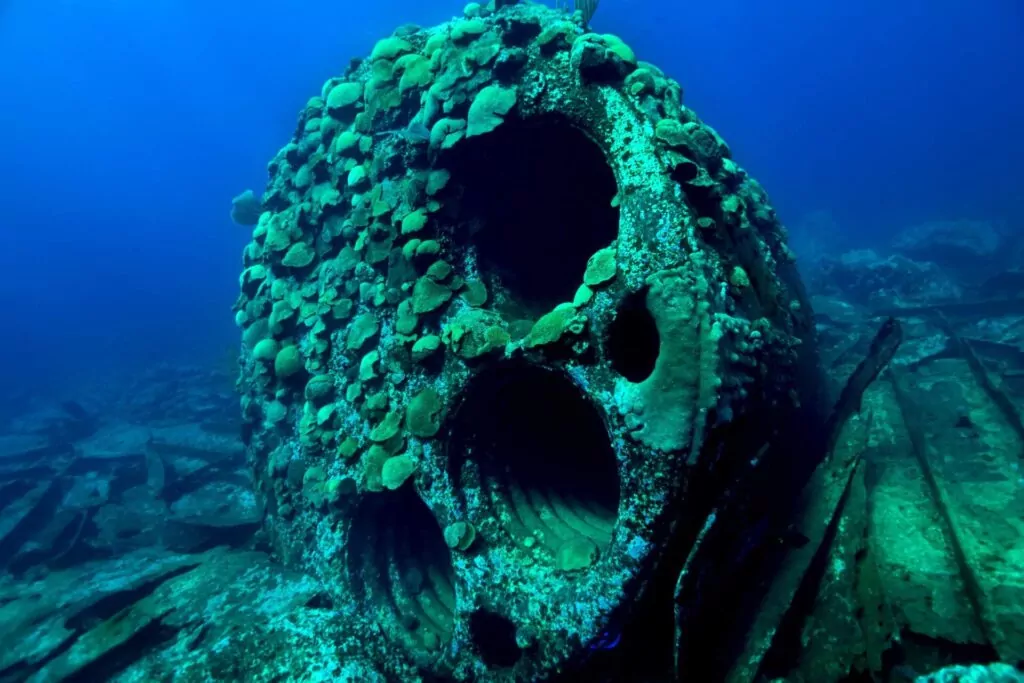
Fireboxes: Round holes running into a boiler where coal or oil is burned.
Donkey boiler: A small boiler used to run the ship’s auxiliary engines when the main boilers are cold.
Superstructure: The structure above the main deck of the ship. On older ships the superstructure would be built at least partly from wood and is unlikely to be intact, with the wheelhouse and bridge having either decayed or been cleared by a wire sweep.
Bridge: Located at the front of the superstructure running across (bridging) the width of the ship, with the wheelhouse in the middle. Bridge wings might overhang the side of the ship.
Wheelhouse: A cabin enclosing the ship’s wheel, compass binnacle and a telegraph to the engine room.
Engine: Located just aft of the boilers. Large steam engines are open and big enough to swim through. Steam engines are typically ‘triple-expansion’, so steam would be expanded a little way in a small cylinder, a bit more in a medium cylinder, and further again in a large cylinder, which is more energy-efficient than using a single big cylinder. The smallest cylinder will be at the front and the largest at the back. Sometimes there are four or more, indicating further stages of expansion, or in some cases substituting two medium-sized cylinders for the largest one. Cylinder diameter can be used to help identify a wreck when correlated with builders’ records.
Auxiliary engines: Small steam engines and possibly diesel engines to power generators and hydraulic systems.
Condenser: A tank full of copper pipes, used to cool and condense steam after it has passed through the boilers. This is often the first thing salvaged, because of the large quantity of valuable copper. A broken condenser can be identified by a spaghetti of copper tubing close to the engine and boilers.
Ventilation hatches: A greenhouse-like structure above the engine room, opened to provide ventilation for the crew. Often providing an easy way to swim into the engine room.
Funnel: A chimney structure above the boilers. On diesel-powered ships, this is just a decorative cover for the exhaust pipe. Fragile, it is often collapsed. The hole might provide access to the engine room, but could be blocked by a grille.
Stern, Propulsion, and Miscellaneous Features
Thrust bearing: A box-like structure on the propeller shaft, the thrust bearing transfers propulsive force from the propeller shaft to the hull of the ship. Typically located just aft of the engine or right at the stern, it might not be easily identifiable on smaller ships.
Propshaft tunnel: A tunnel covering the propeller shaft as it runs through the aft holds, and sometimes big enough to swim through.
Propeller shaft: A shaft connecting the engine to the propeller, constructed from a number of sections bolted together at flanges. Not to be confused with a mast, which will not have flanged sections. The shaft or tunnel indicates immediately on which half of a wreck you are. Follow it one way to the engine room, the other way to the stern.
Spare propeller: Ships often carried a spare propeller. This would be located either on the deck towards the stern, or against the rear wall of the aft-most hold.
Stern: There might be an additional superstructure or deckhouse at the stern. Cabins here would normally be for officers. Like the bow, it might have broken loose and fallen to one side.

Propeller: Typically four blades, and cast in iron or bronze. A bronze propeller will usually have been salvaged, leaving only the tail-shaft projecting.
Rudder: Immediately behind the propeller, connected to the steering mechanism by the rudder-shaft. If the rudder is missing, it can usually be found on the seabed within a few metres.
Steering: Cables or chains run round a quadrant attached to the top of the rudder shaft. These chains run along either side of the ship to below the wheelhouse, where they would be pulled by the ship’s wheel to turn the rudder. Alternative mechanisms include small steam or hydraulic engines, sometimes to assist the chains, or on more recent ships as a steering engine without chains.
Auxiliary steering: Some ships have a second steering wheel at the stern.
Gun platform: In wartime, many merchant ships carried deck guns for defence against submarines and aircraft. The favoured location is on a platform above the stern, which, being built strongly enough to support a gun, is often intact. The gun might have been salvaged, but unless you know for sure, it’s worth having a look on the nearby seabed in case it is lying there.
FAQs
Why is it important to identify parts of a wreck?
Identifying wreck parts helps divers navigate safely, remember key locations, and plan shots when photographing or exploring underwater.
How can I identify the bow of a wreck?
The bow is wedge-shaped, reinforced with extra ribs, and often broken forward. Recognising anchors, hawse pipes, and the anchor winch also indicates the bow.
What is a fo’c’s’le and why is it important?
The fo’c’s’le is the raised area at the bow containing crew quarters and stores. It helps divers orient themselves relative to the ship’s front.
How do I locate the engine or propeller on a wreck?
The propeller shaft indicates the stern end; follow it to find the engine mid-ship. Boilers and other engine room features can also guide identification.
What are common features to look for when identifying wrecks?
Look for the keel, hold coamings, masts, derricks, funnels, bell, bollards, and steering mechanisms. Each feature provides clues about location and orientation.
Subscribe today with promo code DIVE1 — enjoy 12 months for just £1!
