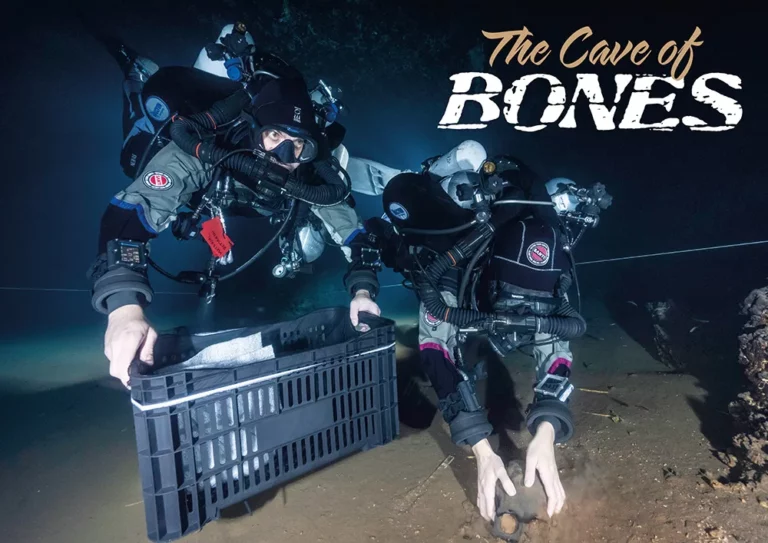

The Cave of Bones, located in Masso Grosso, Brazil, is in a remote area – the nearest town is about a 90-minute drive from the cave site, and the nearest dive shop is over 400km away. This is not a region where scuba diving is a regular occurrence, and the locals were definitely confused by the convoy of trucks, vans and trailers that turned up for project week, as John Kendall explains
Let’s take a step back and look at how I got involved with this amazing location in the first place. In early 2022, I was chatting to my good friend Sergio Schirato, who was telling me about this interesting cave that he had done a dive in. It sounded like a lot of hard work to get there, but that’s not unusual in cave diving. A few months later, I got a call from him. “Hey John, so we’re heading back to the Cave of Bones in September, are you interested in coming”, “Well…”, “Oh and by the way, we dated one of the human bones and it’s 11,000 years old”… “Hell yeah, Ok, where and when do I need to book a ticket.”
Skip forward to September, and Rachael and I were at Heathrow with over 200kg of rebreathers, cameras and other dive kit checking in to our flight to Sao Paulo.
On arrival we immediately started getting the expedition vehicles packed and ready for the two-day drive into the middle of Brazil. I was definitely suffering from truck envy as Sergio turned up in a fully customized Dodge RAM 2500, with a roof lift, and a trailer-mounted gas-filling station.
The next day, we started off early in the morning for the 1,400km drive. Normally, I’d skip over the travel and for the sake of the narrative, we’d magically arrive in Matto Grosso and start diving. Unfortunately, fate had other plans. With my ‘truck envy’ well and truly broken, and two rental vehicles hastily arranged, we finally arrived in Matto Grosso only a few hours behind schedule. At this point’ however’ we switched from ‘stressed travel’ to ‘what an awesome place’.
On to the Cave
Now a bit of background about the cave. This is privately owned land. The landowners use this as a recreational area, and come for picnics, swimming, etc. As we were going to be doing archaeology in the cave, we had to get permission from the landowner, but also licences from the Brazilian government to enable the project. And it didn’t stop there. In addition to the divers, we had a team of archaeologists who were going to be overseeing all the science, we had geologists who were digging bore holes and investigating the rock formations around the cave, a dry caving team who were surveying the above-water elements of the site, and we also had a documentary film crew following our every move (which was always ‘interesting’ when trying to find somewhere discrete to fit a P-valve catheter). All in all, we had 26 people on site, six of whom were divers. Since we were going to be on site for about a week, we built ourselves a little base camp (a few gazebos and the aforementioned trailer compressor system) and got ourselves organized.
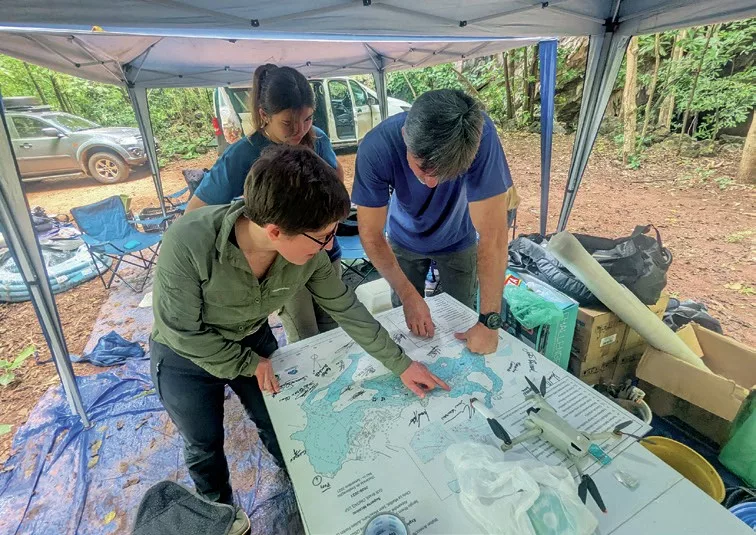


All of the diving on the site would be on CCR, not because the cave is particularly deep, but for the gas logistic advantages that we get. Only needing to fill six small oxygen bottles every day, and topping up our diluent/bailout once each during the week, meant a lot less filling.
The secondary benefit of CCR for this project is the lack of bubbles. Bubbles in a cave that is not dived very often will normally result in percolation – this is where sediments that are on the ceiling of the cave fall down, resulting in reduced visibility. There were several diving goals for the project. The main one was to make a 3D photogrammetric model of the main area of the cave, where we knew there were human remains. Secondary goals were to then recover the human bones for study at the University of Sao Paulo, and to recover some of the animal bones for further study as well.


Over the first three days, we spent around 18 hours underwater (per person) and took about 10,000 photos to make the 3D model. This first involved swimming through the cave placing printer markers in several places. These help the computer to tie everything together while processing. We then had to swim very regulated tracks, getting a lot of overlap between each image.
Every evening we would return to the hotel and the first thing would be to start the images processing, so we could see what we needed to capture the next day. We were then ‘allowed’” to eat and deal with any other things we needed to do. After three days, we had a pretty good model of the human remains, and so phase two could start.

Now you don’t just swim in, grab a bone, and swim out. All the bones needed to be handled with care. We also had to document where they came from, so that they could then be labelled and sorted for the dry study later. This meant we had to take containers into the water for carrying the bones out. And some of the bones were really small, so we got inventive. I’m sure many of you have been to dive centres that use plastic crates for keeping your gear together – well, that’s what we had, so that’s what we used. We added mesh bags around the crates, and then had to add a small amount of lead to make the crate sink rather than float.
So now picture the scene, we’re swimming into a cave system, at shallow depths, on CCR, with both hands involved in carrying a plastic crate. It rapidly starts eating into your underwater capacity, but that is why the dive team were all very-experienced GUE-trained divers. So, I’m sure you want to know what we found… Well, I’ll tell you now.
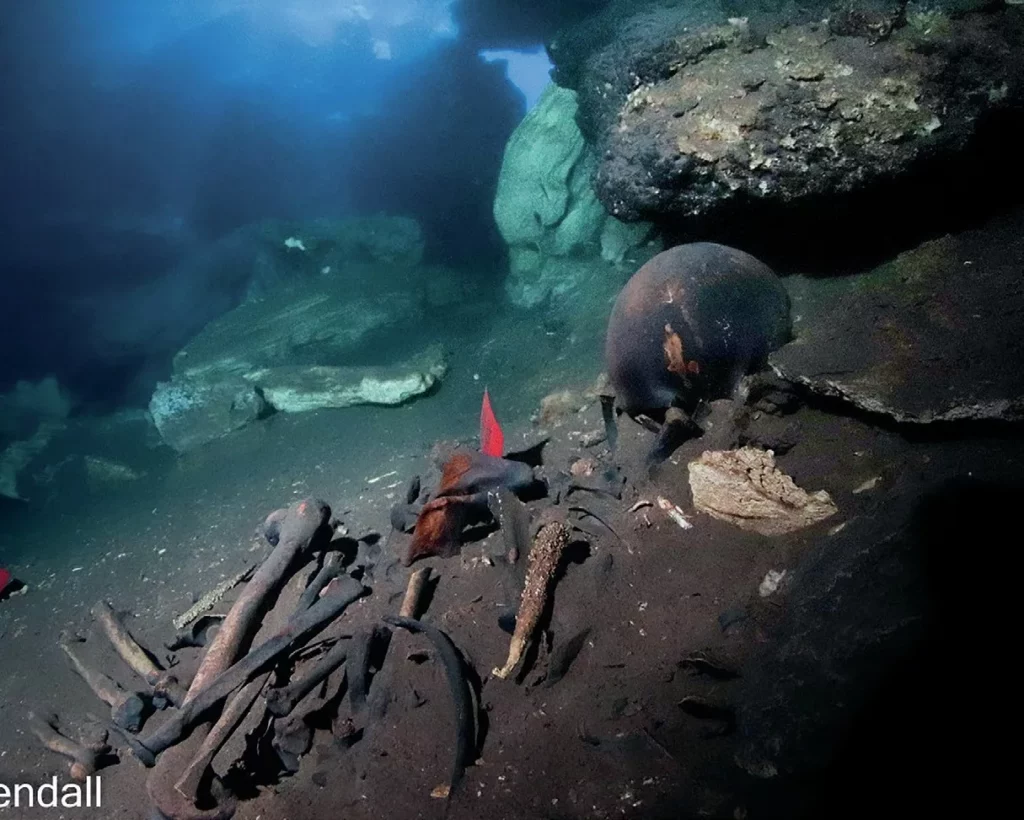
From previous dives, we knew about a skull and what appeared to be a full skeleton. Both of these were scanned in-situ, and then recovered. We also found four additional skulls (or parts of skulls), two of which were children, and another fairly full skeleton. We then found a large number of animal bones, including from tapirs, and a large rodent skull.
In all we recovered and documented around 400 bones, which went off to Sao Paulo to be researched further. Over the last three years, a number of the bones have been dated – the humans are all around 11,000 years old, while some of the animals are up to 24,000 years old. And the giant rodent skull that’s around 100,000 years old.
What is most interesting though, is the position of the bones in the full skeleton. Several of the major bones were in the wrong place, or the wrong way around. This has led to the hypothesis that this individual did not die where the remains are, but the bones themselves were placed in the cave in a burial ritual. There are a number of other elements in the cave that led us to this belief, but what is archaeologically important is that this shows elements of community from 11,000 years ago. So not only are these some of the oldest human remains ever found in South America, they are showing organized community.
We also scanned and recovered a large ceramic pot from a deeper section of the cave. Before we knew it, our diving time was over, and it was time to pack up camp, and drive back to Sao Paulo. Unfortunately, the vehicle gods were not on our side, and as we were returning the rental cars, one of the vans had a wheel bearing fail, so after calling for two recovery trucks to get the broken vehicles home, we jumped on an internal flight back to Sao Paulo and spent the evening ‘decompressing’ in a local bar.
Back to the Cave
Jump forward to 2025, and another phone call – “Hey John, we’re going back to the Cave of Bones, are you in?” “Oh yes, let’s do it”. Several things had happened between 2022 and 2025 – technology has moved on, the University of Sao Paulo have been hard at work sorting and analysing the bones we recovered, and I moved to Mexico. Off the back of all of this, we came up with a plan for me to fly to Brazil a week earlier than the diving project to visit the university and to dry scan all the human bones. For this, we used a handheld laser scanner, which is an awesome tool, and I really wish I could get one that worked underwater.
Over the five days at the university, we scanned all of the complete skeleton bones, as well as the second complete skull. We are going to be using these scans to digitally recreate the site that the skeleton was found, and compare the bone positions to their location in the body.
Travel was easier as well, in part because the project had switched from JJ CCRs to the new Halcyon Symbios CCR. This very capable, but very lightweight, rebreather meant that we were able to reduce the weight that we had to fly (and carry) from over 100kg each down to about 60kg each.
What else changed? Well, for one, we had a new expedition truck, very similar to the previous one, but this time without the engine issues! And again, two days driving and we arrived on site. One other new thing for 2025 was the acquisition of a Starlink internet system – this meant we could upload and update data directly from the dive site, as well as keeping the Social Media monster updated.
2025 was a smaller expedition – five divers, four surface support and four archaeologists, but having been there before, we now had a much-better understanding of the site, and also how best to deal with additional scanning. As before, we started off with placing markers throughout the cave. We printed them larger for 2025, and added small lead weights to each one to stop them moving.

We then split the team and starting scanning. We had much bigger goals in 2025 in terms of the amount of cave we were aiming to scan, so had to be more efficient. We also wanted to investigate, scan and recover more remains that were spotted at the end of the 2022 project.
So, what did we manage in 2025. Another 16,000 photos were taken to use in expanding the 3D model of the cave. We discovered, documented and recovered another six human skulls. We scanned and recovered a fairly intact tapir skeleton, which on investigation turned out to be a species of tapir that went extinct over 8,000 years ago, and for which no complete skeleton existed (well, it does now). We also found a pile of bones in a collapsed part of the cave that contained a mixture of human, giant sloth and sabre-toothed tiger bones.
All of these are in the process of being dated and documented, and I suspect that next time we go back to Brazil, there will be some more laser scanning to do. As a time capsule, the Cave of Bones keeps giving us more and more data, and I can’t wait to return to this amazing location and travel back into history further.
NB: I would very much like to thank Sergio Schirato for inviting Rachael and myself to join the project. I’d also like to thank the Explorers Club for their support, and for allowing us to take flag #132 with us on the 2022 expedition.

“We scanned and recovered a fairly intact tapir skeleton, which on investigation turned out to be a species of tapir that went extinct over 8,000 years ago, and for which no complete skeleton existed (well, it does now)”
FAQ Section
Where is the Cave of Bones located?
The Cave of Bones is situated in a remote area of Mato Grosso, Brazil. It is approximately 90 minutes from the nearest town and over 400km from the closest professional dive shop.
How old are the human remains found in the Cave of Bones?
Carbon dating has revealed that the human remains discovered in the cave are approximately 11,000 years old, making them some of the oldest human remains ever found in South America.
Why do the divers use CCR (Closed Circuit Rebreathers) for this project?
Divers use CCR primarily for gas logistics in remote areas and to prevent “percolation.” Unlike open-circuit scuba, CCR doesn’t release bubbles, which keeps sediment from falling from the cave ceiling and ruining visibility.
What kind of extinct animals were found in the cave?
The expedition recovered bones from an extinct species of tapir (over 8,000 years old), giant sloths, and sabre-toothed tigers, as well as a giant rodent skull dating back 100,000 years.
What is the “burial ritual” hypothesis mentioned in the study?
Archaeologists believe the cave served as a burial site because several skeletons were found with bones placed in anatomically incorrect positions, suggesting a deliberate, organized community ritual rather than natural expiration on-site.
This article was originally published in Scuba Diver Magazine
Subscribe today with promo code DIVE1 — enjoy 12 months for just £1!
