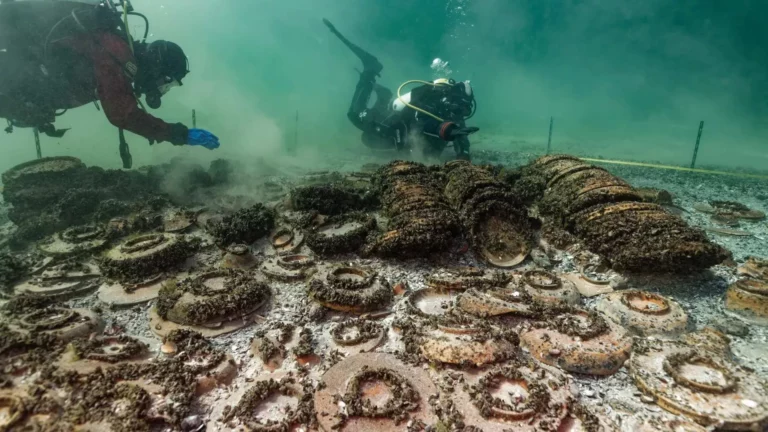
An ancient Roman ship has rotted away on the bed of Switzerland’s Lake Neuchâtel – but it has left behind an unusually intact cargo that is being eagerly excavated by archaeological divers.
What they describe as the richness, diversity and excellent condition of the hundreds of artefacts is said to make the discovery exceptional, providing a rare ‘snapshot’ of everyday commerce 2,000 years ago.
The wreck-site is being claimed as a discovery unique for Switzerland or for any inland waters north of the Alps.
The goods, the last remaining evidence of a merchant vessel that sank between 20 and 50 AD, are being identified, documented and in many cases recovered from the lakebed under the supervision of the Cantonal Archaeology Office (OARC).
It is working in collaboration with Swiss non-profit body the Octopus Foundation and the Archaeological Service of the State of Fribourg (SAEF).
Spotted from the air
The site was discovered through aerial photography in November 2024 as part an OARC programme to monitor the health of the lakebed but also with an eye for submerged heritage.
This was followed by exploratory scuba diving and an initial excavation campaign in March 2025, with the aim of assessing and quantifying the potential of the site and its challenges, particularly in terms of heritage preservation.
The OARC says that what were considered the most vulnerable objects needed to be removed to protect them from the triple threat of lakebed erosion, offshore anchoring by pleasure boats and, especially, acts of vandalism and looting.
Among the items are several hundred intact ceramic tableware vessels, including dishes, plates, cups and bowls, produced in the region. There are also amphoras for olive oil imported from Spain, along with utensils and tools that would have been used by the crew.
Sail and wheels
Components of harnesses and wagons were also found, including well-preserved wheels, the only Roman examples of their kind in Switzerland. The further discovery at the wreck-site of swords suggests that the civilian merchant vessel had a military escort on board.
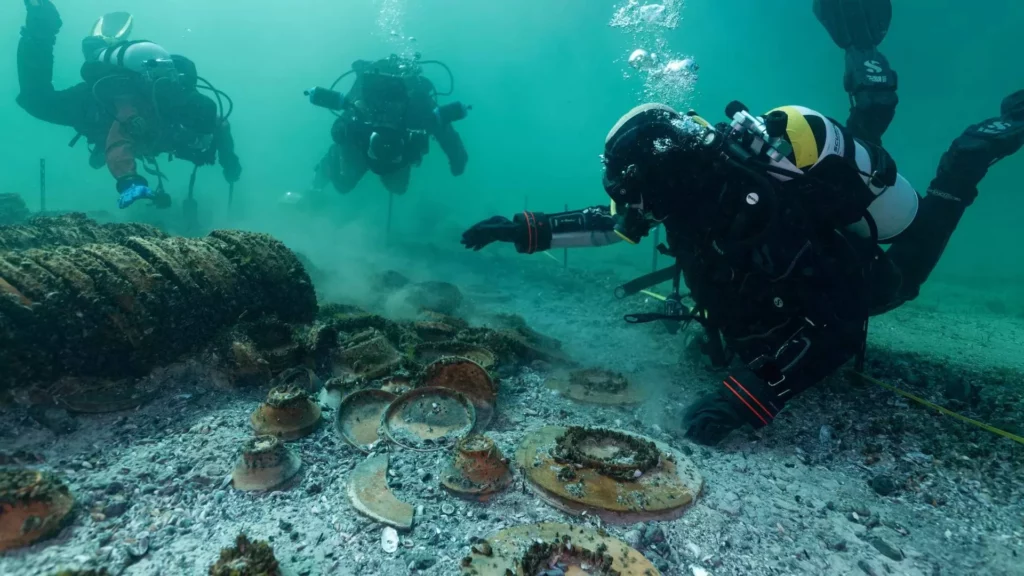
In Roman times, lakes such as Neuchâtel formed part of an inland transport network that connected river routes and overland trade, and the wagons would have played a part in this hybrid transport system.
The vessel would have provided transport across the lake between Roman settlements, probably linking trading hubs such as ancient Eburodunum (modern Yverdon-les-Bains). The lake was known to the Romans as Lacus Eburodunensis at the time of the shipwreck.
Following conservation and specialist study, the artefacts are expected to be exhibited at the Laténium, Neuchâtel’s archaeology park and museum.
Also on Divernet: Divers with a stake in the past

This story would have been SO much better with photos and explanations of what was found!
https://youtu.be/QbEgLJV-EsA?feature=shared
There’s a video with the process of archeology work.