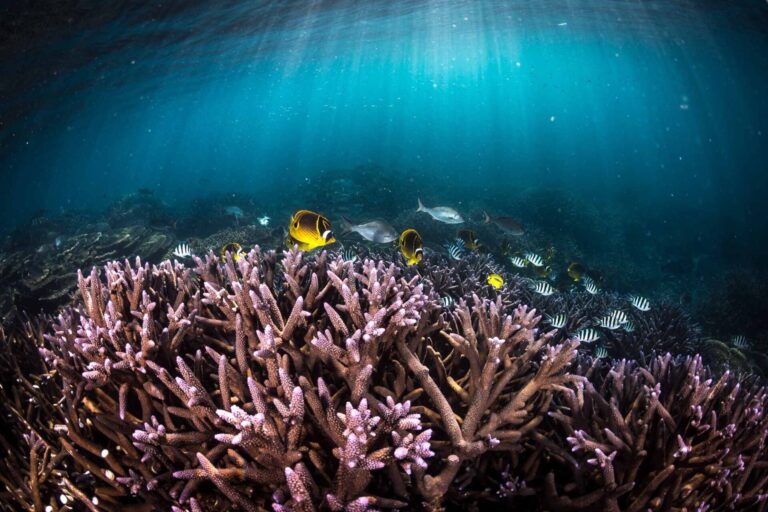
Scientists have long been gloomy about the prospects for coral-reef survival around the warming world, but according to the Wildlife Conservation Society (WCS) artificial intelligence is inclined to look on the brighter side than humans.
A new study led by the New York-based WCS has concluded that AI models are providing “more accurate and more hopeful predictions” for the future of coral reefs amid climate change.
While acknowledging that many reefs face serious risks and degradation, AI predicts that many others might remain stable or even recover, especially where local management can reduce pressures such as overfishing, water pollution and coastal degradation.
Machine-learning trained on decades of real field data is predicting coral-reef status and outcomes more accurately than theory-based single-variable climate-impact models, according to the study.
‘Overly simple’
Predictions up to now have been based on “overly simple” measures such as excess heat but have not always correlated well with actual coral-reef status, say the WCS researchers.
“Machine-learning models are not based on simple theories and limited testing,” says lead study author Dr Tim McClanahan, an ecologist and director of science for WCS’s Global Marine programme. “They are grounded in extensive field observations and satellite and shipboard measurements.
“These models are revealing that coral-reef responses to climate change are highly influenced by an array of local factors like temperature variability, depth, currents and human pressures from things like fishing and coastal development.


“Because of that, the impacts of climate change are not uniform. Many reefs will face negative and even devastating outcomes, but some show resilience or recovery if we do not add more local insults to the global climate injuries.”
New coral-reef strategy
“AI can improve how we predict and plan for coral-reef futures,” adds biologist Dr Emily Darling, director of WCS’s Coral Reef Conservation Programme. “But AI needs data, and continuing to support high-quality coral reef monitoring and science is critical to identifying which reefs are likely to persist and where action will have the biggest impact.
“This underpins WCS’s new global coral-reef strategy, which centres climate-resilient coral reefs as the top priority for conservation investments.” The 2025-2030 Coral Reef Conservation Strategy was launched earlier this month, as reported on Divernet.
The new study, which has now been published in the journal Coral Reefs, calls for continued work to bridge AI-driven predictive models with traditional explanatory science.
In this way WCS says that researchers can better forecast reef resilience, target high-value conservation sites, and ensure that limited resources are focused where they matter most. “We cannot bury reefs while they are still living,” says McClanahan.