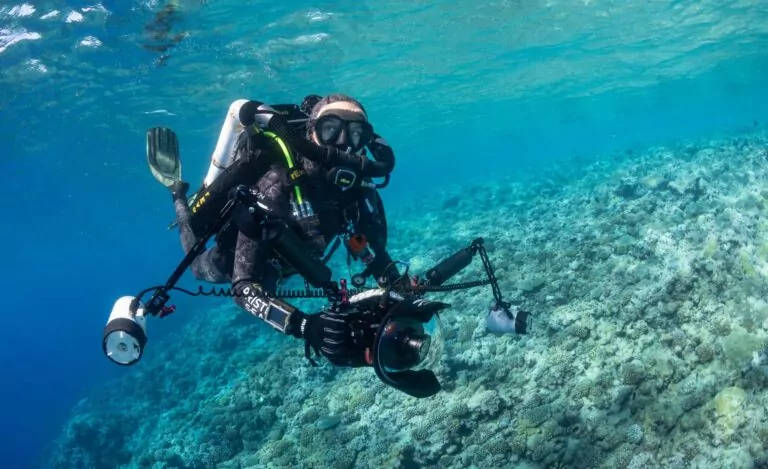
“A mere drop in the bucket of what we desperately need to protect the ocean” was how diver Enric Sala, National Geographic explorer-in-residence and founder of Pristine Seas, summarised the outcome of the third UN Ocean Conference (UNOC3) in Nice, which ended yesterday (13 June).
Sala criticised host country France for falling at the last hurdle. “My expectation for the UN Ocean Conference was to hear many policy-makers speaking about how important it is to do the things they have not yet done – and my expectations have been fulfilled,” he said.
Also read: Satellites/AI put the ‘Protected’ into MPAs
“A few governments have made real changes in the water, especially those creating new highly or fully protected marine areas. Yet the host country France missed an epic opportunity to lead on ocean conservation.
“This was France’s moment but, instead of making a splash, its leaders continued allowing bottom-trawling in areas of the ocean set aside for protection.”
French President Emmanuel Macron, as might be expected, saw UNOC3 rather differently. He expressed optimism about progress being made to protect the oceans and the fact that some 50 world leaders were attending the conference, compared to the 20 at UNOC2 in Lisbon in 2022 (the first Ocean Conference was held in the USA in 2017).
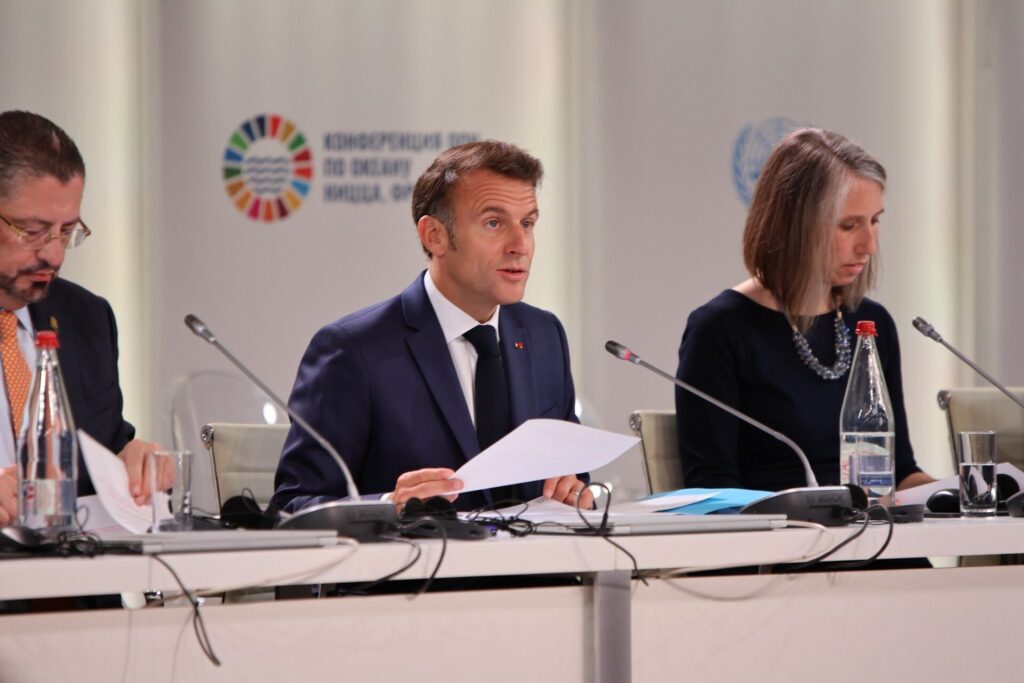
Macron highlighted impending ratification of the long-discussed High Seas Treaty as an “historic milestone”. The treaty, aimed at protecting marine biodiversity in international waters, had received sufficient support to come into effect from the start of 2026, he said, representing the first international framework to regulate and administer the high seas.
Fifty-one countries have already ratified the treaty with 15 more now committing to doing so, and only 60 signatures needed to bring it into force.
Macron also emphasised the importance of multilateral co-operation and the need for a moratorium on deep-sea mining, which he described as “frenzied madness”.
The announcement of new Marine Protected Areas (MPAs) timed to coincide with the conference was welcomed, but the numbers served to highlight the limits of international ambition, according to Sala.
“These national parks of the sea will help us inch toward the goal of protecting 30% of the ocean by 2030,” he said. “The only problem is, we can’t inch our way to 30×30. We must race. We need to establish 85 new MPAs daily to achieve this goal – and these reserves must be strictly protected.”
This figure had emerged in a study published shortly before the conference by Dynamic Planet and National Geographic Pristine Seas.
To fill the gap between the current 8% of the global ocean under some kind of protection and 30%, about 190,000 small MPAs would have to be established in coastal regions alone, with an additional 300 large MPAs in remote, offshore areas, according to the report.
Steps forward
At UNOC3 there was a general agreement to boost MPAs by about a third, pushing global coverage to an estimated 12%.
Samoa announced nine new fully protected MPAs covering 36,000sq km of ocean. The Marshall islands had already designated the Bikar and Bokak Atolls as national marine sanctuaries, the first in the country, earlier in the year.
French Polynesia pledged to protect some 23% of its waters, including two new highly protected MPAs near the Society and Gambier Islands that would ban all extractive activities such as fishing and mining.

Colombia announced protection of two remote coral reefs in the Caribbean Sea that were noted for diverse marine life. Its new Serranilla & Bajo Nuevo MPA covers an area of 3,800sq km.
Tanzania designated two new MPAs in biodiverse waters off Pemba Island, together spanning some 1,300sq km including coral reefs, seagrasses, mangroves and threatened shark and ray habitats.
Both Greece and Spain declared protections for a quarter of their national waters at the conference, and Brazil announced that it would create additional MPAs.
The coalition of countries calling for a moratorium on deep-sea mining grew from 34 to 37, with even non-signatories such as China expressing opposition to unregulated seabed mining. In late April, US President Donald Trump, who did not attend the conference, had broken international ranks by signing an executive order to accelerate deep-sea mining.
Meanwhile 95 countries, including all EU members, issued a joint declaration supporting a global target to reduce plastic production and use. The declaration also called for eco-design, bans on harmful plastics and a financial mechanism to support implementation.
World Restoration Flagships
The UN named its first “World Restoration Flagships,” aiming to restore nearly 5 million hectares of marine ecosystems across Asia, Africa and the Americas. Projects include coral-reef recovery in the Mozambique Channel and island restoration in Mexico.
UK commitments at the conference included introduction of legislation to ratify the High Seas Treaty, a £4 million uplift to the Global Fund for Coral Reefs, £2.8 million to help small island-states build sustainable blue economies and support for shark and ray conservation.
The UK has also launched a three-month consultation on banning bottom-trawling in 41 MPAs covering 30,000sq km.
“If one message emerges from the UN Ocean Conference this week it should be this: MPAs that allow damaging activities like industrial fishing are protected in name only,” said Enric Sala.
“Science shows us that we reap the greatest food security, biodiversity and climate benefits from MPAs when they are strictly protected and monitored. Protection can’t be optional.”
Also on Divernet: Diver Theo joins Stephen Fry to skewer bottom-trawling, Sir David recalls scary diving helmet experience, Prince William ‘optimistic’ about ocean future, Hard-hitting Attenborough film condemns MPA trawling