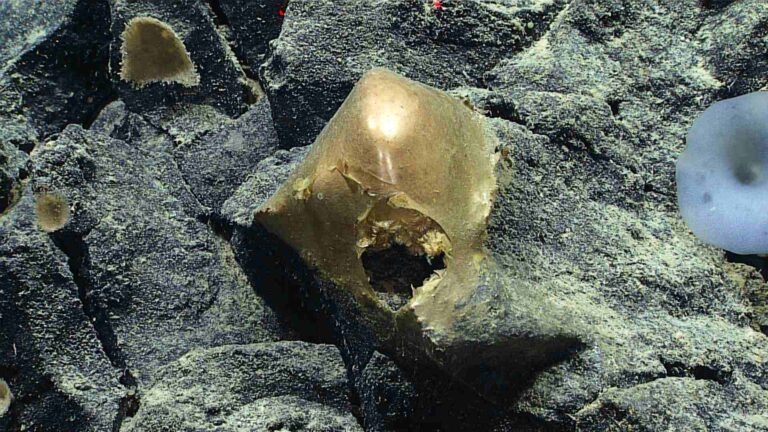
Three years ago a mysterious “golden orb” was spotted by an ROV videographer at a depth of 3.3km on a Gulf of Alaska seamount, as described at the time on Divernet.
Stuck firmly to a rock among scattered white sponges, the smooth, dome-shaped object measured 10cm across, with a hole at its base revealing its interior colouring to match that outside.
At the surface some of the best brains in marine science were onboard the ROV’s mothership, NOAA Ocean Exploration’s research vessel Okeanos Explorer, or following its live-steaming, and their off-the-cuff attempts at identifying the object ranged from dead sponge attachment to a coral or an egg-case.
Indicating that considerably more research would be required, expedition co-ordinator Sam Candio admitted to being humbled by the fact that “while we were able to collect the ‘golden orb’ and bring it onto the ship, we still are not able to identify it beyond the fact that it is biological in origin”.
The find, made during the Seascape Alaska 5 exploration and mapping expedition, caught the popular imagination. Online suggestions ranged from the orb originating in a far-off galaxy to it containing a coded message from an ancient civilisation – or had something unknown already crawled out of it?
However, as a new announcement from NOAA Ocean Exploration has now made clear, the experts had been close first time around. It might have taken several years to put the matter to rest, but the enigmatic golden orb was not a dead sponge attachment but the base of a giant anemone.
Fleshy structure
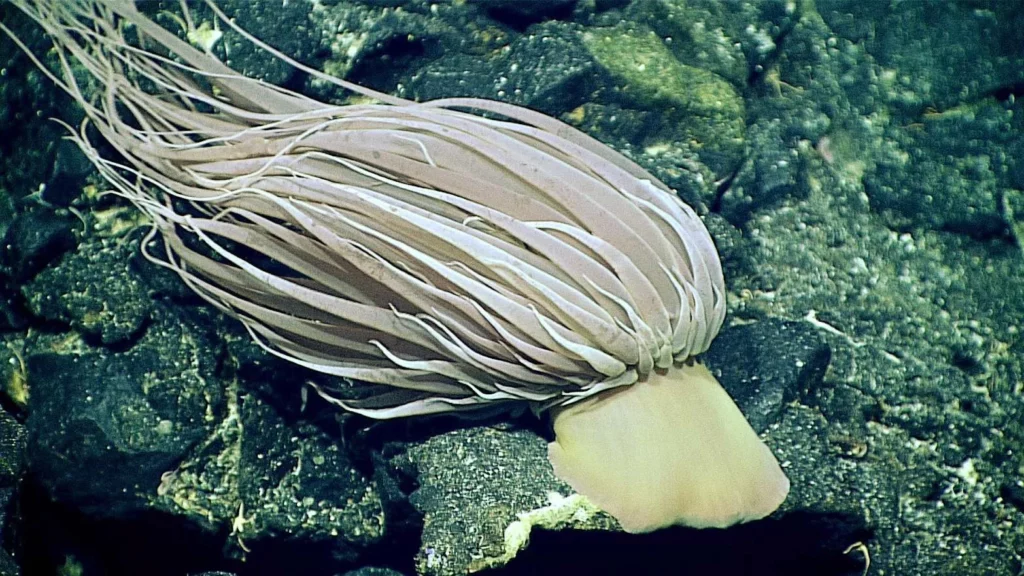
According to NOAA, the orb consists of tissue from a deep-sea anemone called Relicanthus daphneae. The fleshy structure by which the animal anchored itself had likely broken off or degraded, which is why it resembled a smooth golden orb while at depth. It looked less like an orb after being hauled to the surface.

“That golden piece is usually hidden underneath the animal, but this one seems to have been left behind,” says NOAA. Deep-sea anemones remain under-researched, including Relicanthus daphneae, so its tissues do not match familiar shapes at first inspection.
The orb is now simply exhibit USNM_IZ_1699903 at the Smithsonian Institution’s National Museum of Natural History (NMNH), where its examination took place.
Why did it take so long to identify? “We work on hundreds of different samples and I suspected that our routine processes would clarify the mystery,” said zoologist Dr Allen Collins, director of NOAA Fisheries’ National Systematics Laboratory, which is located within the NMNH in Washington DC.
“But this turned into a special case that required focused efforts and expertise of several different individuals. This was a complex mystery that required morphological, genetic, deep-sea and bioinformatics expertise to solve.”
Initial examinations indicated that the object lacked typical animal anatomy but consisted of a fibrous material with a layered surface packed with stinging cells like those of a cnidarian such as a coral or anemone.
The cells were identified as spirocysts found only in the Hexacorallia group of cnidarians. A similar specimen collected in 2021 during an expedition on Schmidt Ocean Institute’s research vessel Falkor had revealed similar cnidocysts.
Initial DNA barcoding was inconclusive but whole-genome sequencing indicated a large amount of genetic material from the giant deep-sea anemone. Genome sequencing of both specimens confirmed that they were genetically almost identical to Relicanthus daphneae.
NOAA Ocean Exploration is certain that many further deep-sea mysteries await. Live-streamed dives from Okeanos Explorer resume in May with a “shakedown” expedition in the depths off Hawaii.