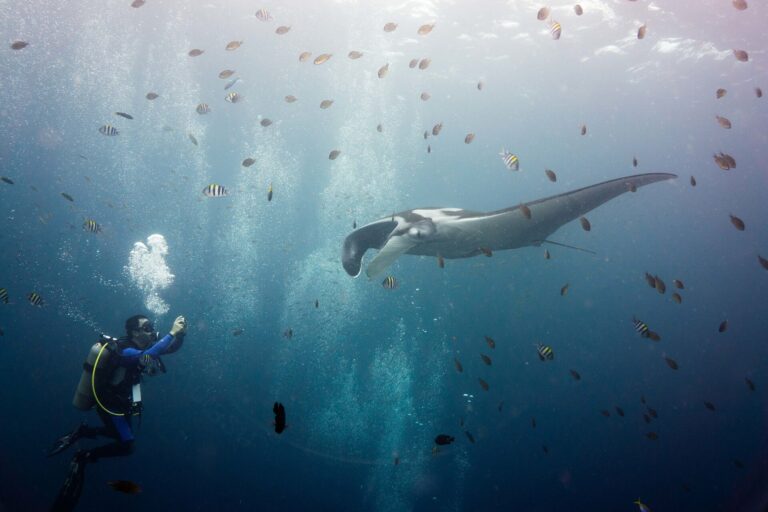
Oceanic manta rays are able to dive to well beyond 1km deep, and now it seems that once away from shallow coastal waters they rely on this ability for orientation and long-range navigation.
An international team of researchers working in New Zealand, Indonesia and Peru tagged 24 examples of Mobula birostris, the world’s biggest species of ray to learn more about their deep-diving behaviour. Their study has just been published.
“We show that, far offshore, oceanic manta rays are capable of diving to depths greater than 1,200m, far deeper than previously thought,” says first author Dr Calvin Beale of Murdoch University in Australia.
“These dives, which are linked with increased horizontal travel afterwards, may play an important role in helping mantas gather information about their environment and navigate across the open ocean.”
The rays were tagged and observed between 2012 and 2022 at three sites: near Whangoroa in northern New Zealand, Raja Ampat in eastern Indonesia and near Tumbes off Peru’s north coast.
The team recovered eight of the 24 tags, which were programmed to release after several months, and their high-frequency data was downloaded.
“It is quite a challenging task, trying to spot a small grey floating object with a short antenna bobbing around in the waves with other flotsam and jetsam,” says Beale. The other 16 tags transmitted summary data via satellite.
A total of 2,705 tag-days of data were recorded, and on 79 days mantas were found to dive to extreme depths, maximum 1,250m. All but eight of these dives, defined as deeper than 500m, occurred off New Zealand.
Bounce dives
The mantas would usually dive deep within a day after leaving the continental shelf, descending in steps and spending little to no time at maximum depth, making clear that they were not diving to forage or escape deep-diving predators.
The ocean environment is more stable and predictable at depth than at the surface, and the team believes the rays are seeking cues such as changes in the Earth’s magnetic field strength and gradient, or oxygen, temperature and even light levels.
“By diving down and ‘sampling’ these signals, they could build a mental map that helps them navigate across vast, featureless stretches of open ocean,” says Beale.
The mantas would resurface again in steps and, after a prolonged recovery period at the surface, would then travel for up to 200km over the next few days.
The reason few extreme dives were recorded in Peru and Indonesia is thought to be because the mantas there are content to remain in their coastal habitats. In Raja Ampat the seas are mostly shallow and the few deepwater corridors relatively short, so the rays have less need to seek navigation information.
“Understanding the nature and function of deep dives helps explain how animals cross vast, seemingly featureless oceans and connect ecosystems thousands of kilometres apart,” says Beale, who looks forward to future studies using larger datasets. The new study is published in Frontiers in Marine Science.