A species of shark popular with divers has been recorded mating but, making the observation a world-first, in a threesome. The action took place in shallow reef waters off New Caledonia.
Mating behaviour had only rarely been documented in leopard aka zebra sharks (Stegostoma tigrinum) in the wild until University of the Sunshine Coast (UniSC) marine biologist and ecologist Dr Hugo Lassauce succeeded in capturing the “thrupple” sequence.
Following extended preliminaries, two males of the globally endangered Indo-Pacific species were seen copulating in quick succession with a female. All three sharks were about 2.3m long.
“It’s rare to witness sharks mating in the wild, but to see it with an endangered species – and film the event – was so exciting that we just started cheering,” said Lassauce.
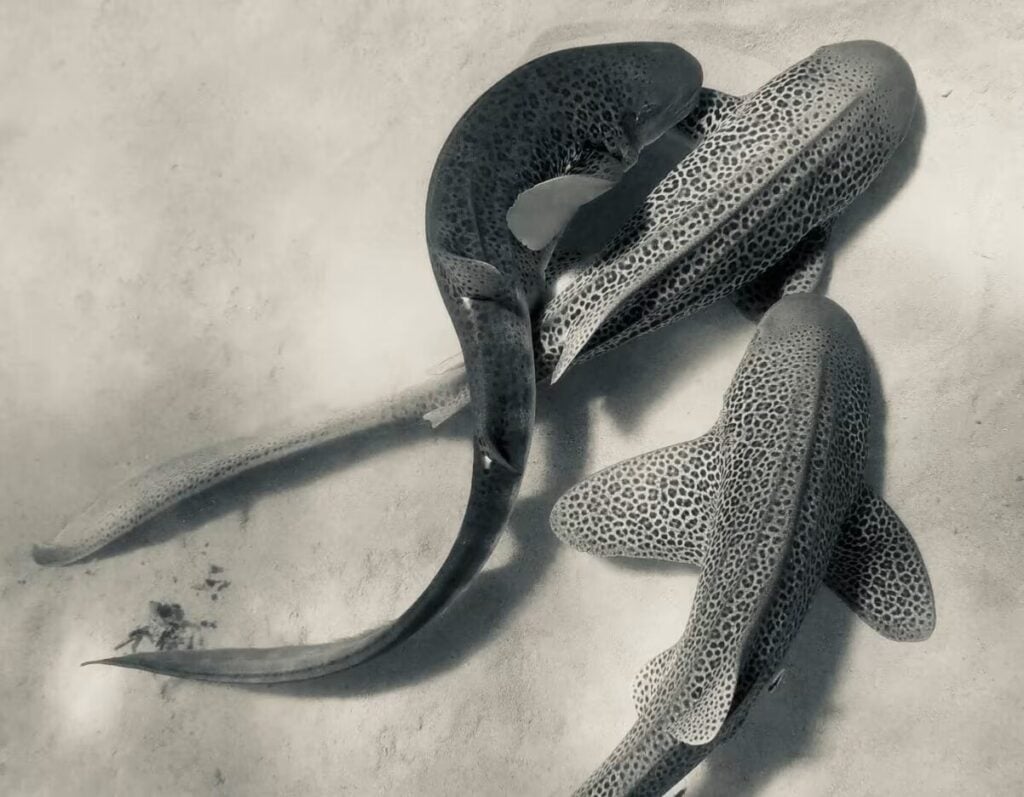
It was not exactly a chance encounter, however, because the post-doctoral researcher had been snorkelling with the sharks 15km off the coast of the South Pacific archipelago every week for a year, as part of the capital Noumea’s Aquarium des Lagons’s monitoring programme.
The two male sharks were identified as regular visitors to the site over at least seven years.
“I’d seen males swimming fast after females before and I’d arrived on the scene just after a male and female separated, but I’d never seen the whole sequence,” said Lassauce, who initially spotted the female with both males grasping her pectoral fins on the sand below.
“I told my colleague to take the boat away to avoid disturbance and I started waiting on the surface, looking down at the sharks almost motionless on the sea-floor. I waited an hour, freezing in the water, but finally they started swimming up. It was over quickly for both males, one after the other. The first took 63 seconds, the other 47.
“Then the males lost all their energy and lay immobile on the bottom while the female swam away actively.”
It is hoped that the findings might help with research into artificial insemination and rewilding of the species – a study based on the observations has just been published in the Journal Of Ethology.
Head-teeth: ‘The better to grip with’
Less familiar to divers, male chimaera, the mysterious deep-sea fish also known as ghost sharks, have evolved to sport teeth outside their jaws for use when mating, marine biologists have just revealed.
The sharp, retractable teeth, mounted on a rod that juts from the male ghost shark’s forehead, had previously been thought to be no more than imitation choppers, but the new research has found them to be genuine biting or gripping implements.
The forehead rod, called a tenaculum, appears to be used to grasp female chimaera, much as mating requiem sharks might use their mouths for the purpose.
“If these strange chimaeras are sticking teeth on the front of their head, it makes you think about the dynamism of tooth development more generally,” says University of Florida biology professor Gareth Fraser, senior author of the new study. “If chimaeras can make a set of teeth outside the mouth, where else might we find teeth?”
The team, which also included scientists from the Universities of Washington and Chicago, studied living specimens collected from Puget Sound as well as fossils to solve the mystery.
One 315-million-year-old fossil showed the tenaculum attached to the upper jaw, with genetic testing confirming that the head and mouth teeth contained the same genes.
“Over time, the tenaculum shortened but retained the ability to make oral teeth on this forehead appendage,” says Fraser. The study is published in the Proceedings Of The National Academy Of Sciences.