Scuba divers have found 16 cannon off Heligoland, the island off Germany’s North Sea coast that served as a British naval base during and after the Napoleonic Wars.
Reckoned to date back to the years around 1800, the 12-pounder guns were initially thought to have come from HMS Explosion, which sank off the island in 1807.
They were found scattered over an 80 x 70m area in the northern part of the strait separating Heligoland from the even smaller island of Düne to the east, but there was no sign of a shipwreck. Explosion is known to have been abandoned after sustaining damage, but many of its guns had been salvaged at the time.

The cannon are said to be “clearly of British origin”, recognisable from design characteristics such as their “Blomefield rings”, according to underwater archaeologist Dr Florian Huber. The research diving company he founded, Submaris, had been carrying out a survey with Kiel University’s marine geophysics & hydroacoustics group when the weapons were found.
Blomefield rings were developed by artillery officer Thomas Blomefield for British artillery around the end of the 18th century. Cast onto the rounded cascabel at the breech end, they were designed to allow free movement of the breech ropes and control recoil, making guns stronger without increasing their weight. They became widely used in naval warfare.
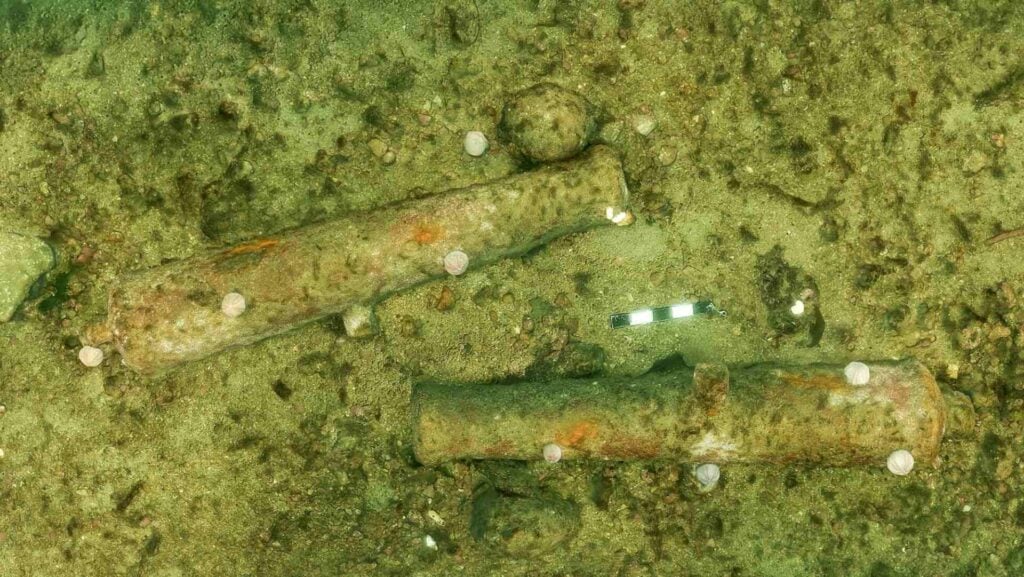
The guns also bore the Royal Navy’s “broad arrow” emblem, the Samuel Walker & Co manufacturer’s mark and the monogram of King George III (1760-1811).
The discovery is said to complement underwater finds made in the area in the 1990s that also relate to the former naval base.
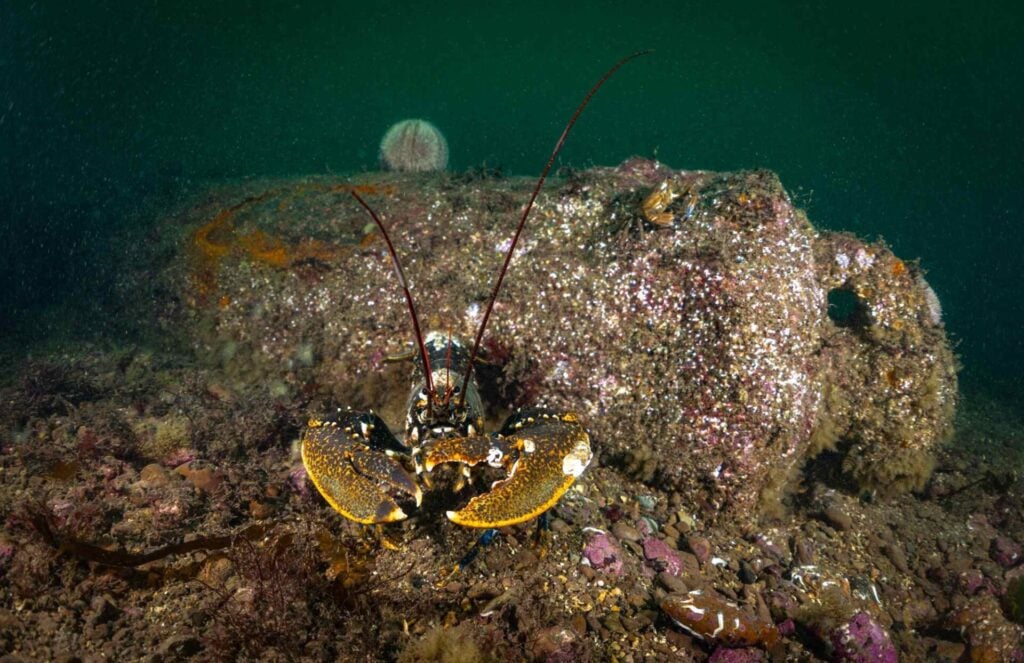
The team believe that the Royal Navy deliberately sank the cannon before the island was handed over to Germany in 1890 as part of an exchange of territory under the Heligoland-Zanzibar treaty.
The guns were obsolete by that time, and it might have been uneconomical to ship them home. Heligoland would become a significant German naval base during both world wars.

“The discovery of the 16 cannon deepens our understanding of Heligoland’s maritime history and underscores the island’s importance in the Napoleonic Wars and British naval history,” says Huber. “At the same time, they document the end of an era.” The guns have been recorded using high-resolution echo-sounder mapping and 3D modelling.
It was Huber and his Submaris team who identified an Enigma cypher machine found while clearing ghost-nets near Germany’s border with Denmark in 2020, and in 2023 they were involved in discovering the truth about the sinking of notorious World War One U-boat UC-71 – both stories reported on Divernet.