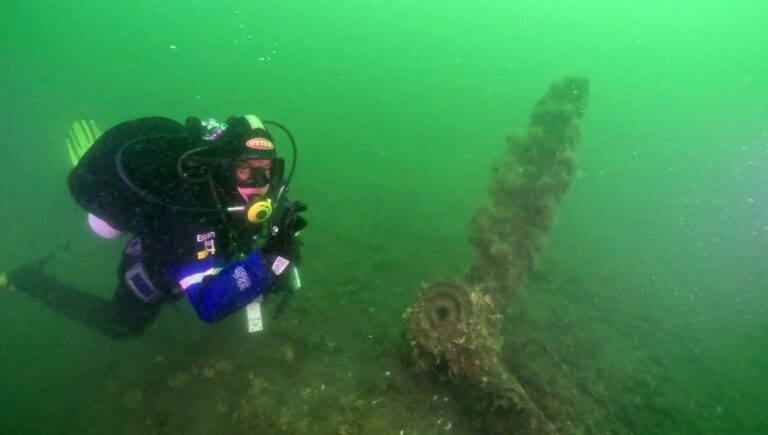
A US dive-team exploring a Baltic aircraft wreck-site has found two .50-calibre machine-guns, knocked loose when the WW2 bomber crash-landed more than 80 years ago – and they could be the key to identifying the plane and its crew. The guns were recovered and cleaned on the dive-boat to reveal their serial numbers.


The B-17 Flying Fortress, which would have crashed in 1943, was documented by a Texas A&M University nautical archaeology team during an underwater investigation in Kiel Bay between Denmark and Germany this summer, and has now been officially reported.

The divers were working with the US Defence POW/MIA Accounting Agency (DPAA) government agency, which exists to locate and identify the remains of the 81,000 American service personnel still unaccounted for from past wars around the world.
B-17s typically carried a 10-man aircrew, consisting of the pilot, co-pilot, navigator, bombardier, flight engineer/top-turret gunner, radio operator, two waist gunners, ball-turret gunner and tail gunner.
Debris scatter
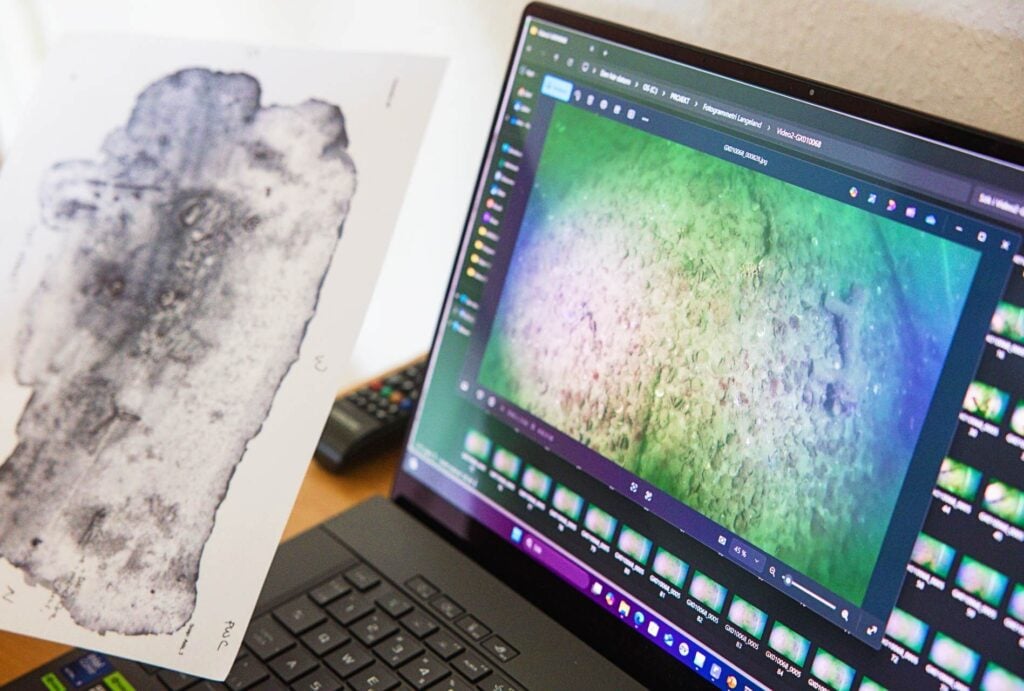
The wreck-site had originally been reported to the DPAA by a local diver in 2001 as a potential target of interest. The investigative project was launched to verify that report and then find clues to identify the aircraft.
Led by Texas A&M University’s Dr Piotr Bojakowski, the researchers used side-scan sonar and magnetometry to survey a 1sq km area before sending an ROV to obtain footage of an anomaly that resembled part of an aircraft wing.


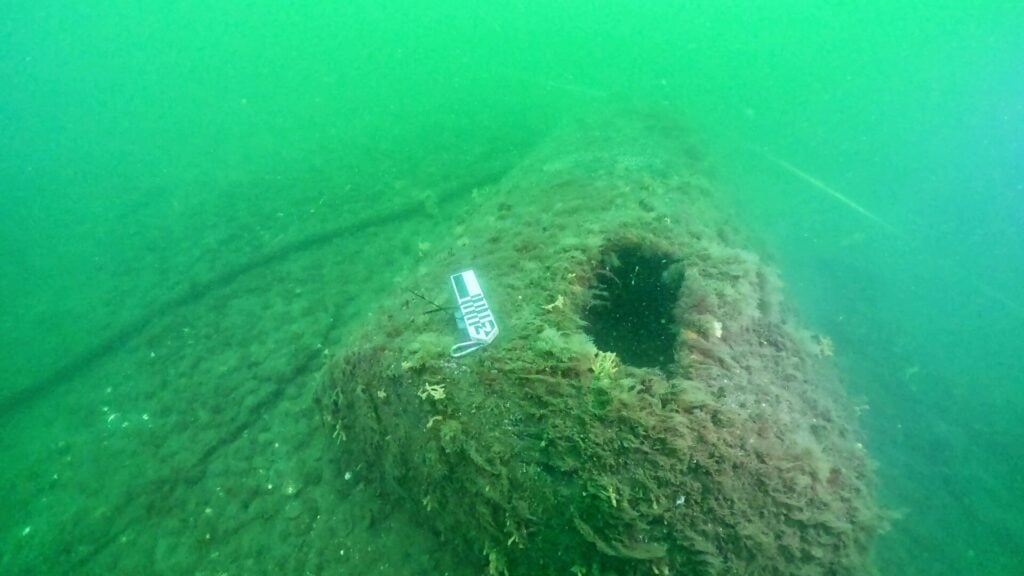
The divers found the wreckage “buried under years of sediment and marine growth” and, working for much of the time in visibility of less than 3m, were able to confirm that it was a downed four-engined heavy bomber.
“There is no obvious plane, but rather a debris scatter,” said nautical archaeology graduate student Bethany Becktell, describing her dives. “Objects come into view as we strategically swim around the area, marking visible wreckage on dive-slates with compass-bearings and taking photographs with a GoPro camera.

“Ammunition generates almost constant pings on the metal-detector we use to search for buried material. Scattered debris that identifies the site as a plane become clearer; engines are visible, as well as parts of a wing, a cockpit window, a tyre and a fuel-tank.”
“It’s an exciting process to see a crash site under water,” said Bojakowski. “Even though it’s in ruins, you begin to visualise the entire aircraft with the engine and wings and fuel-tanks. You slowly start piecing everything together in a way that makes sense, and understand what happened.”
Best answers

“On the aircraft wreckage, it’s really important to find the machine-guns,” added Katie Custer Bojakowski, an instructional assistant professor of anthropology.
“They are a controlled item in the military and so are not only stamped with a serial number but their location on any given aircraft was also tightly controlled throughout the war.
“As more archival research is done on the serial numbers, we’ll have a positive identification of the aircraft, and then a positive identification of the people who were known to be lost on the aircraft.”

The diving was carried out in July, with assistance from volunteers from the Nordic Maritime Group, and the archival research is continuing.
“We want to investigate the case not just as an archaeological site; we want to understand what happened and bring closure to the families,” said Piotr Bojakowski.
“It is a unique experience that requires a lot of archaeological work and careful investigation of all individual pieces to provide the best answers.”
Also on Divernet: Dive / Bomber