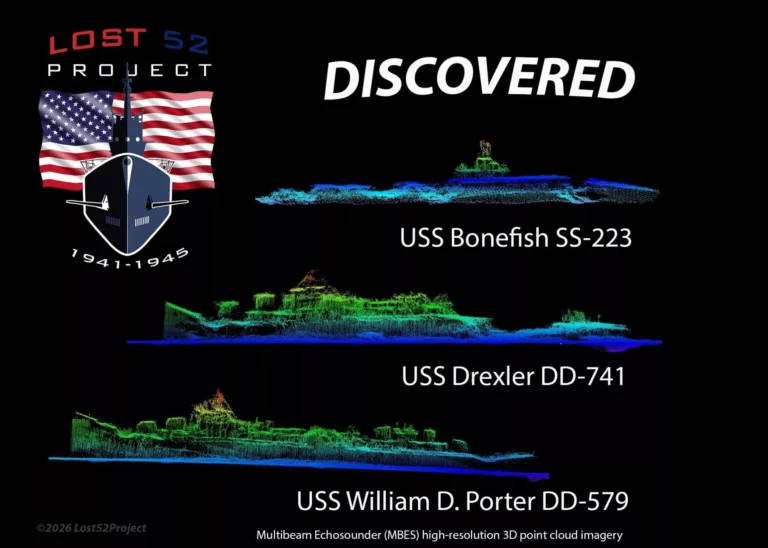
A Pacific expedition has yielded the final resting places of four shipwrecks and their crews, lost at abyssal depths in the Sea of Japan for more than 80 years.
The just-announced discoveries were made in late 2025 by the New York-based underwater archaeological body Lost 52 Project, using multibeam echo-sounder (MBES) technology.
The Lost 52 Project was initiated by Tim Taylor, founder and CEO of Tiburon Subsea, and is dedicated to uncovering and documenting the final resting places of the 52 US Navy submarines lost on patrol during WW2.
The latest venture succeeded in locating one of these submarines, the Gato-class USS Bonefish (SS-223) along with one of her victims, the Japanese merchant ship Konzan Maru.
Also located were two Sumner-class destroyers USS Drexler (DD-741) and USS William D Porter (DD-579). A total of 243 sailors died when the vessels sank in action.
‘Poignant highlight’
Finding Bonefish provided a “poignant highlight” of the expedition, according to the Lost 52 team. Under Commander Lawrence L Edge, the 95m submarine had already completed seven Pacific war patrols, earning the Navy Unit Commendation and seven battle stars for distinguished service.
It was Bonefish that torpedoed and sank the Konzan Maru on the submarine’s eighth and final mission in June 1945, in the Toyama Wan area of the Sea of Japan. Reprisal attacks from the merchant ship’s escort vessels brought about her own sinking, with the loss of 85 crew.
Found at a depth of around 3.4km, Bonefish was the second-last US submarine sinking of WW2 and the Lost 52 Project’s ninth submarine discovery.


The destroyers Drexler and William D Porter are said to have played a critical role in the Pacific campaign, with the former sunk in a kamikaze attack during the Battle of Okinawa with a loss of 158 men.
The Porter met her fate after a series of similar fateful events, with 61 wounded and no loss of life. Both were found at depths of around 3.8km.


The loss of Konzan Maru and its crew “in the chaos of war” represented the broader impact of conflict on seafaring nations, according to the team. The depth of the Japanese wreck has not been disclosed.
Lost 52 technology
The Lost 52 Project makes use of autonomous underwater vehicles (AUVs) to run pre-programmed survey grids and map large areas of seabed at depth. It also uses Synthetic Aperture Sonar (SAS) to produce ultra-high-resolution acoustic images that allow researchers to better discern wreck shapes.
It usess ROVs with HD video cameras and lighting systems for close inspection, while multi-source data fusion enables sonar, video and navigation data to be combined into detailed maps and the creation of ‘4D’ site reconstructions.
“Working with pioneering underwater robotic technology has allowed me and my team to document each gravesite using advanced 4D modeling photogrammetry, thus creating the most comprehensive historical and archaeological records to date, ensuring that the legacy of our heroes is preserved for generations to come,” said Taylor.
Two years ago the Lost 52 Project located the WW2 US submarine known as “Hit ‘Em Harder“, as reported on Divernet.
In recognition of his landmark discoveries, Taylor was awarded the US Navy Distinguished Public Service Medal, its highest honour for civilians, in 2021. His company Tiburon Subsea develops autonomous underwater robotic technologies for both defence and commercial applications.

I wish someone would search for the USS Spence DD512 that sank during Typhoon Cobra in Dec. 1944. My Father was one of only 23 survivors.