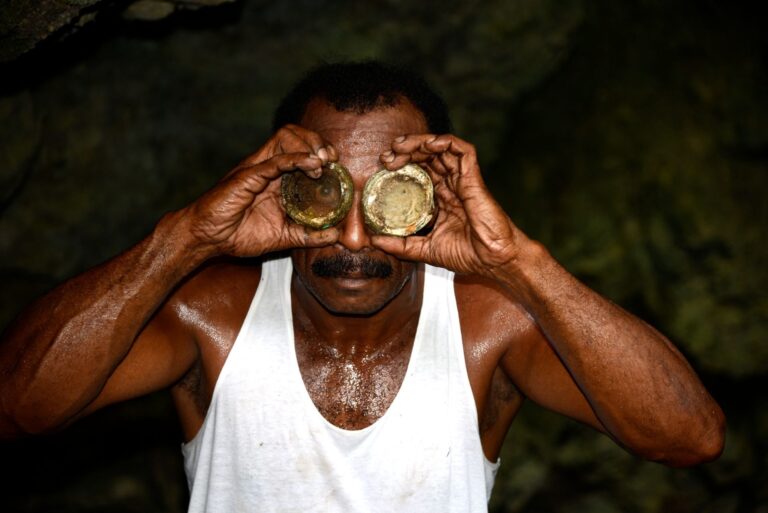
Way off the beaten track, as he often tends to be, diver-explorer PIERRE CONSTANT seeks out cave-sites on a West Papua island where Japanese forces once burrowed into subterranean networks during World War Two
The main island of the Biak archipelago lies in Cenderawasih Bay, near the northern coast of the Indonesian province of West Papua. While 90% of mainland Papua is Christian, 50% of Biak is Muslim, though it was originally animist, because the Biak Numfor culture is a Melanesian one.
The island was first sighted by Portuguese navigator Jorge de Meneses in 1526, and Spanish navigator Alvaro de Saavedra sailed by two years later.
During World War Two, Biak was a stronghold for the Imperial Japanese Army. Towards the end of the war, 11,000 IJN troops were hiding in its jungle caves with plenty of ammunition and nine Type 95 HaGo light tanks, waiting for General McArthur’s US forces.
Gua Jepang (Japanese Cave), 5km from Biak City, was part of a system that extended 3km towards Parai Beach and provided a refuge for 3,000 Japanese troops. However, after a US plane had been shot down by a missile fired from there, the Americans started bombing the site, massacring those inside.
By the end of the Battle of Biak, which lasted from the US landing on 27 May until 17 August, 1944, the USA had suffered 3,000 casualties and 474 dead, while the Japanese forces had 6,100 dead and 450 captured. Their commander Col Kizume Naoyuki committed hara kiri.
Japanese Bay
After a two-day journey from France via Jakarta, my plane lands in Biak at 5.30am. I’m jet-lagged, and will take two days to recover.
I head for Gua Jepang on the back of a motorcycle belonging to Jake, the Asana Biak Hotel’s receptionist. Covered in green moss, a cemented path leads to a stairway that disappears underground in a zigzag.


Rather wet, the archway entrance is like that of a cathedral, with water dripping from the ceiling. The enormous chamber reveals an exit to the right and another gigantic one to the left. Broken bottles lie everywhere.
I discover a golden-brown bone embedded in the cave-floor. An impressive curtain of vines and roots runs down the wall on the left, which opens into a large sinkhole. The site is atmospheric.
Slim pandanus trees with their crowns of long spiny leaves stand erect in the middle of the sinkhole, adding a touch of Jurassic Park to this eerie environment. Old rusty Japanese barrels can be found at the foot of the hanging vines.
The trail loops around the interior, climbing slowly to a rise overlooking the core of the hole. Suddenly, Jake points out a copper-brown snake, about 1m long, resting motionless straight ahead of me. “Mangabasio!”, he warns, taking a step back. “Poisonous!”

I take a few shots before the snake ventures up the cliffside with amazing facility. The open-air museum displays machine-guns, mortars, shells, bombs, rockets, a collection of Japanese canteens, helmets, bottles and even old 4x4s and a propeller.

It is market day in Bosnik, site of the amphibious US landing of 27 May. The stalls sell typical Papuan food such as areca nut, cassava, sweet potatoes and sago cakes, as well as smoked octopus and beads of smoked shells, fresh fish, papaya leaves, beans and bananas.
Everybody chews areca nut all day long and greets me with a vivid red-mouthed grin as I stroll by, a stranger in a strange land: “Hello, mister!” Bosnik is the departure point for public boats to the nearby Padaido Islands, known for offering attractive dive-sites.

Covered in jungle, a 40m-high limestone ridge runs like a spine along the south coast, all the way to Tanjung Barari, Biak’s eastern cape. It’s an old fringing reef that evolved into a karst environment, with caves and underground rivers. I plan to explore it over the next few days.
Opiaref Cave
Still jet-lagged, I get up at 3am. Divemaster Yulius pops round later on his motorbike, frowning at the sight of my pile of bags. We head for the village of Opiaref, beyond Bosnik. I have heard of a large cave with pools of water, a playground for the schoolkids, and am anticipating some cave-diving, although Yulius is not a cave-diver.

To be politically correct we pay a visit to the ‘bigman’, who does not have any objections to my visit. He is eager to know if I’ll discover anything.
Behind the elementary school, a path leads to a giant opening in the limestone cliff, big enough for a subway tunnel. Gua Serumi (Opiaref Cave) looks like an underground river. Beyond the rockpile at the entrance, the water pools are stunningly clear. This is the freshwater reservoir of the village.

Donning my equipment on a slippery rock covered in bat guano, I jump in.
The first pool is 2-3m deep, but I find a passage to the right under the rock that plunges into a narrow tunnel. Some fish come to meet me – they are slate-grey with a double dorsal fin, opaque cobalt blue eyes and a protruding lower jaw. Large, inquisitive shrimps with long blue pincers are attracted by the torch-beam.


I make my way to the second pool. Easily 10m high, the main tunnel ends with a rock wall, about 60m from the entrance. Climbing over the rocks in the middle of the cave, I notice that the depth increases on the other side. Another passage opens on the right, narrower and snaky.
The rock wall still in front, I notice the stark contrast between the white limestone and some conspicuously dark-brown sedimentary rock. A vertical oval-shaped narrow corridor opens up on my left and leads to a side chamber, oblong and parallel to the main tunnel.

The bottom is covered in highly volatile, fine silt that a fin-kick can disturb in a second. The excellent visibility is a plus. Gua Serumi is small and has a maximum depth of just under 9m.

Yulius introduces me to Salmon, a bearded, jovial Papuan farmer. Also a diver, he knows of a freshwater lake near Samares Beach on the north coast: “Let’s go!”
The road meanders for a while, then becomes a dirt track carved with gullies by the rains. It’s a mountainous area of thick jungle with big trees.
Leaving the car behind, we proceed uphill on foot, then steeply downhill for the next 45 minutes. The awful sound of chainsaws confirms that logging is going on in the area, and silences the joyful shrieks of sulphur-crested cockatoos, Eclectus parrots and black-capped lories.
Pantai Samares is a deserted Pacific beach. A trail climbs up into the jungle between large buttress-root trees and nipa palms. Opsnundi (Jumping Man) Lake appears in a clearing, a magical, turquoise pool of water. Big logs have fallen into it, but the water is gin-clear and it is a visual enchantment.

My feelers tell me of a hole in the middle, but I won’t know for sure until I venture beneath the surface.
Air Biru Cave

In the village of Anggraidi, we check the cave of Air Biru. The large opening looks like a gargantuan mouth with fangs – bulging, rounded stalactites. It’s a clearwater pool. A big fish checks me out on my 15-minute dive but I fail to find any leads.
Seen from under water, the big stalactites encourage creative photography. I find the dark-grey fish with its yellow-rimmed fins in a corner – it’s the same species as in Opiaref, though this one is 25cm long. An eel emerges from the darkness into the light, only to disappear in a flash.
Snermus & Snermas Lakes
A tar road links Biak City to Korem on the north coast. Three freshwater lakes give the illusion of sinkholes, but their apple-green colour takes away any hope.
Snermus and Snermas Lakes provide decent swimming-pools for the local kids with their floating rafts and logs but under water the visibility is hardly 50cm, and maximum depth 12m to the silt. Disappointing.
Cradled in a U-shaped bay, Korem Beach was the site of a devastating tsunami in 1996. Tanjung Saruri, on the north coast, is a cape with uplifted coral terraces. It’s a very photogenic shelf, with pools of water at low tide.

Further west is the village of Warsa, and beyond it lies the bridge that provides the gateway to Supiori island, which is more mountainous than Biak. There the road divides between north and south, leading all the way to Korido.
Some 45 minutes south of the bridge is the interesting cave of Mankruro, which was also used by Japanese soldiers.

Opsnundi Lake
With a burst of courage, I return to Opsnundi with all my gear. Salmon volunteers to carry the tank: “No problem, Papuans are strong men!”. I have enough to carry with my backpack, the gear in a mesh bag and the camera at arm’s length.


Despite the lack of sunshine, the dive proves to be a thrilling experience. In blue water, I marvel at the jumble of logs draped in mosses and hanging algae, and fish that have never seen a diver before.
With a maximum depth of 13m, I also find a small limestone cave, but by the time I finish the 52min dive I am shivering.
Simpson’s Cave
An interesting spot lies at Ruar village, where a stream flows out of a cave in the cliffside. I poke my nose inside and, after progressing 10m in the underground tunnel, find that the water emerges into a deep vertical pit with sharp limestone all around it.
I dive in with my torch and a strong line attached to a rock above the hole. At a depth of 3.5m the corridor is level but I face a dead end, with nowhere for me to squeeze through.
Simpson, the ‘bigman’, reckons I will be keen see some Japanese caves in the jungle behind Ruar village. He looks doubtfully at my flip-flops but says reassuringly: “It is only 200m away!”
It turns out to be a steep uphill trek, slippery through the jungle and an hour there and back. We reach the gaping jaw of the cave, at the foot of a steep cluster of boulders, but there is no way in there with flip-flops.
The following Sunday morning, dressed in white shirt and black tie, Simpson is ready for church. “I’ll be back in an hour,” he says. I am fast asleep on a chair on his balcony when he returns – five and a half hours later.
Back on site. Simpson swiftly chops down a couple of slim, straight trees and turns them into a ladder that will allow us to negotiate the cave entrance.


The cave is huge, with hidden chambers, stalactites, shawls (calcite crystal formations), huge columns and thin pillars.
The floor is littered with broken bottles, rusty cans and square biscuit-tins. I can barely imagine the dreadful conditions in which these Japanese soldiers lived in the darkness, like rats. It must have been miserable and mentally depressing.

Some remains of a gas mask’s round spectacles lie on the ground outside the entrance. I name the site Simpson’s Cave.
Lima Kamar
Hidden downhill on the left side of the road lies a humble Japanese memorial with an old wooden pillar carved with Kanji inscriptions. Nearby is Lima Kamar, a subterranean cave with five chambers. “It used to be a Japanese hospital during the war,” explains Simpson.

It’s a cluster of small chambers linked together by narrow passages, with medicine flasks and empty bottles lying scattered in a corner. This rat-hole gives a chilling dimension to the horrors of a bygone past.
Owi Island
One evening I meet the Bupati, Yusuf Melianus Maryen, who was the political leader of the Biak Regency for more than 10 years. A warm, affable man, he greets me heartily with a traditional ceramic plate displaying the Cenderawasih bird of paradise.
I explain the nature of my work and Bupati offers to take me to Owi Island with his boat. Salmon has revealed the existence of caves containing “blue water” there.

The crossing on a flat sea takes half an hour. Owi Island’s white-sand beach is fringed with swaying coconut trees; a kid paddles his dug-out outrigger canoe.

A Catholic church displays a signboard inscribed Rarama bebye: “You are welcome”. We pay a ritual visit to ‘bigman’ Pete Demaras, a white-bearded fellow with a red ring of areca-nut juice around the chin.

We climb on top of a ridge and a new cave opens down a slippery slope. “This is Funfundei, which means ‘Feelgood’… During the war, the American soldiers came here to collect water”. There had been a US airfield on the island.
Switching on my headlamp, I sneak in. I need to be acrobatic through the narrow passages with stalactites overhead. I come across a clearwater pond and think: I’ll check this one out! Soon I am marvelling at two exquisite underwater chambers with stalactites, stalagmites, shawls and straws (tubular stalactites).


I also find a few fossils. There is a combshell with five fingers, some Trochus turban shells and clams. The maximum depth is 5.5m and it’s only a 20-minute dive, which does not allow exploration of any further passages. Formed above water, Feelgood Cave was later flooded by rainwater percolating through the rooftop.
Before leaving the island, Salmon reckons I should be interested in some aircraft wrecks. “Not far!” he promises. The 25min walk through a coconut grove into the bush of Owi Island leads to an overgrown tar highway – the US airfield.
I wipe the sweat from my forehead with the back of my hand. “How about the wrecks?” I enquire, still craving the real stuff.
“The airplanes? Oh… they are gone already!”

Also by Pierre on Divernet: BOUND TO DIVE THE VITU ISLANDS, DIVING INTO CUBA’S FAR WEST, NORONHA: AN ATLANTIC DIVING HOTSPOT, DIVING LIFOU, A FOSSIL ATOLL, FLORES, GATEWAY TO KOMODO, HELL’S BELLS AND OTHER YUCATAN CAVE SPECIALS and VANUATU BEYOND THE COOLIDGE