John Christopher Fine reports on his recent experiences using a ‘concierge’ dive operation while scuba diving in Islamorada, Florida Keys
It sounds like a cannon going off. A Goliath grouper can croak out sounds that signal discontent underwater. When intruded upon, these big fish can make noise. Mouth wide open, this one could have swallowed Jonah.
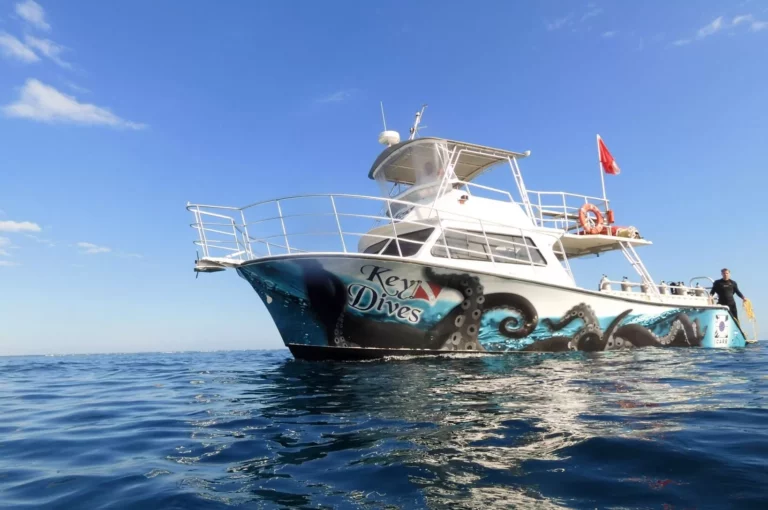
Key Dives’ Captain Bradley Williams has taken us 10km offshore to a shallow reef just south of Snake Creek Inlet. It was a fast trip out from the dock on the centre’s 12m Newton custom-built dive-boat, “Giant Stride”, equipped with two 375hp John Deere diesel engines.

“Giant Stride has capacity for 39 passengers but we limit dive-trips to 18,” Mike Goldberg had said at Key Dives’ offices and retail store on Overseas Highway in Islamorada, Florida.
Overseas Highway is what in the Keys they call US 1, a mostly two-lane road running from just below Homestead on the mainland to Key West.
After 20 years at a marina further south at Tea Table Key, Key Dives moved operations a few miles north to a canal-front location just north of the Snake Creek Inlet.
Mike had left the Virgin Islands, where he had operated a dive-resort, and brought with him commitment to making divers feel welcome with a concierge dive operation; happy, skilled staff; and free guided dives on every trip, something no one else had done in the area, and still tend not to do.

Mike is giving back to conservation 2% of all dive-revenue collected. “The more you dive with us, the more I give to charity for ocean conservation,” he says. “Others say they are into conservation and they are, yet despite my asking and hoping others would do it, I’m the only one to take it out of my pocket to do it.”
Mike and Key Dives have been contributing their tithes for ocean conservation for the past nine years. Along with Dr Kylie Smith, an environmental coral specialist, Mike founded I.CARE (Island Coral & Restoration Education), a non-profit devoted to growing and out-planting coral on reefs.
Key Dives is a Blue Star eco-tourism operator as well as a full-service dive-shop and repair facility. A new Coltri compressor fills nitrox as well as air tanks. An innovation enables high-pressure whips to fill air tanks onboard Giant Stride.
Marine life encounters: Goliath groupers to loggerhead turtles
There is no such thing as Cousteau’s “Silent World”. If the loud boom of a Goliath grouper croak isn’t enough, a venerable loggerhead turtle decides to take its meal. With powerful jaws, the large turtle takes up a conch shell and, with a crack like a rifle-shot, breaks it into pieces.
With the shell in its mouth, the loggerhead works it back and forth in its jaws, spitting out fragments of shell as it swallows the meat. It’s one of many astounding offshore performances to be seen in this area of the Florida Keys.

Diving on Crocker Reef at 14m, visibility was greater than that. Parallel valleys between coral ledges ran deeper. On any dive in the Keys or elsewhere in the world, divers notice the absence of living stony corals. Many events have taken a toll on reef life over the past few years, not least on these reefs.
Gorgonian coral and brightly coloured sponges attract reef fish to this area. When divers spear invasive lionfish, nurse sharks are sure to come calling to find out whether any generous diver will offer them a free meal.
Lionfish-hunters rarely share that tender, white flesh these days, preferring to take their catch ashore, cut off the spines and make small fillets of delicious meat.
Captain Bradley has Giant Stride moored at a ball-float provided by the sanctuary to prevent anchoring and consequent damage to the reefs.
Drift diving and reef conservation in Islamorada
The second dive is a drift called Fish Bowl. Kristy Gross, Key Dives’ operations manager, leads the dive, carrying a reel attached to a dive-flag on the surface.

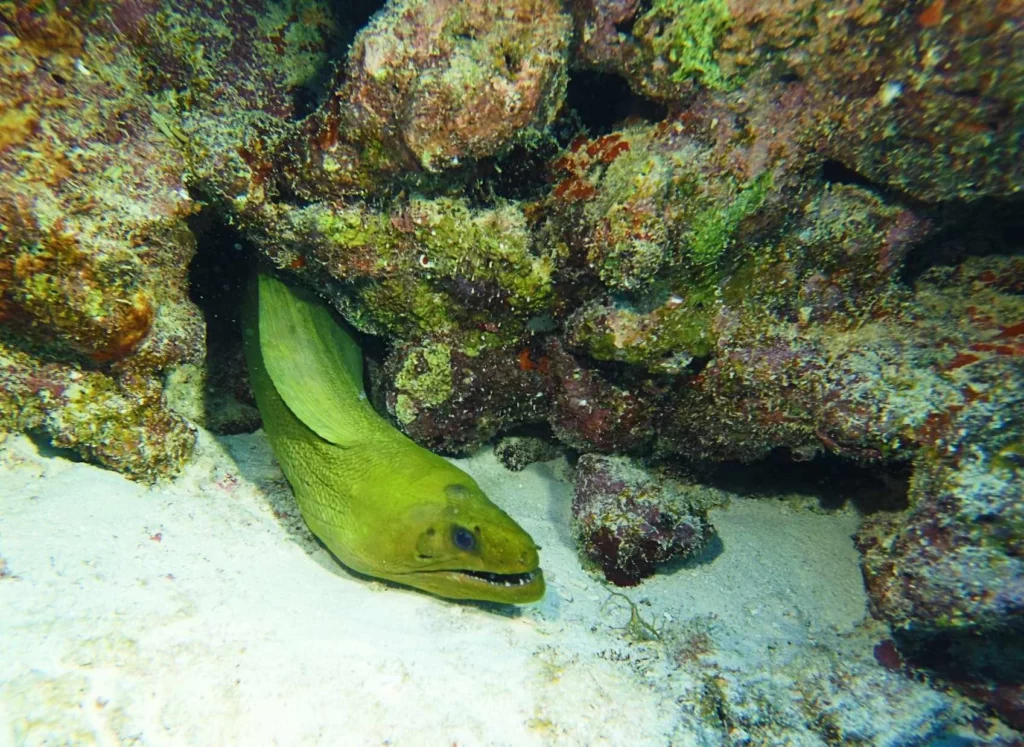
A current running at 1.5 knots whisks the divers along a brisk pace. Green morays swim free, although shy, ducking under coral as photographers close in to take pictures.
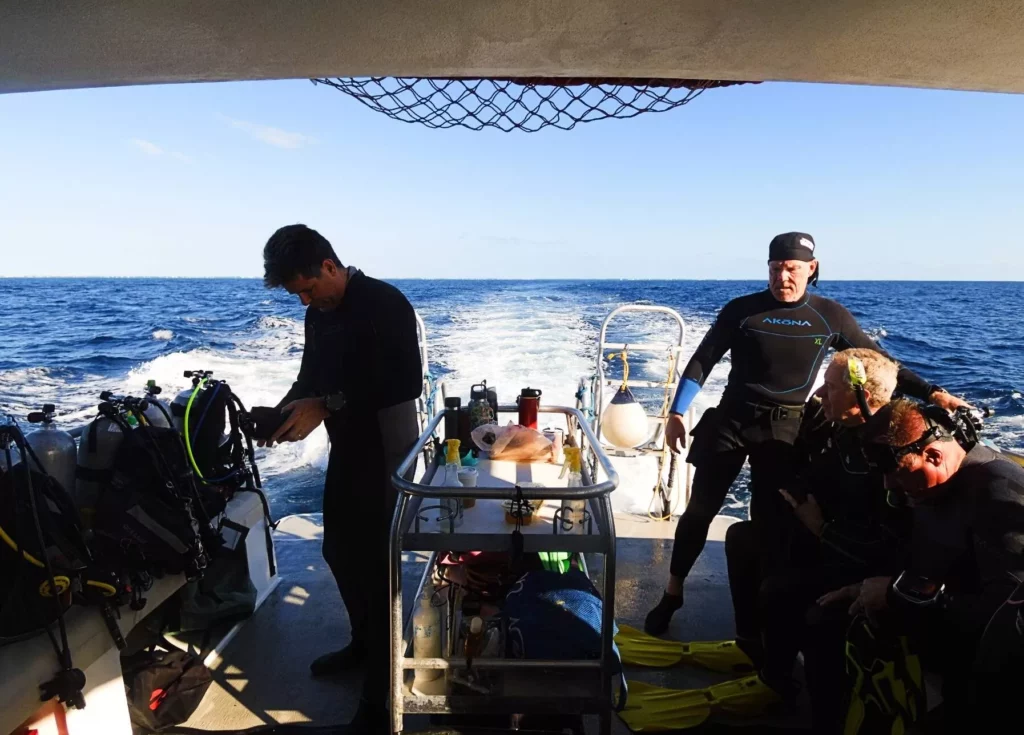
Some dive operators have no idea what it takes for a diver with up to 40kg of gear on to get back aboard their boat after a dive. Giant Stride has two well-designed ladders with hand-hold rails and wide steps. Once up far enough, there are other rails onto which to hold to get on deck.
A camera-table rail provides hand-holds, then overhead solid rails give balance as deck-hands guide divers to their seats.
Key Dives also makes good use of a yellow float-line attached to a large red ball. At pick-up the deck-hand throws the line out so that divers can take hold and pull themselves towards the boat.

Camera gear and fins are handed to the in-water dive-guide, who passes them up. This beats trying to hold onto a swim platform or ladder while attempting to get fins off or hand gear up, especially when there are waves and everything is going up and down. A good ladder means a good dive operation.
Victory is a 16m reef-dive offering good visibility. I.CARE has been out-planting coral at this site and monitoring growth for several years now. Reef-life abounds and many tropical fish can be seen.
Because the reefs are within the National Marine Sanctuary, taking, touching and spearfishing are not allowed. Marine life is accustomed to friendly divers. With a little patience, lobsters can actually be persuaded to come out of their crevices and pose for photographers.
We are then dropped at a place called Rocky Top, a 9m dive but spectacular. Here I.CARE out-plantings of staghorn, brain and star corals are taking hold and giving the reef new life.
A friendly young green turtle lives here and poses for photographers, to the enjoyment of all the divers. Captain Bradley has named the turtle Rocky.

Diving the Eagle shipwreck
Every Friday is Eagle day at Key Dives. The shipwreck is about 10km offshore, some 6km north of the Alligator Reef light-tower. The 88m former cargo ship’s superstructure is in about 24m of water and it’s 33m to the sand.
Intact when she was sunk as an artificial reef in 1985, a 1998 hurricane split the shipwreck in two, twisting the hull apart. It is marked with thick buoyed descent-lines.
Giant Stride ties off to the bow buoy, establishing lines from the stern to the downline so that divers can pull themselves along in the current and descend.
Originally called Raila Dan, the Dutch-built ship was launched in 1962. Different owners, different names, and the last official one was Aaron K. Steaming from Miami to Venezuela in 1985 a fire broke out, and later the derelict shell was towed into the Miami River.
It was the Eagle Tire Co that donated $20,000 towards leaning up and sinking the vessel as an artificial reef, so now the site is referred to as the Eagle.

Eagle’s mast provides a cross in the ocean. Photographed against the sun with a Goliath grouper swimming past makes for a tantalising image.

Turtles and sharks are usually present on the wreck and now, with the passage of time, marine life has taken refuge on the steel hull and superstructure. Diving the Eagle is a weekly Key Dives highlight.
Crater Junior, a 12m dive, lies close to the Eagle and is often used as a second-dive site. Visibility is exceptional here, at least 24m. Valleys between the coral ranges are sand-filled and offer contrast to reefs that rise about 1m above the bottom, with larger clumps of coral heads.
A natural brain coral can be seen on this dive, wonderfully encouraging us that the reef is healthy.
Shallow reefs for photography: Davis & Davy Crocker
A favourite dive-site for both scuba-divers and snorkellers is the 6m-deep Davis Reef, home to a friendly Goliath grouper. Depending on its mood, and how many divers have passed by before, the big fish will swim up to divers and pose for pictures.
This is an excellent reef for beginners and underwater photographers. The reef can easily be seen from the surface with its top in 3m of water.
Another shallow (6m) reef-dive is at a site called Davy Crocker. With exceptional visibility this reef can rival any in the world for beauty. Our dive-guide leads the way with a green moray eel checking us out before ducking back into its coral home.
Nurse sharks wedge themselves under a ledge, remaining still while using their powerful cheek muscles to pump water over their gills.
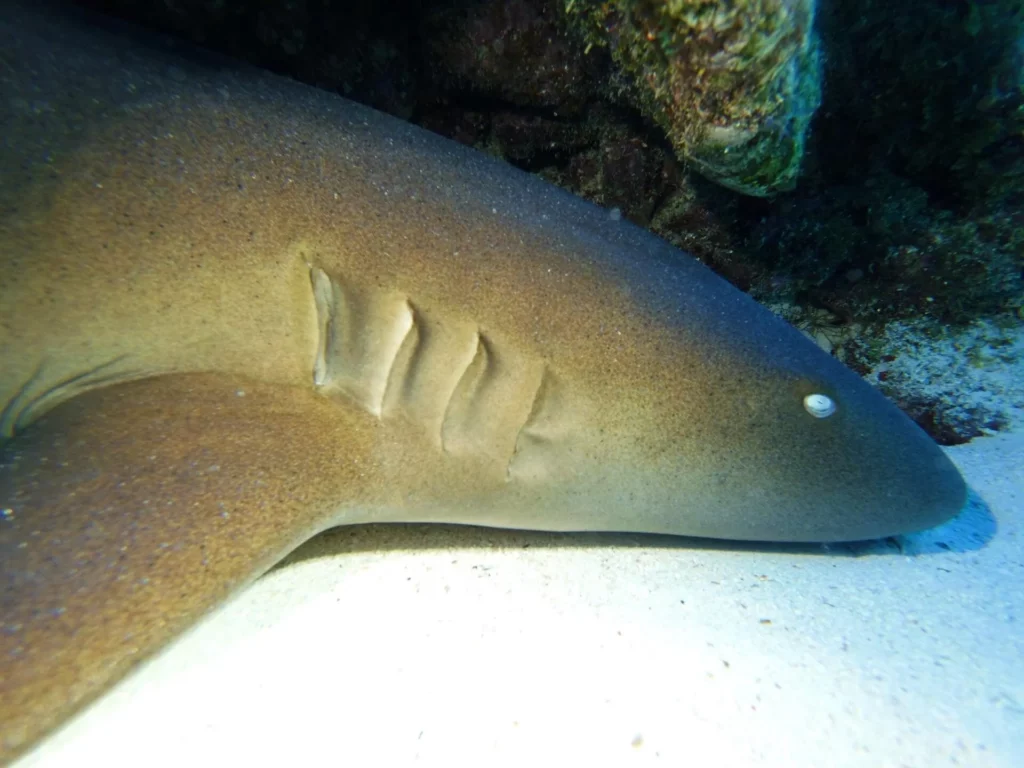
These nurse sharks are also used to divers and remain still for pictures until they get bored and swim away.
Away from the shallow area at Davis Reef is a deeper side that leads down through sand valleys between coral lanes to 24m at the sandy eastern edge. This can be an exciting dive when large ocean-dwellers come in out of the blue. Bull sharks have been sighted on the deeper side.
We do a second dive here, drifting with the divemaster holding an SMB. It’s exciting as a one-knot current whisks us along over coral-reef outcroppings and sand valleys along which nurse sharks swim. The healthy reefs are resplendent with tropical fish and moray eels.
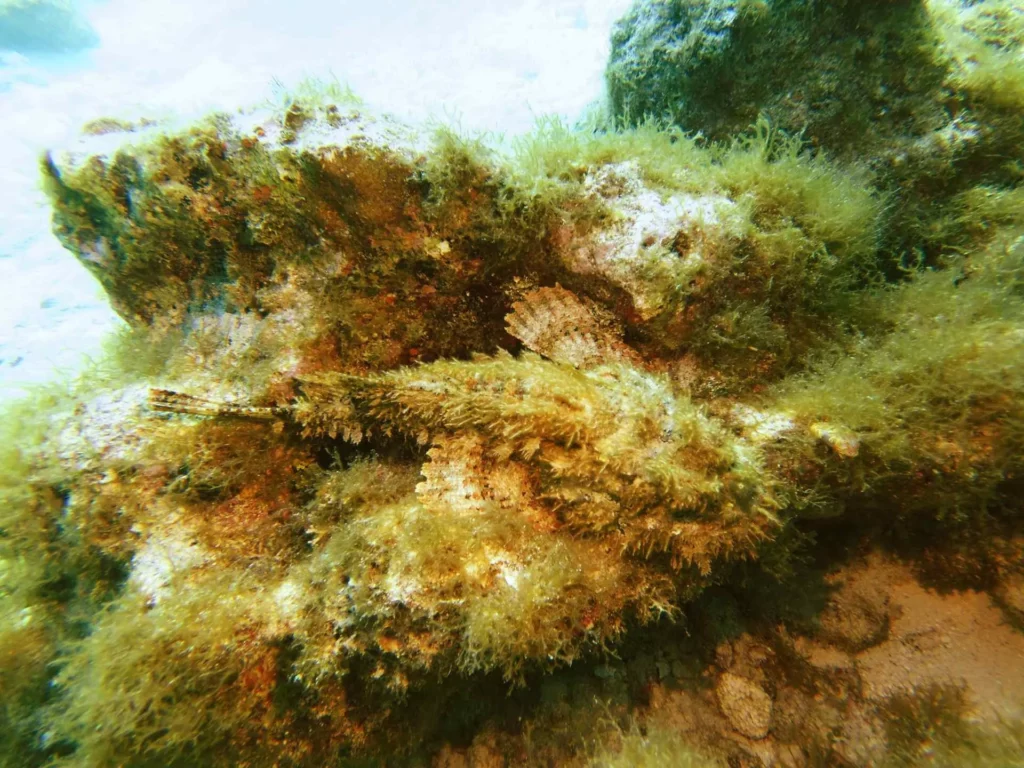
Key Dives’ experienced dive guides make all the difference for those unfamiliar with the reefs. The divemaster accompaniment enables divers to take full advantage of what can be seen at the sites. Experienced and novice divers alike appreciate not having to be overly concerned about orientation and the extra measure of safety afforded.
There are many places to dive along Florida’s Atlantic coast. For those looking for adventure with safety, a concierge dive-boat like this, with an experienced and enthusiastic crew can make a good choice.
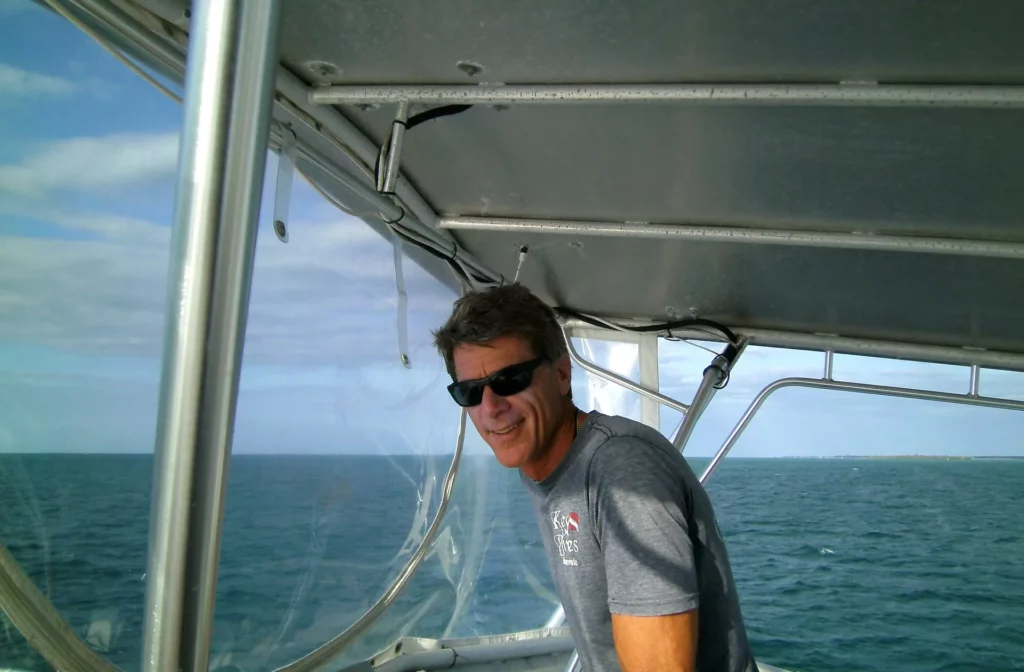
Mike Goldberg has been diving, teaching diving and running dive-operations for a long time but still thrills at things he sees and does under water.
When told about the loggerhead turtle chowing down on a conch shell, he says he had never seen that and wished he had been on the dive instead of doing paperwork at the shop.
To experience diving in the Islamorada area, which is about 30km south of Key Largo, visit the Key Dives site.
Frequently Asked Questions
What is the best time of year for scuba diving in Islamorada?
While diving is year-round in the Florida Keys, the late spring and summer months (April to July) typically offer the calmest seas and best visibility, often exceeding 25m.
How deep is the Eagle shipwreck in Islamorada?
The Eagle shipwreck sits in approximately 33m of water on the sand, with its superstructure rising to about 24m, making it an ideal site for advanced divers or those with deep-diving certification.
What is “concierge diving” in the Florida Keys?
Concierge diving, offered by operators like Key Dives, focuses on high-level service where the crew handles heavy gear, provides guided tours, and ensures a stress-free entry and exit from the water.
Can beginners dive the reefs in Islamorada?
Yes. Sites like Davis Reef and Davy Crocker are shallow (6m–9m), offering exceptional visibility and minimal current, which is perfect for novice divers and underwater photographers.
What is I.CARE in the Florida Keys?
I.CARE (Island Coral & Restoration Education) is a non-profit dedicated to restoring the reefs in Islamorada. Divers can often visit sites like “Victory” or “Rocky Top” to see active staghorn and brain coral out-plantings.
Other features by John Christopher Fine on Divernet
