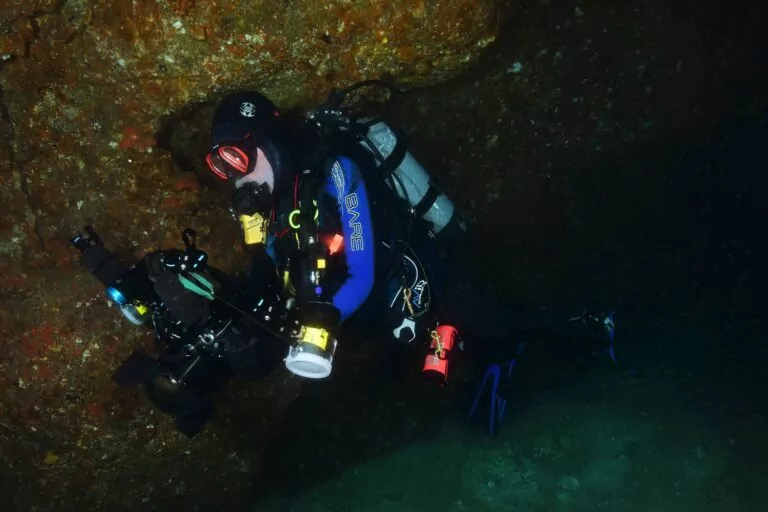
This body of water on Mexico’s Pacific coast is associated with spectacular marine life, but its wrecks shouldn’t be overlooked, say MICHAEL SALVAREZZA & CHRISTOPHER P WEAVER. Though many were deliberately sunk as artificial reefs, that didn’t mean they hadn’t enjoyed illustrious careers, often dating back as far as World War Two
The Sea of Cortez, sometimes referred to as the Gulf of California, is a favourite destination for scuba divers. It is home to inquisitive sea-lions, migrating whales, schooling hammerhead sharks, swirling baitballs of fish and a palette of marine life so intriguing that Jacques Cousteau referred to its waters as “the world’s aquarium”.
Also read: Diving the Bermuda (Triangle) shipwrecks
There are numerous opportunities here for both land- and liveaboard-based diving. Divers departing from the southern city of Cabo San Lucas can enjoy great dives in the vicinity and return for lunch, or venture further offshore to the fabled Gordo Banks.

There, nutrient-rich water funnels through a series of seamounts and attracts dazzling schools of sharks, mobula rays, tuna, wahoo and marlin.
In La Paz, divers and snorkellers have the opportunity to encounter whale sharks while, in the Cabo Pulmo National Park, bull sharks are the diver’s quarry. Recently pods of orcas have been encountered and some liveaboards are orienting their adventures in the hopes of encountering these true apex predators.

For our expedition to explore the waters of the southern Sea of Cortez, we departed Cabo San Lucas and headed north aboard the Nautilus Adventures liveaboard Gallant Lady.


Most bodies of navigable water hold the secrets of ships beneath their surface, and the Sea of Cortez is no different. While most visitors are mesmerised by the marine life in this area, we wanted to explore these sunken relics and learn their stories.
The C-54
The first was a wreck known as the C-54 Agustin Melgar, an old minesweeper that sank in 2000 south of a place called Puerto Escondido. At 56m long with an 11m beam, this is one of the least-known and most under-rated wreck dives in the Sea of Cortez.

The ship was built in Tampa, Florida in 1944 and launched under the rather unromantic name USS Device (AM-220). After an initial assignment to the Panama Canal Zone she moved to Pearl Harbor to escort other ships and convoys.

She patrolled the waters around Palau in Micronesia in late 1944 before returning to escort duties at such Pacific locations as Kossol Roads, Manus, Ulithi, Guam, Saipan, Philippines and, lastly, the island of Okinawa, where she escorted several war cargo and assault ships.
On 6 April, 1945, AM-220 was called to the aid of the warship USS Mullany, which had been struck in Japanese kamikaze attacks, and rescued 16 survivors. She kept sweeping mines throughout the Far East and supported the operation of the US 3rd Fleet against Japan. The vessel was awarded three battle stars for her WW2 service.
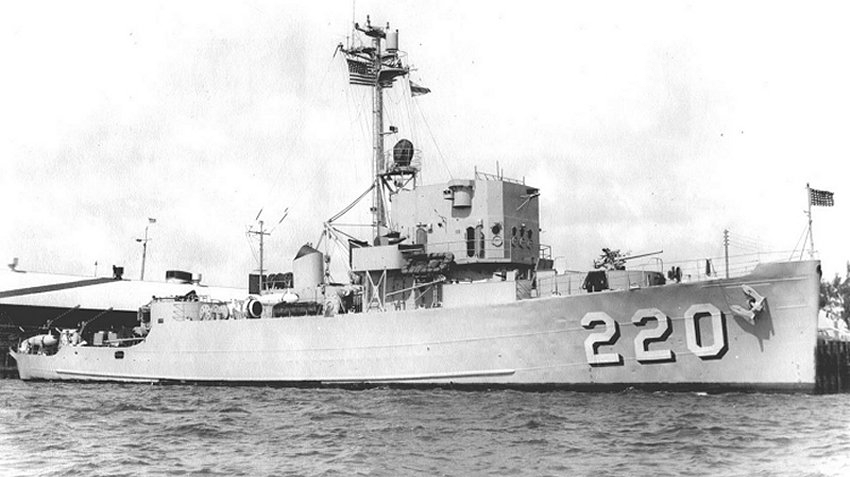
In 1950 she was recommissioned as a training vessel, operating on the US east coast, Canada and the Caribbean, before becoming MSF-220 in 1955 and in 1962 was sold to the Mexican government. Her surface story ended only in 2000, when she was sunk intentionally to create an artificial reef within the Loreto Bay National Park.

Today as C-54 the wreck makes a great dive for shipwreck explorers. We always reflect on a ship’s history when we pass through its ghostly remains or touch the metal of her superstructure because every one has a history. In C-54’s case it’s the terrible fighting of WW2 that comes to mind as we swim through her long silent corridors.


The wreck sits upright 21m deep and is covered in marine growth. Brilliant yellow gorgonians and red encrusting sponges adorn its structure, and an assortment of fish use the vessel for shelter.
Because the vessel was well-prepared before sinking penetration is easy, with many swim-throughs and easy exits visible throughout the dive, which makes an ideal introduction to the wrecks of the southern Sea of Cortez.
The Fang Ming

Near the El Bajo seamount, the Fang Ming has a darker legacy. This Chinese fishing vessel was seized by the Mexican authorities on 18 April, 1995, for trying to smuggle migrant workers into the USA. They found 88 men and seven women kept in a confined space onboard.

After four years, the government decided that it had no use for the seized vessel and on 18 November, 1999, sank the 56m Fang Ming near Isla Ballena as Latin America’s first artificial reef.
This popular dive-site lies on the west coast of Espíritu Santo Island, in front of El Corralito in 23m of water. It hosts an abundance of marine life, including large green turtles that seem to enjoy a quiet rest on the decks.

On our dive, we experienced a thermocline at around 18m, where the water temperature dropped from 24 to 21°C, below which the water was much murkier. This added a sense of mystery to the wreck of a ship once used for smuggling humans.
The C-59
Another sunken secret of the southern Sea of Cortez is what is usually called the C-59 wreck, though it is in fact the USS Diploma (AM221), an Admiral-class minesweeper that was awarded three battle stars for her WW2 service in the Pacific.
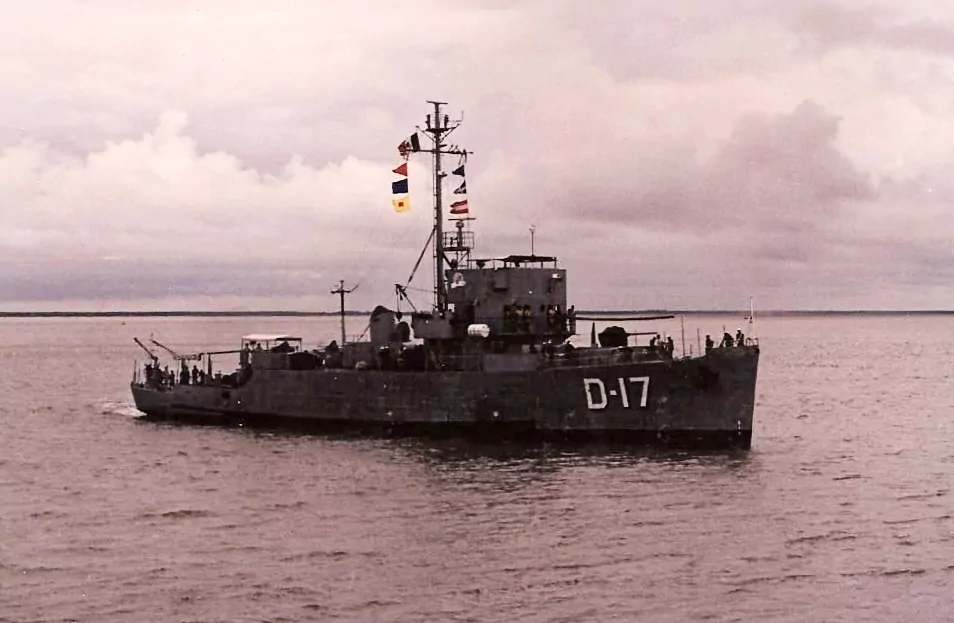
In 1962 she was sold to the Mexican Navy, renamed ARM DM-17 and then in 1994 ARM Cadete Francisco Márquez (C-59). By 2004 she was obsolete and sunk as an artificial reef near La Paz.
The wreck lies on its port side, in water ranging in depth from 21 to 9m, another example of a ship that saw ferocious fighting and now lies fading beneath the waves of the Sea of Cortez.
As on other purposely sunk ships, large cut-outs enable easy penetration. During a late-afternoon dive we were busy exploring the interior when a large California sea-lion rocketed through the wreck, diving deep into the cargo holds and then shooting out just as fast.

Seeing this marine mammal exploring the wreck brought smiles to our faces. If only we could dart about as deftly as a sea-lion!
Inside, the rusting hulk of C-59 is drab and silty, the darkness creating a sombre mood for divers. We take a moment to reflect on how this ship was once part of the effort to defeat evil.
The Salvatierra
The 97m Salvatierra was built during WW2 as a ferry to carry shipyard workers across Chesapeake Bay to Newport News, Virginia. She never saw combat action but every contribution to the war effort, large or small, was necessary.

After the war the ship was sold at auction, given the Salvatierra name and flew the Mexican flag as a ferry running between La Paz and Topolobampo (near Los Mochis in the state of Sinaloa).
In June 1976 the Salvatierra sank after striking the Suwanee Reef in the dark of night. Because she had been carrying a highly combustible cargo of gasoline, jet fuel, butane and diesel fuel there were no passengers on board.
She sank in 18m but, several months later on 30 September, Hurricane Liza moved over La Paz with winds reaching 120mph, and was powerful enough to roll the Salvatierra over onto its bottom, with the action of the waves tearing the entire housing off the deck. Battered and bruised as it is, it still now makes a terrific wreck-dive.

We explored this dark and murky shipwreck. Swimming along the twisted hulk, we could see tyres, truck parts, barrels and containers. Towards the stern, the propeller is covered in marine growth. The Salvatierra, back broken and metal sides punctured and ripped open, strikes a tortured pose.


Penetrating inside and swimming through the dim corridors takes us back to that fateful day when the ship was mortally wounded by the nearby reef. This is not a wreck that has been “prepped” for divers, so they need to be cautious when navigating through the interior.
We emerged to find an enormous southern sting ray, easily 3m from nose to tail, and scorpionfish and territorial sergeant-majors earnestly defending their egg-masses. The Salvatierra, now a thriving reef, was enjoying its final act as a marine-life haven.

When visiting the Sea of Cortez, by all means enjoy the spectacle of marine life but don’t overlook the shipwrecks below – their stories are to be learned, experienced and shared.
Also on Divernet: HOLY SPIRIT, CAGE NIGHTS WITH JUMBO SQUID, BE THE CHAMP! – YOUNG SEA-LIONS, THE SEA OF CORTEZ AND THE BAJA PENINSULA