
Dr Terry Cummins and his wife Cathie make the most of last-minute spots opening up on a Spoilsport liveaboard itinerary out to the upper Ribbon Reefs of the Great Barrier Reef
Photographs by Dr Terry and Cathie Cummins
It was late September when we had a last minute and unexpected pleasure of going out on Mike Ball Dive Expedition’s Spoilsport again. One of the advantages of living in Cairns is you can take up opportunities like this occasionally. This trip was promoted as a seven-day ‘Far Northern Expedition’, which takes you to the far north of the Great Barrier Reef Marine Park (GBRMP). We were excited at this opportunity as we would be gathering some material and photographs for broader projects we are working on.
Soon we were leaving Cairns for some of the best diving on the planet! We were lucky with the weather which allowed us to first head east to Bougainville Reef in the Coral Sea.
After a brief visit to Bougainville, we headed North and were spoilt enjoying some sensational diving over several days at the Pirates Cove / Stanley Island region north of Cape Melville, and then further south into the northern Ribbon Reefs, where we dived the Cod Hole, Light House Bommie and Gotham City.
Days pass quickly when you are having fun, so when Kristy O’Neil, our Trip Director, informed us on the evening of our sixth day, after another sensational dinner, that we would be waking up at Steve’s Bommie, all the passengers were extremely excited about the opportunity to dive this iconic dive site!
And truly a treat to round off an amazing trip. Come the next morning, the highly anticipated call ‘Wake Up Time’ meant we were anchored over Steve’s.
Steve’s Bommie is a relatively small pinnacle coming out of 30m to within 5m of the surface. So who was Steve? Steve was a much-liked mate and deckhand on a non-dive vessel which transversed the reef.
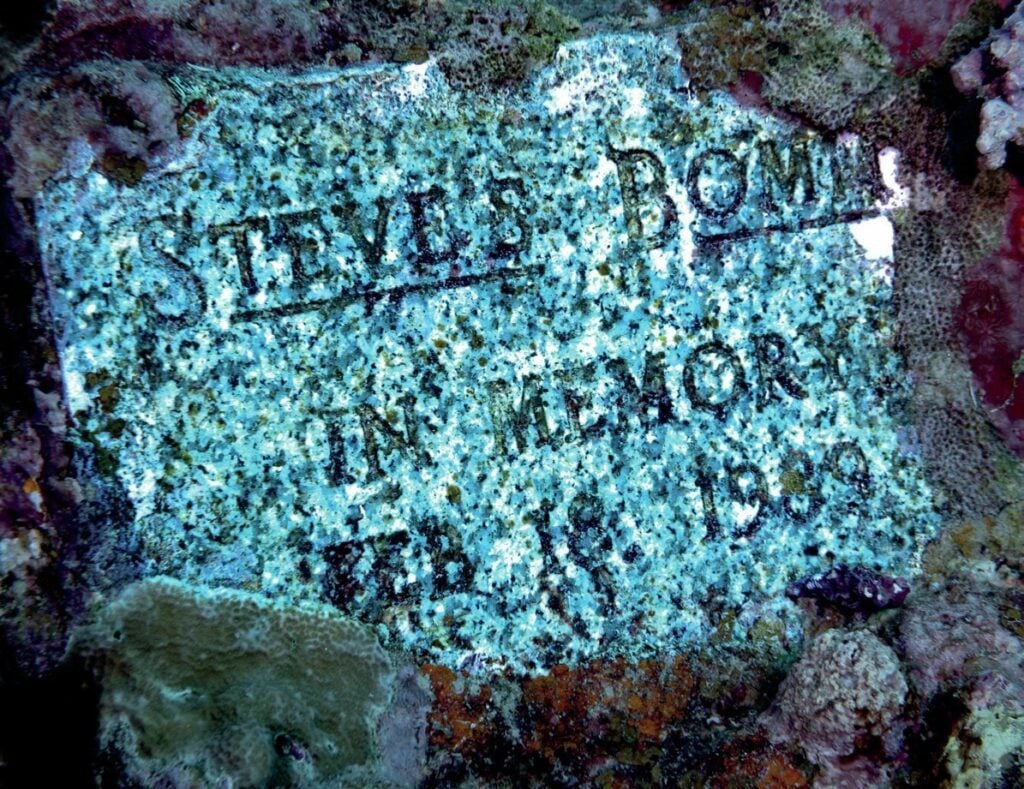
While he tragically drowned at the Cod Hole in the late-1980s, his favourite dive site was the bommie that now bears his name and fittingly a plaque has been placed there to remind us of him.
We divers enjoyed ‘first breakfast’, which is typically of the continental style with choices of cereals, yogurts, and fresh fruits and, of course, tea and coffee, but before long we were soon on the dive deck getting our cameras and dive gear ready.
Did you know?
The Great Barrier Reef Marine Park protects a large part of Australia’s Great Barrier Reef from damaging activities.
By 7am we were beaming with excitement and ready for another humorous, yet detailed, dive briefing from Kristy which included her inspiring artwork on the briefing board. Kristy included that we had an ‘open deck’ at ‘Steve’s.
This meant multiple dives were possible over the entire morning and until noon with proper consideration to recreational dive limits and to closely monitor any significant changes in the dive conditions. Dive conditions were good with a south-easterly swell and only a very slight current.
The presence of any current is not necessarily a problem on Steve’s as you can always position yourself on the lee side, and a current often adds to the number of pelagic fish and sharks you encounter.
Nevertheless, a swim line from the stern of Spoilsport to the bommie is always attached to help guide divers.
Kristy cleverly split the divers into two teams 20 minutes apart to minimise the impact of all of us at once on a relatively small dive site. Our cameras and strobes were made ready, so after a giant stride entry from the dive deck, the crew carefully passed down our cameras.
We are ‘solo’ or ‘self-reliant divers’ certified. Far from a ‘same ocean, same day’ approach, this is a ‘must-do’ certification programme for serious photographers as looking through the lens makes you a very unsuitable buddy in most instances.

Nevertheless, we generally exit the water together and while underwater often meet up and point out to each other items of interest. Being solo we always carry a redundant spare air supply and all the other safety equipment.
Spoilsport also supplies every diver with a Nautilus transmitter which in the unlikely event of an emergency can be activated and used to pin-point your position on the surface.
It was a short swim to the bommie, and with visibility running at about 20 metres, we were spell-bound by what greeted us even though we had more than 25 previous dives logged on Steve’s. As Kristy had also instructed, we began a clockwise circumnavigation of the bommie with decreasing depth on each lap.
We would do this throughout the dive to experience as much as possible this magnificent dive site and to maximise our bottom time via a multileveling dive profile. We also gained the benefits for all divers circling in the same direction as opposed of divers going everywhere on what is really a small dive area.

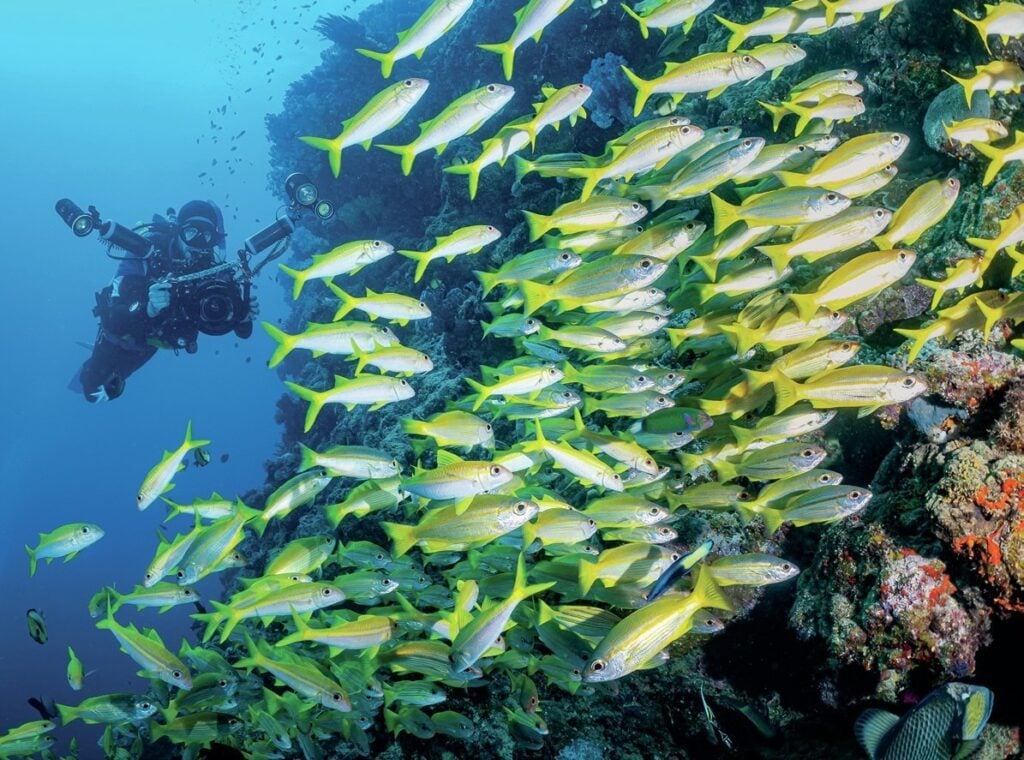
We immediately encountered grey, white and blacktip reef sharks and barracuda orbiting the bommie. A large school of ever-present yellow snapper provided wide-angle subject matter and displayed no real concern for either the diver’s presence or the multitude of predators we came across.
The position of Steve’s plaque is on a small outcrop off the main bommie. The traverse between the two is very rewarding as it is in this small gutter that you commonly find a bright red frogfish. After capturing the customary photo of Steve’s plaque, time was spent on the coral formation close by.
We knew this held rewards from previous dives. So it was no real surprise that there we found leafy scorpionfish there, perfect subjects for the Nikon 105 mm micro, 50 mm lenses and spotting strobes of our photographic arsenal.
We also encountered a little octopus. On reviewing the photographs we had taken, we could not believe the colours we captured and would recommend that every diver carry a torch on all dives.
(Cathie’s likes the fact that she can change lenses from 16mm to 50mm while remaining underwater, while Terry is limited to adding a wet diopter for macro when using his portrait favouring 105mm micro). The 105mm came in very useful when we encountered a soft coral crab.
These little critters measure just 1.5cm, are a perfect macro subject and are relatively easy to find if you spend the time to look hard enough.
Meanwhile Cathie caught up with a large green turtle asleep under one of the many ledges while Terry made friends with a wobbegong shark also sleeping under a ledge, or maybe he was just waiting for the smorgasbord of fish dashing here and there in the diver’s bubbles.
Steve’s is covered in many species of hard and soft corals, but it is not all about coral, even though that is mostly what the media talks about when reporting on the GBR. It is also very much about the variety of fish you see.
Kristy’s briefing included that we should look out for stonefish, cleaner shrimp, and other species of interest that the experienced crew marked the location of with retrievable cylume light sticks.
On this dive we saw several ‘stonies’ and quite a few lionfish of both the black and brown varieties hunting for their breakfast. Even after all our diving, stonefish and even lionfish, can be hard to see when your mind is somewhere else and another good reason to not put your hands on the reef.
If necessary, carry a camera stick if you need to really steady yourself for that perfect photograph, but above all, control your buoyancy. Spoilsport has their own admirable policy to protect the marine environment: ‘Peace on the Reef’ (V).
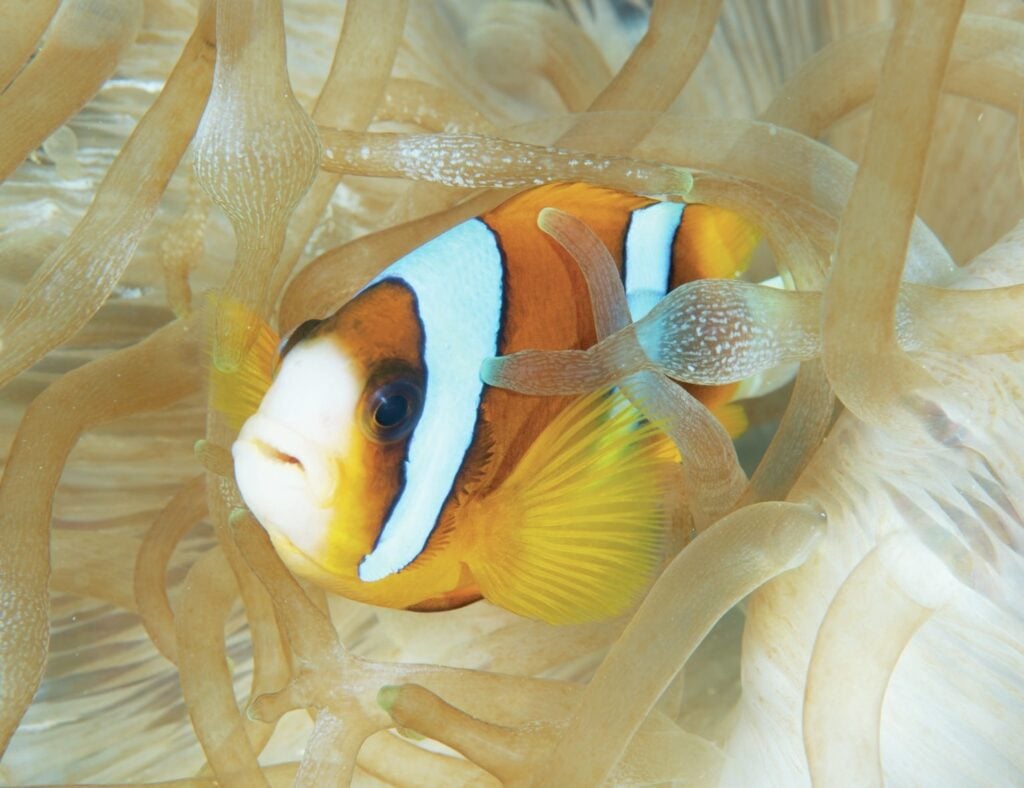
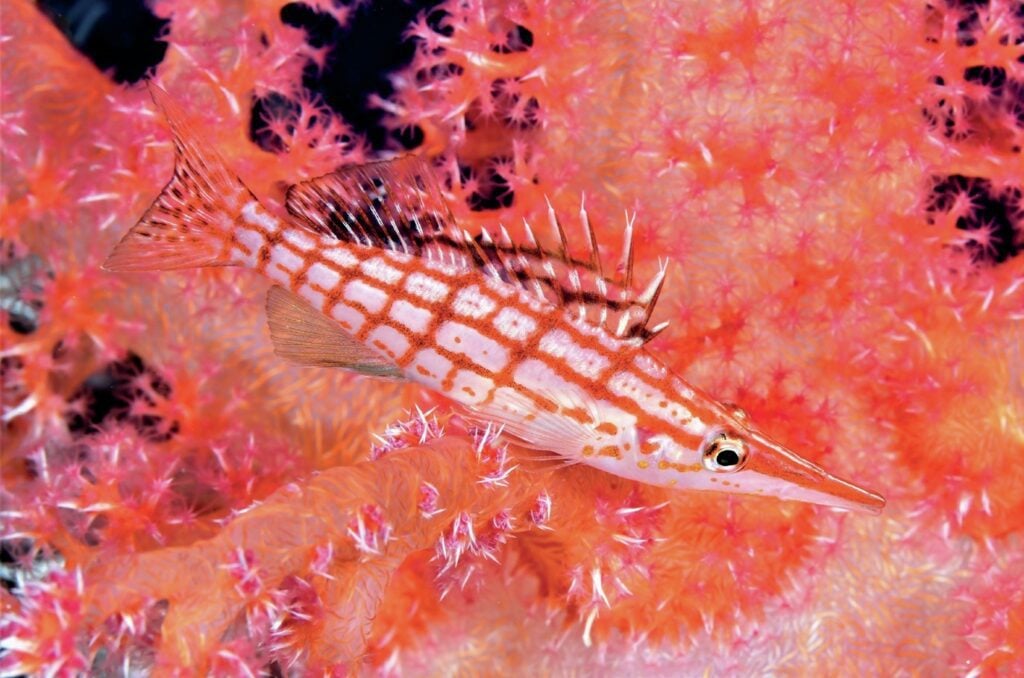
The marker buoy secured at 5m on the top of the bommie is perfect for a safety stop where you can still see and photograph the multiple species of Nemos, leopard blennies, Moorish idols, a variety of hawkfish, coral trout (and cod), wrasse, leafy scorpionfish and a massive number of other small creatures buzzing around while the pelagic and sharks remain in your view out in deeper water.
All too soon we had to end dive one (BT 60 minutes and MD of 27m). A favourable slight current and good visibility assisted our swim back to Spoilsport underwater and to also avoid any surface chop.
At this stage Cathie got a new buddy – an olive sea snake – who followed her back to Spoilsport where schools of various fish species, including sea bass, had started to gather under the hull.
The snake finally headed to the deep, but the schools of bass did not take flight on the divers returning to the big catamaran.
Kristy and her crew greeted us back on board with their usual enthusiasm and good cheer while recording our depth, time and securing our cameras in the large freshwater bins.
Our skipper, affectionally known as Pirate Pete, asked about our dive, and expressed envy when we gave him a quick report and showed him, and a few of the crew, some of our shots through the back of our Nauticam housings. But believe it or not, we were hungry.
This is not a common feeling you have on Spoilsport with a sensational selection of food flowing as a river of culinary delights.
So it was time for a full-on second breakfast (ie bacon, eggs, mushrooms, smoked salmon, baked beans, a variety of toast and on other days the second breakfast might include pancakes with fresh cream and strawberry/ blueberry topping or maple syrup).

After second breakfast we checked / replaced camera and strobe batteries and then got ready for a second dive. With a surface interval just over an hour, we were back on the bommie for another 60-minute dive with a maximum depth of 24m.
The dive was like our first, but also different. While we again met some of the same great photography subjects from our first dive, new fishy subjects attracted the interest of our cameras.
For example, Steve’s hosts many cleaner stations, so we photographed a variety fish being tended to by busy little blue and white cleaner wrasse and revisited several of the photographic subjects we encountered on our first dive.
With the second dive nearing an end we were saddened that we cannot stay underwater longer. So after momentarily stopping at 16m for a few more photos, we completed our safety stop at 5m and headed back to Spoilsport, and once again we were greeted with the usual enthusiasm and interest in our dive.
What a morning we had, but now it was time for lunch. This time we were treated to a smorgasbord of tasty delights. We have to say the home-made soups also provided with all main meals on Spoilsport are amazing.
This adventure did not fully end at Steve’s. After lunch it was time for a well-deserved snooze, review of our photos from the trip, again checking the dive gear and camera equipment, etc, while Spoilsport headed to our last dive site, Flare Point, for an afternoon dive and the customary end-of-trip dive party to celebrate another fantastic trip.
We all know there are dive trips and there are dive trips, but as an Australian, if you really want to experience the best of the best in your own backyard without the hassles associated with many overseas trips – Spoilsport is the stand-out answer.
The quality of the diving, staff, food, the comfort of a well-appointed reliable vessel and a compliment of like-minded divers makes for an experience rarely found elsewhere. You will not stop smiling and likely to get some of the best and most memorable photos you will ever take.
The authors
Dr Terry Cummins OAM, PhD, is acknowledged as a long-term participant in the global dive community and member of several government advisory committees.
Cathie is an award-winning photographer. Both have travelled the GBR and Coral Sea extensively as well as PNG, Solomon Islands, Fiji, Mexico and Tahiti to mention just a few.
Terry uses a Nikon D500 SLR with lens ranging from a 10mm fisheye to a 105mm micro and has a wet diopter lens and GoPro as back-up.
Cathie dives with a Nikon Z 50 mirrorless with an assortment of dry and wet lenses. They both use Nauticam housings with twin Sea and Sea strobes and spotting lights from Digital Diver.
FAQ: Steve’s Bommie & Spoilsport Liveaboard
Q: What makes Steve’s Bommie a special dive site?
A: Steve’s Bommie is a pinnacle rising from 30m to 5m, rich in coral and marine life including reef sharks, turtles, scorpionfish, and schools of snapper. It’s also home to a memorial plaque honouring Steve, a beloved local deckhand.
Q: Where is Steve’s Bommie located?
A: It sits in the northern Ribbon Reefs of the Great Barrier Reef Marine Park, accessible via liveaboard itineraries from Cairns.
Q: What can divers expect to see at Steve’s Bommie?
A: Grey, white and blacktip reef sharks, barracuda, turtles, wobbegong sharks, leafy scorpionfish, soft coral crabs, lionfish, stonefish, and large schools of yellow snapper.
Q: How is diving organised at Steve’s Bommie with Spoilsport?
A: Spoilsport typically offers an “open deck” format, allowing multiple dives throughout the morning. Divers follow multilevel profiles, circling the bommie to maximise bottom time.
Q: Is Steve’s Bommie suitable for underwater photography?
A: Yes, it’s a paradise for macro and wide-angle photographers alike, with colourful corals, unique critters, and pelagic encounters providing endless subjects.
Q: What safety measures does Spoilsport provide?
A: Each diver is equipped with a Nautilus transmitter for surface location, plus experienced dive guides and safety protocols ensuring a secure diving experience.
Q: What is life like onboard Spoilsport?
A: Spoilsport is renowned for its comfort, excellent crew, gourmet meals (including second breakfast!), and camaraderie among divers, making it one of the premier liveaboards in Australia.
This article was originally published in Scuba Diver Magazine
Subscribe today with promo code DIVE1 — enjoy 12 months for just £1!

Great article looking forward to more interactions. We’re now committed to constructing a scuba divers Academy in the Republic of Vanuatu and looking for interested partners reach out if there’s an interest