Warming seas may force whale sharks into shipping lanes, according to a new study by FREYA WOMERSLEY of the Marine Biological Association and DAVID SIMS of the University of Southampton
Global warming has the potential to reshuffle the spaces used by life on Earth, across all ecosystems. And our new research shows that whale sharks – the world’s largest fish – could be at risk, as warming oceans may force them into busy human shipping lanes.
More than 12,000 marine species are expected to redistribute in future as seas warm up. Those animals that are unable to move to remain within suitable environments risk being wiped out entirely.
But things are different for larger and highly mobile animals that can move freely to find conditions that suit their needs. For them, changing ocean conditions may not be such a huge threat in isolation, as they can migrate to cooler seas.
Rather, shifting conditions may force species into new and more dangerous areas, where they come into contact with ship propellers and other direct human threats.
We fear that this will happen with whale sharks. These huge sharks can reach up to 18m – about four cars end to end – but despite their size and robust appearance, their numbers have already declined by more than 50% in the past 75 years.

In previous research we discovered that this decline may be partly due to collisions with large ships. Whale sharks are particularly vulnerable as they cruise around feeding on plankton and other tiny organisms, rarely needing to swim faster than human walking pace. While spending long periods moving slowly near the surface, they’re often struck by ships and killed.
Our new research builds on this previous work. We find that climate change will put these docile giants in even greater danger, as their preferred habitats move in into new areas with heavy ship traffic.
An uncertain future
The research was carried out by an international team of more than 50 scientists from 18 countries involved in the Global Shark Movement Project, using 15 years’ worth of satellite tracking data from almost 350 individually tagged whale sharks.
Movement tracks were matched to temperature, salinity and other environmental conditions at the time to determine what sort of habitat the sharks preferred.
These relationships were then projected forward in time based on climate models (powerful computer programmes that simulate the climate) to reveal which parts of the ocean may in future have similar conditions to those used by the species today.
Our state-of-the-art approach uncovered totally new areas that may be able to support whale sharks in future, such as US waters in the Pacific in the region of the California bight, Japanese waters in the eastern China Sea and the Atlantic waters of many west African countries.
We quickly realised that these regions are home to some of the world’s busiest sea ports and shipping highways, so we overlaid our maps of habitat preference with those of global shipping to determine that sharks are expected to run into ships.
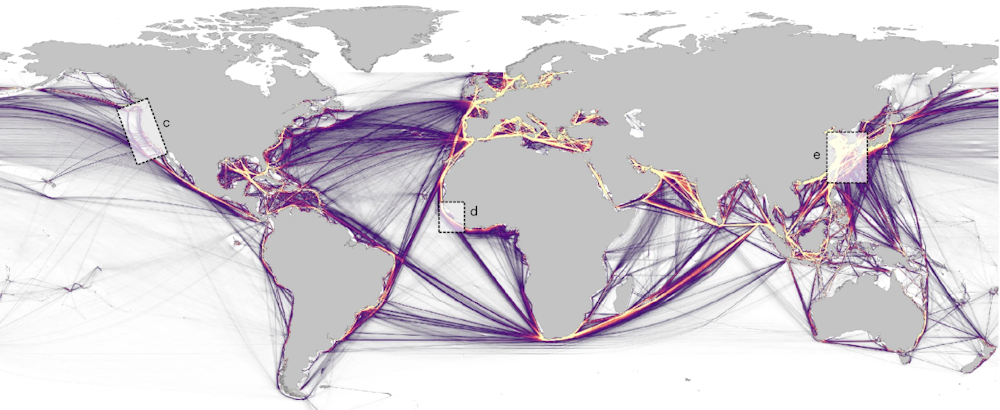
Through this we project that co-occurrence between sharks and ships will be be 15,000 times greater by the end of this century if we continue to rely heavily on fossil fuels, compared to only 20 times greater if we follow a sustainable development scenario.
This does not mean that collisions will increase by 15,000 times, or even by 20 times, as we can only predict where whale sharks will be in future and the precise number of ships will vary. However, if the sharks do move into these new areas and their busy shipping lanes, increased mortality is a very real possibility.
We’ve already recorded shark-attached satellite tags abruptly stopping transmissions in shipping lanes, with depth-recording tags showing the sharks slowly sinking – likely dead – to the seafloor.
Changing tack
Our results are alarming but highlight that we do have the capacity to change the population trajectory for whale sharks. In this case, through mitigating climate change, we can also indirectly ensure that the ocean is a safer place for some of its largest residents.
We already know which strategies to trial for limiting collisions between ships and sharks. In February 2024 a meeting of signatories to the UN’s convention on the conservation of migratory species put forward a series of recommendations with specific focus on whale sharks.
These include slowing speeds and re-routing around key sites, and setting up a collision-reporting network. It is now up to individual governments to take action.
It’s possible that other species will experience similar pressures as a result of climate change. For example, heatwaves in the oceans may force other sharks into cooler surface waters which are being exploited by longline fisheries, or into deeper depths where there is less oxygen.
It’s time to shift our focus onto these interacting stressors in future, so that we can start to quantify the mosaic of threats that marine animals must endure in the oceans of tomorrow and protect those most at risk.

Don’t have time to read about climate change as much as you’d like?
Get our award-winning weekly roundup in your inbox instead. Every Wednesday, The Conversation’s environment editor writes Imagine, a short email that goes a little deeper into just one climate issue. Join the 35,000+ readers who’ve subscribed so far.
FREYA WOMERSLEY is a Postdoctoral Research Scientist at the Marine Biological Association and DAVID SIMS is Professor of Marine Ecology at the University of Southampton. This article is republished from The Conversation under a Creative Commons licence. Read the original article.
Also on Divernet: HOW WE DISCOVERED WHAT KILLS SO MANY WHALE SHARKS, WANT TO SEE WHALE SHARKS? NO PROBLEM, YOUNG MALE WHALE SHARKS ARE HOMEBODIES, WANT TO SEE WHALE SHARKS? NO PROBLEM