You don’t have to go deep to see big animals in UK waters, as STUART PHILPOTT explains when he goes hunting for thornback rays
The owner of Porthkerris Divers (www.porthkerris.com), Mike Anselmi, said the Helford River Estuary was one of the best diving sites in the area. The shallow seabed attracted a huge diversity of marine life, including spotted sea hares, cuttlefish, clams, scallops, hermit crabs and blonde rays. But from May through to August, the star of the show has to be the thorn back rays (Raja clavata). Mike said the rays congregate in larger numbers around mid-August.
During this period, it’s not unusual to encounter at least five or six different individuals on a single one-hour long dive. The rays normally stick together in loose packs so when one is spotted, there’s a good chance of finding several more.
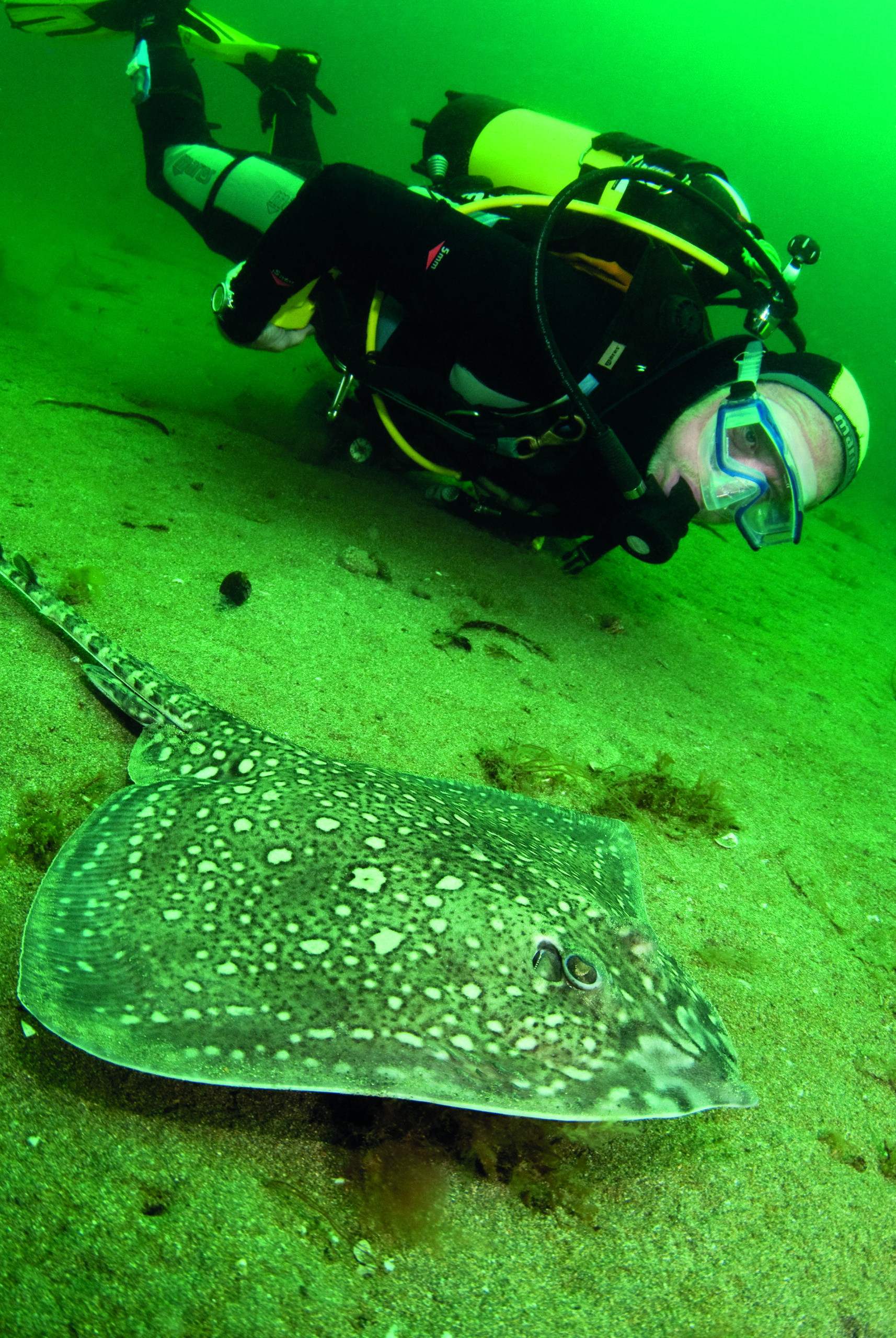
This Helford River Estuary diving spot is ideal for divers and photographers that want to get an up-close view of the thorn backs. I even managed to fin side by side with several rays as they effortlessly soared across the seabed. Thorn backs shouldn’t be confused with their close relatives, stingrays. They are totally non-aggressive and don’t pose any threat to divers.
There is no lethal-looking barb protruding from the tail. Instead, they have 30-50 spines which I guess could possibly give somebody a graze, but only if they were intentionally grabbed or man-handled. The mouth is located on the white-colored underside. Inside are rows of very small teeth which make perfect tools for crunching on crabs, prawns and flatfish.

The Charter Boat For Ferrying Divers
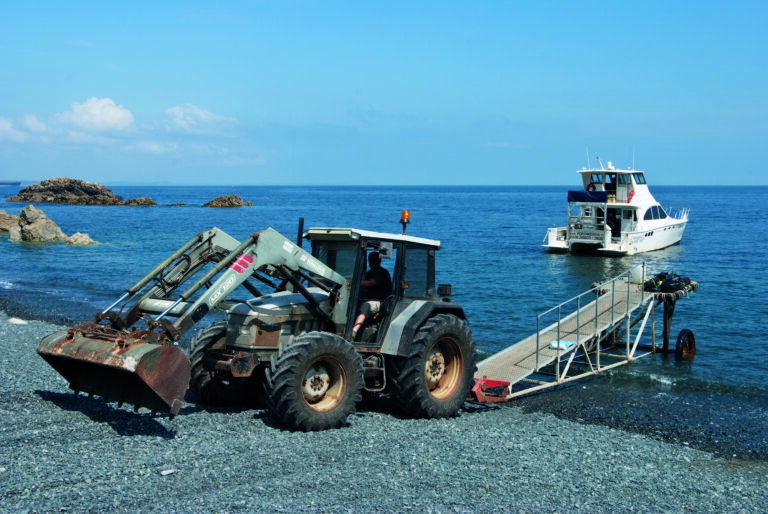
Porthkerris Divers have two hard boats ferrying divers to and from the local diving spot. We went out on Mike’s flagship, the 14-metre Celtic Cat. Getting onto the boat is quite a novel experience. There is no jetty, so divers have to walk along a high-rise gangplank which is then pushed into the sea by a tractor.
Mike’s other hard boat, the smaller eight-metre Celtic Kitten is equipped with a bow ramp so it can come right up to the beach. Celtic Cat has plenty of room onboard for kitting up and gear stowage. There is also a big enclosed cabin area where I could get hot drinks.
A double diver lift has been fitted to the stern. This is controlled by CCTV linked to the high-rise bridge. Mike usually offers the thornback ray dive on request. He said the rays come closer inshore during calm weather. They don’t like rough seas.
Arrival at The site
Porthkerris Divers is a family run business located way down on the southwest coast near the Lizard in Cornwall. RNAS Culdrose is a good landmark to aim for and then follow the signs to St Keverne. The last few miles of road can be quite confusing (I managed to take the wrong turning), but there’s still several bars of mobile signal available if you need to call the dive centre for emergency directions.

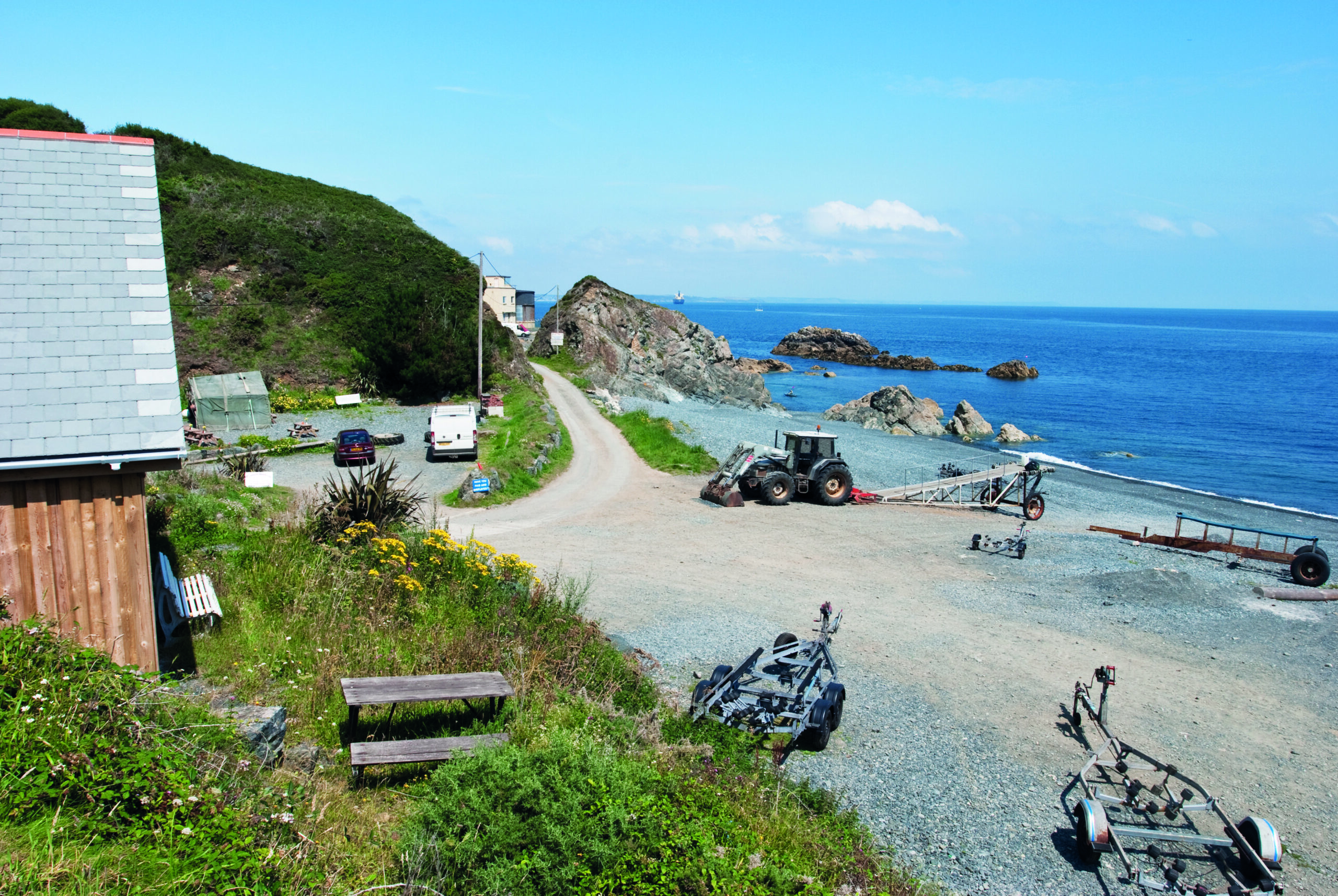
The narrow hedge-lined lanes eventually open out onto a very picturesque little bay. The dive centre building is located next to the pebble beach. On-site facilities include a dive shop, two camp sites, self-catering apartments, toilets, cafe, car park, gas fills and plenty of shore-diving possibilities.
There’s even a number of decent pubs and restaurants situated close by. The local seal sanctuary at Gweek is also worth a visit après-dive.
“When the tide eased off we found two or three different rays buried in the sand and they were much easier to approach”
Pre-dive Briefing by Expert Pros
The Helford River Estuary is approximately 20 minute’s boat ride from Porthkerris beach is one of the perfect diving sites. At high water the mouth of the estuary is around 12m deep. This shallows off to about 8m inside by the boat moorings. The seabed mainly consists of sand and shingle in the central channel. Nearer the edges and further up the estuary, this changes to a maerl-like composition interspersed with patches of weed (perfect for scallops).

At times there can be strong currents, so it’s best to dive a few hours before high water on the flood tide when things are calming down. The visibility is usually better and there is more chance of seeing some thornback rays. Keep a close eye on air supplies, as chasing after rays can be quite a tank-draining experience.
All divers should carry a delayed SMB. Mike asks that they are deployed at the end of the dive before starting any safety stops. This is a busy waterway, so be extra vigilant on ascents. Propeller haircuts are definitely not recommended!
The Fascinating Dive
Mike dropped us in the middle of the channel right by the river mouth. The tide was still flooding which meant the current would take us inside the channel rather than out to sea. We would also have ‘cleaner’ water for my photographs. We made a free decent from the diving sites without reference to the seabed. The rays are not in any particular area, so there is no set direction to take, it’s basically pot luck.

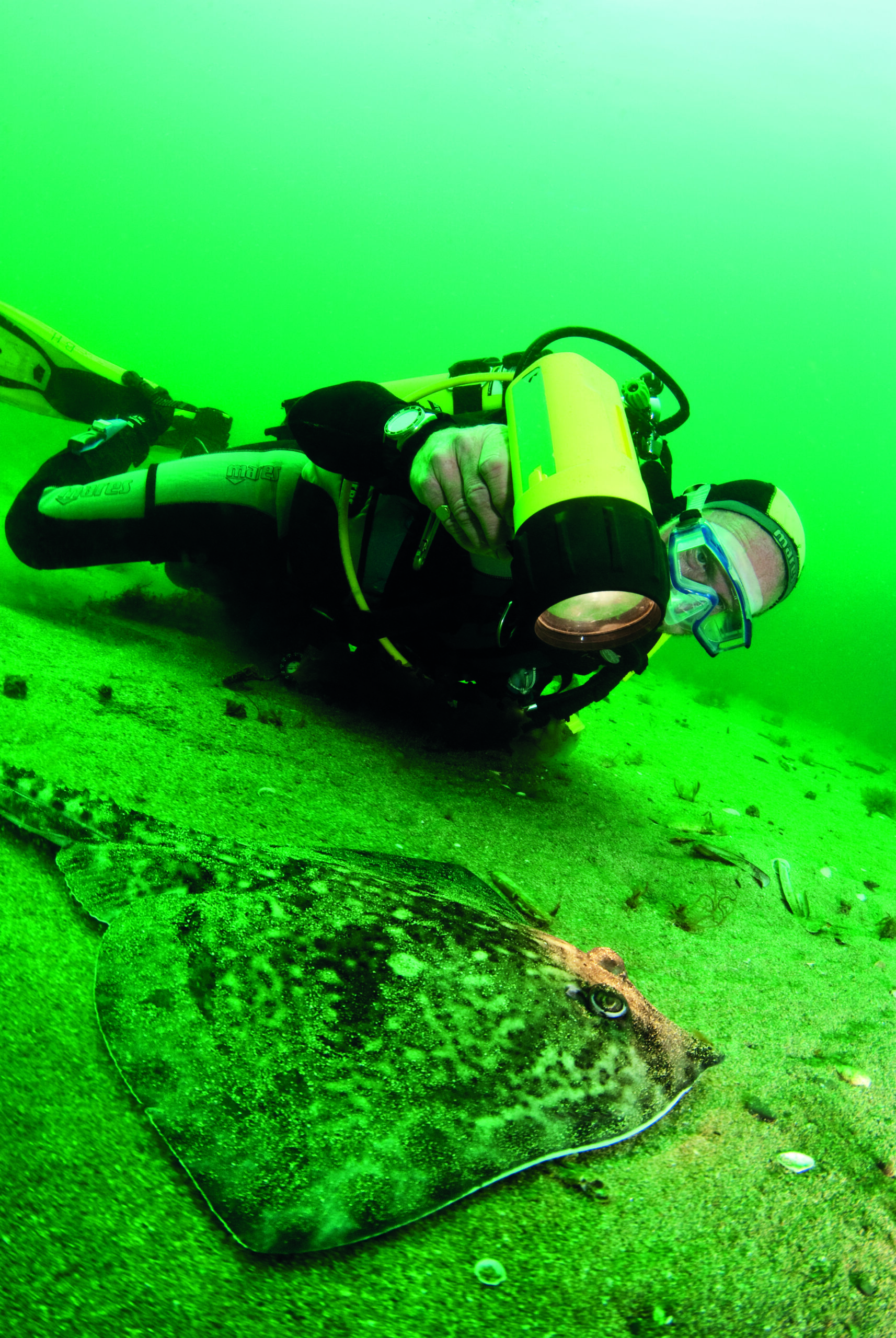
We drifted along with the current scanning the seabed for any signs of ray-like indentations. Creeping up on thorn back rays turned out to be much easier than expected. I had brought along Brian Hayes, a diving friend of many years, to act as a ‘model’ and chief ray spotter. We found ray number one within the first two to three minutes of our dive. I could clearly make out the diamond-shaped outline hidden beneath the sand. A pair of eyes and a sharp pointy nose was the only parts visible.
Working as a team we managed to get within touching distance of around five or six different individuals on both dives. The rays seemed to react differently depending on the tides. During flood tide they were more active and on the move. Mike thinks this is when they are feeding.
On three occasions we had to swim like lunatics just to keep up with them. When the tide eased off we found two or three different rays buried in the sand and they were much easier to approach, in fact, I could have touched them with my camera dome and they still wouldn’t have budged. Maybe they thought their camouflage blended in so well we couldn’t see them?

Encounter with Thorn Backs
As the tide turned there seemed to be less rays about and they were moving much more slowly. We had also moved up the estuary nearer to the boat moorings. The seabed composition had changed and there were far more spotted sea hares around. We swam along with one extremely relaxed ray for a good five minutes and then bumped into a very photogenic cuttlefish. None of the rays shot off in an erratic manner or seemed distressed by our presence. Considering they were being sandwiched by two divers this was quite surprising.

The thornbacks we encountered varied in size from small 20cm wingspans to much-larger 50cm plus specimens. The colour schemes were usually grey or brown with a kaleidoscope pattern of spots and splodges on the topside. Most had two claspers dangling from the tail area, meaning they were males. We only bumped into one small female throughout the entire dive. Average recorded sizes are around 60cm weighing in at 3kg-4kg. Mature rays can grow to more than a metre in length and weigh over 15kg.
A Must-Have Dive in Cornwall
If you are visiting Cornwall this dive is an absolute must. Sitting at a maximum depth of 12m, it’s shallow enough for every certification level to enjoy. Our close encounters were total natural. There was no provocation or feeding enticements going on in the background. They say a picture paints a thousand words, so hopefully my photographs show just how close we managed to get. With rather more luck than judgement, we had chosen a perfect day for weather.

There was plenty of sunlight and very little wave action to worry about. Underwater visibility averaged eight metres throughout and the current took away any silt kicked up during our power-finning spurts. For once I actually have to admit this was pretty good going for UK conditions. The toughest part of the day was keeping Brian focused on the job at hand. He was getting more and more distracted by the number of decent-sized scallops scattered all over the seabed. He even threatened to get out his goody bag!
Mike offers a single dive on Celtic Kitten at £30 per person, or £45 per person for two dives. The Helford River is also used as a second of the best diving sites on some day trips. Two dives on Celtic Cat cost £60 per person, this also includes hot drinks and snacks. Porthkerris Divers offers a range of PADI and SSI diving and freediving courses, as well as blue shark and basking shark snorkelling trips.
Photographs by Stuart Philpott
Dive Site Guide: Helford River Estuary, Cornwall
Location: Cornwall, UK (near the Lizard Peninsula)
Max Depth: 12m
Average Visibility: 6–10m (weather dependent)
Best Season: May–August (peak sightings in mid-August)
Marine Life Highlights: Thornback rays, blonde rays, cuttlefish, scallops, spotted sea hares, hermit crabs, wrasse, sea bream, octopus, grouper
Difficulty Level: Easy (shallow depth, suitable for all certification levels)
Currents: Can be strong – best dived a few hours before high water on the flood tide
Entry Style: Boat dives via Celtic Cat (14m hard boat with diver lift) or Celtic Kitten (8m hard boat with bow ramp)
Operator: Porthkerris Divers – family-run dive centre with shop, gas fills, accommodation, and shore-diving options
Costs: £30 (1 dive on Celtic Kitten) / £45 (2 dives) / £60 (2 dives on Celtic Cat including hot drinks & snacks)
Topside Attractions: Gweek Seal Sanctuary, coastal hikes, local pubs & restaurants
FAQ:
When is the best time to see thornback rays in Cornwall?
The peak season runs from May to August, with mid-August offering the highest chances of encountering multiple thornback rays on a single dive.
Are thornback rays dangerous to divers?
No. Unlike stingrays, thornback rays do not have a venomous barb. They have small spines on their backs but are completely non-aggressive, making them safe for divers to observe up close.
What depth are the dives in the Helford River Estuary?
Dives in the estuary reach a maximum depth of around 12 metres, making them accessible to divers of all certification levels.
What other marine life can be seen in the Helford River?
Divers often encounter spotted sea hares, cuttlefish, scallops, hermit crabs, blonde rays, and even alligator snapping turtles on rare occasions.
Who operates diving trips to see thornback rays in Cornwall?
Porthkerris Divers, a family-run centre near the Lizard Peninsula, offers guided trips aboard their boats Celtic Cat and Celtic Kitten, as well as PADI/SSI courses and shark snorkelling tours.
This article was originally published in Scuba Diver Magazine
Subscribe today with promo code DIVE1 — enjoy 12 months for just £1!