DAVE SMYTH, Field Diving Officer for the British Antarctic Survey at Rothera Research Station, dives every day, year-round, and he loves his job. So what is a typical day’s diving in Antarctica like? See you on the ice
Ice Station Rothera Diving Experience
IT’S HARD TO BELIEVE we’re in Antarctica today, as we trudge down through crisp snow and strong sunlight that makes us squint through our sunglasses. The reality is that it’s -17°C, and ice crystals are forming in my beard.
Walking down to the dive store, the team are in good spirits for the day ahead. We plan to carry out our first dive in South Cove, just a few hundred metres from the store, collecting the monthly specimen for the British Antarctic Survey (BAS) marine assistant Simon “Simo” Reeves.
Daily Antarctic Diving Operations
Along with our boating officer and two marine biologists, I dive daily throughout the year to collect marine animals, deploy data-loggers, collect sediment samples, survey iceberg scours and monitor epifaunal growth on heated plates.
The data that these dive projects produce is vital. BAS is the UK national operator in Antarctica, and delivers world-leading interdisciplinary research in the Polar regions, looking at important issues such as climate change, bio-diversity and ozone depletion.
The monthly collections are part of a long-term investigation into climate change. The yearly variations being recorded in these animals are helping marine scientists to understand how temperature rise will affect the Antarctic marine environment in the future.
The second dive of the day will be the re-deployment of a data-logger at Cheshire Island. This logger provides BAS with data on physical parameters such as temperature and pressure.
When used in conjunction with the species collections, this can paint a clearer picture of environmental changes taking place due to temperature rises.
At the dive store, the team fires into action. Cylinders are charged, Agas connected up and thermal covers placed on first stages. These – plus link line, comms units, dive reel, gloves and hoods, oxygen, first-aid kit and, finally, the ever-important seal-prod are then all loaded onto the dive sledges and Skidoo.
Terri is only in her early 20s but she is a BAS veteran of three winter seasons, and one of Antarctica’s most experienced divers. She gives us the final shout, and we file out and take our places on the various dive sledges.
Terri slips the Skidoo into gear, and we’re off. As we travel to the ice-holes that we cut on the sea-ice with a chainsaw the day before, the true nature of the Antarctic weather can be felt.

Challenges of Year-Round Antarctic Diving
Any exposed skin feels nipped with the cold, and hair and beards freeze within minutes. As we reach the edge of the sea-ice, our boating officer and gnarly old man of the sea Dave (Mine Clearance) Hunt informs the communications manager that we are commencing our travel on the ice. The Skidoo kicks up some finely powdered snow as it grips, and we’re
on the ice.
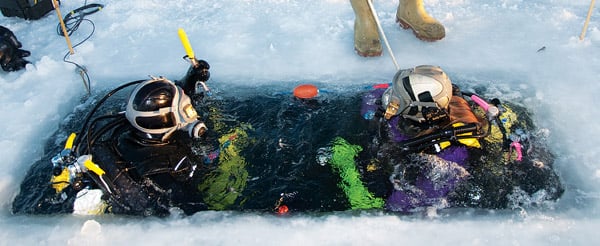
It’s only a short trip to the ice-holes. The dive-reel is fixed into position, anchored to the ice by a titanium ice screw. The comms transducer is attached to the edge of the ice in the same way, and the divers are linked to the dive-line, dangling their finned feet into the dark waters below the ice-hole while waiting to be kitted up.
Antarctic Marine Life Beneath the Ice
AS I PASS TERRI AND SIMO, their bottom-timers, compasses, hoods and gloves, the steam rises off the -1.8° water where it meets the chillier air.
Simo sits back and slips his arms through the straps of his Buddy Tekwing, while Terri slides into her Buddy Commando.
I start the supervisor’s checks, calling the air-in readings out to Dave to record, and checking that the suit inflate hasn’t frozen, and that the BC inflation and dumps are working.

Safety and Equipment for Ice Diving
A quick check over the buckles, weights, gauges and suit-zip, and we’re ready for masking up. The Aga is the old favourite of professional coldwater divers – I remove each one from its fleece-lined bag for the divers.
I send Terri in first, seal-prod in hand, just to check there are no leps (that’s what we call leopard seals) about. After the tragic incident in 2003 when we lost our marine biologist Kirsty Brown to a leopard seal, BAS introduced a new safety policy. We never dive when leps are in the water, and one diver must always carry a seal-prod.
Dave gives Terri a comms check from topside and she replies: “All’s well, and I’m reading you strength 5.” All stations are go. I tap Simo on the shoulder, and he slides into the dark water armed with a multitude of collection bags. As I let out dive-line, he disappears from view.
A few moments later, we get a strength 5 call from Simo, and the collection starts. As Dave and I sit on the ice listening to the conversation from the divers below, we wish we could be down there too – the specimen collection site at South Cove is an enjoyable dive.

THE COMMS BUZZ with “the visibility is fantastic today” and “look at these crinoids and see that sea lemon”, referring to some of Antarctica’s spectacular animals. After 20 minutes I give the call “only five left until safety”, and the divers make their way back up the gradient for the 6m stop.
Three minutes later, we hear “divers leaving stop”. The ice hole resembles a witch’s cauldron as exhaled air bubbles boil at the surface.
As two Aga-clad heads poke out, Dave dashes forward with collection buckets filled with sea water, and removes the sample bags from Terri and Simo.
I grab the cylinder yokes and heave each of the divers out of the hole, leaving them perched on the edge of the ice while we de-kit them. The Agas and BCs come off and are dragged away from the ice and quickly stowed onto the sledge.
The divers are given warm hats and gloves, and take their places on the sledges. Dave fires the Skidoo up, and we’re off the ice and back at the dive store within 10 minutes.
Getting the divers back before they become too cold, and the Neoprene drysuits freeze solid, is a priority. Back in the warmth of the dive store, the kit is washed down and welcoming cups of tea are passed about by our resident carpenter Gav, who heard we were on our way back over the VHF. It’s then time for lunch before the next dive.
It’s a role-reversal, as Dave and I kit up and Simo and Terri become supervisor and tender respectively. We follow the same procedure as before. Sitting on the edge of the ice, I get the tap on the shoulder from Terri and slide into the dark water for a preliminary seal check.
I SLIP SLIGHTLY APPREHENSIVELY under the ice and have a quick scan below. There is no sign of any leps, all good. We give our comms checks to topside and drop down to 20m.
As I look up towards the dive-hole, I can see my two colleagues peering down at me – visibility is excellent today.
Below the ice, the exhaled bubbles from our Agas catch the light from the surface, and dance along behind us like dim neon light-bulbs.

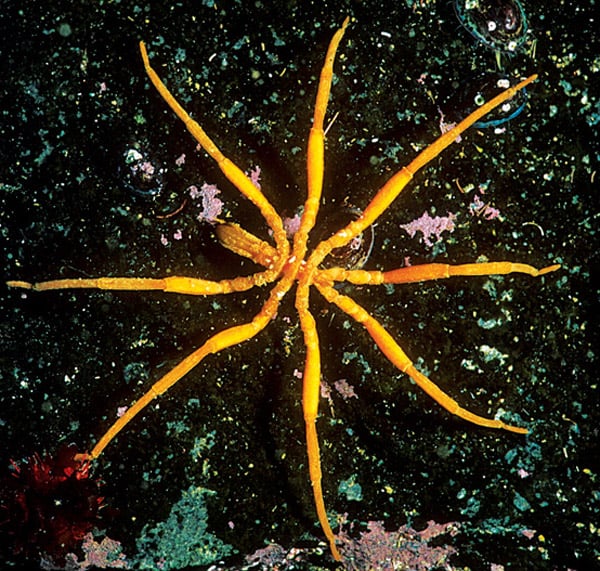
We swim east towards the logger’s location, passing rocks covered in brilliant orange and yellow sponges, bundles of golden translucent sea-squirts, feathered crinoids, assemblages of feeding sea slugs, bright yellow sea lemons and numerous varieties of coloured starfish.
Compared to the harsh extreme surface environment of ice and snow, the diversity and abundance of life beneath the ice is breath-taking.
The kaleidoscope of colours matches wall-dive experiences I have had in the Caymans and the Maldives. The profusion of life-covered rock ends suddenly as we pass a huge barren section of cracked wall. The lack of life is the result of a recent iceberg scour.
I catch Dave out of the corner of my eye, pointing into the gloom. For a split second there is a sudden rise in adrenalin – has he spotted a lep?
I squint through the dimly lit depths, and take a relieved breath as I see the sub-surface buoy marking the data-logger. I swim up to it, and Dave passes me the replacement logger while keeping an eye out, seal-prod in hand. I refit the logger into its housing, job done.
We head back along our line towards the shaft of light that marks the entrance to our ice-hole, watching our exhaled air project a fantastic range of blue hues as it meets the surface ice. As we swim up to 6m, the light show created by air bubbles breaking the surface is almost hypnotic.
WE GIVE TOPSIDE THE CALL that we’re on our safety stop, and take in the beauty of our surroundings, illuminated by that light from above, and feeling that we must have one of the best jobs in diving.
The three-minute stop finishes too soon. We make our way to the surface as our bubbles catch the light and bounce along the underside of the ice.

A Unique Diving Adventure with BAS
At the surface, there is a mad flurry of activity as the kit is packed away. We’re soon back in the dive store, warming our hands around a cup of Gav’s tea. I go to my office, sign off the dive logs, and it’s the end of another exhilarating day of Antarctic ice-diving with BAS.
My thanks go to all those at Rothera Research Station who make the diving possible. It really is a team sport down here.
Diving in Antarctica
Britain is currently the only country represented in Antarctica that dives all year round. The British Antarctic Survey has pioneered many of the techniques used in scientific coldwater diving.
During the winter months much of the diving is through ice-holes, whereas in summer most dives are from RIBs, with as many as five a day taking place.
No specialised kit is used. The gear can all be found at any scientific dive operation in the UK. It’s your standard 4mm compressed Neoprene drysuit with thick fleece thermals, a coldwater first stage, a 12-litre main tank and 3-litre pony, an Aga with buddy-phone, a thick pair of Neoprene mitts and a 5mm hood.
FAQs
What is Ice Station Rothera?
Ice Station Rothera is the British Antarctic Survey’s research station where scientists and divers conduct year-round Antarctic research, including marine studies.
What does diving at Ice Station Rothera involve?
Diving includes ice-hole dives, collecting marine specimens, deploying data-loggers, monitoring epifaunal growth, and surveying iceberg scours in freezing Antarctic waters.
What gear is required for Antarctic diving at Rothera?
A: Standard scientific dive gear is used, including 4mm Neoprene drysuits, thick fleece thermals, coldwater first stages, 12L main tanks, pony bottles, Agas, buddy-phones, and mitts/hoods for thermal protection.
Why is Antarctic diving important for science?
Antarctic dives provide vital data on climate change, marine biodiversity, and environmental shifts, helping scientists understand temperature rise impacts on marine ecosystems.
Can beginners dive at Ice Station Rothera?
Antarctic diving is highly specialised due to extreme cold and ice hazards; participants are typically trained scientists or experienced technical divers under BAS supervision.
How does BAS ensure diver safety in Antarctica?
BAS implements strict protocols, including seal-prods, dive comms, safety supervisors, and careful monitoring of ice-hole conditions to protect divers from environmental hazards.
Subscribe today with promo code DIVE1 — enjoy 12 months for just £1!