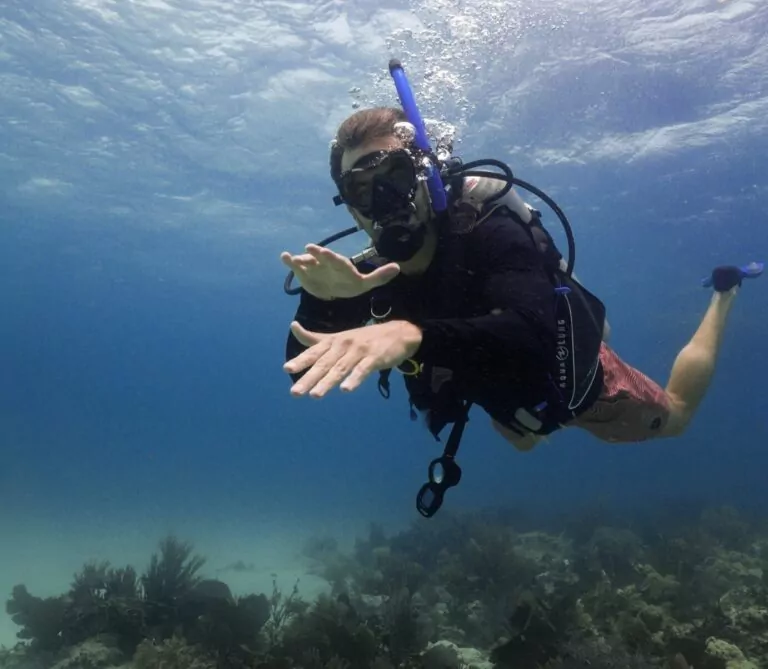
‘Above water, as a Deaf person, I am always seen as the one who is ‘unable to communicate’ with others,’ says top model, actor and now diver Nyle DiMarco. Under water it’s the opposite, however – as he explains to Steve Weinman, a knowledge of real sign language could benefit all scuba divers
“It was a bit strange trying to unlearn ASL [American Sign Language] to learn scuba-diving signs,” says Nyle diMarco. “It almost felt like limiting – knowing that I could still have the same amount of full-blown conversation under water with ASL.
Also read: Fiji dive-trip at stake in PADI Master challenge
“Some of the standard diving signs, while extremely necessary, are not quite intuitive and could be misinterpreted for something else.

“However, the exciting part is that Thomas Koch, who I took the course with, is now in the process of expanding an entire underwater language. Why rely on random gestures, when we already have a full visual language that works – which is sign language!
Also read: PADI links with gear-makers in new-diver trawl
“If we standardise diving hand-signals using sign language, divers wouldn’t just communicate better under water, they would also have the ability to connect with Deaf people inland!”
Nyle DiMarco refers to himself as part of the Deaf community with a capital D, identifying with the Deaf culture rooted in his native language, which is ASL.
The 36-year-old actor, model and activist came to public attention in the USA back in 2015 by winning the TV reality series America’s Next Top Model.
He had been modelling as a freelance for about a year at that point, but became only the second male and the first Deaf winner in 22 seasons of the show. His victory led to a full-time contract with a New York modelling agency.
The following year, he and a professional partner won the TV competition Dancing With The Stars, making him only the second Deaf person to win the long-running equivalent to the UK’s Strictly Come Dancing.
Modelling, dancing, diving…
Scuba-diving is a more recent addition to Nyle’s range of accomplishments. His interest had been kindled by long acquaintance with PADI course director Thomas Koch, who is also Deaf. “I’ve known Thomas since I was a kid,” he says. “For 15 years I’d been wanting to take courses under him, but I could never find the time.”

Looking at his CV that isn’t too surprising, but when Nyle did find the time to get certified, he really went for it. He has now taken four courses around Islamorada in the Florida Keys with Aqua Hands, the PADI dive-centre owned by Thomas and described as the world’s only Deaf-owned dive company.
Open Water Diver was followed in quick succession by Advanced Open Water Diver, Enriched Air and the AWARE Coral Reef Conservation course.
“PADI’s courses gave me the essential skills and knowledge to navigate the underwater world with confidence, and Thomas’s ASL made the experience truly exceptional,” says Nyle. What’s more, his take on the scuba learning experience provides unexpected insights.
“The underwater world is truly the Deaf world,” he says. “Everything flips. Above water, as a Deaf person, I am always seen as the one who is ‘unable to communicate’ with others. But under water? Everything changes.

“While training in the sea I noticed something hilarious – hearing instructors couldn’t quite teach other hearing divers under water. They’d start the dive, try gesturing / miming instructions, but it rarely worked.
“Within minutes, their students would look confused and everyone would swim back up to the surface so the instructor could talk.
“Then they’d dive again – then everything would repeat. I watched them go back up and down again like an elevator. Their learnings and hands-on experiences are cut short.
“Meanwhile Thomas, the only PADI Deaf course director in the world, and I? We stayed under water the whole time. Zero surfacing. No interruptions. He was able to explain techniques, correct my form and walk me through each drill, all in ASL, in real time, many feet deep.
“It was seamless and, honestly, the under water felt like our turf!”

Dinner plans and coral-bleaching
Nor was this the only reversal that Nyle encountered under water. “Another funny scenario: I’m often the one relying on pen and paper to communicate with hearing people. But in the under water, suddenly it’s the hearing folks scribbling slowly on waterproof notepads, while Thomas and I are just chilling in sign language.
“He was effortlessly pointing out reef creatures, explaining what we were seeing and, yes, we even made dinner plans under water.”
One moment really stuck with Nyle as he and his instructor explored the coral reefs. “Thomas pointed out several sections of bleached, bone-white coral surrounded by fertile reefs. In ASL, he explained right there: ‘That coral is dead, a direct result of rising ocean temperature. Global warming is real, and it’s visible even under water.’
“I was then able to ask him more questions about that, under water. And I couldn’t stop thinking about the other hearing divers with a hearing instructor. That conversation wouldn’t have happened.
“Hearing divers would’ve had to wait until they surfaced, maybe 15, 30 minutes later, to ask: ‘Hey, what was that white stuff we saw?’ Assuming they even remembered. But because Thomas and I could communicate under water, I learned in the moment. And it stuck with me.”
Deaf Utopia
Nyle diMarco was born in Queens, New York into a family in which not only he but his parents and his two brothers were all congenitally Deaf. When his parents split up, his mother Donna moved with her children to Maryland.
There Nyle attended the Maryland School for the Deaf and went on to obtain a mathematics degree at the specialist Gallaudet University in Washington.
In 2013, the year he graduated, he appeared in an ASL film called In The Can, and over the next few years broke into TV, playing a leading role in the series Switched At Birth and appearing in a comedy series, Difficult People.

He has always made clear that, far from considering himself disabled by deafness, he views it as an advantage to be equipped to communicate without speaking – as in, for example, modelling.
Dedicated to broadening awareness of Deaf culture, in 2016 he started the Nyle DiMarco Foundation, a charity providing access to resources for deaf children and their families.
Four years later he started his own production company, Clerc Studio, which gave rise to Deaf U, a Netflix reality series set at Gallaudet; an Oscar-nominated documentary short called Audible and, this year, Deaf President Now!, a documentary he co-directed and produced about a student protest sparked at Gallaudet in 1988 when a hearing candidate was elected over Deaf rivals. He has also shared his story in an autobiography, Deaf Utopia.
Galapagos in his sights
Being able to communicate so effortlessly with his scuba instructor even while submerged helped Nyle to breeze through the initial scuba courses, but now he needs to gain solid underwater experience to make the most of that dream start.
“What’s left is to do 50 dives in order to dive in the Galapagos,” he says, citing that destination as top of his wish-list, followed by Lofoten in Norway – big-animal encounters are clearly in his sights. “I travel all over the world a lot, so I think I can sneak away for a dive or two!”
The only disadvantage he can see as a diver is that so few others currently know sign language: “They chose to only know limited non-ASL scuba hand signals! I’m unable to communicate with them down below.
“That is exactly what Thomas is trying to do: to bridge the gap between two worlds. The ocean is still one of the least-explored places on Earth and, honestly, so is the potential of hand signals.”
Persuading Deaf people to take up diving should not pose a problem; Nyle believes that the challenge is “more of encouraging hearing divers to not only get involved in scuba diving but to take courses under a Deaf instructor. Nobody knows better how to use gestures cleverly under water.
“I watched Thomas Koch communicate with hearing divers under water without difficulties, using clear and intuitive gestures that made sense instantly. I think hearing learners would be better off with the Deaf!”
One final point: I asked Nyle if it had surprised him to learn that scuba divers often refer to the underwater world as a noisy place. “This is news to me now – I had no idea!” he replies. “Now I need to go down that rabbit-hole…”
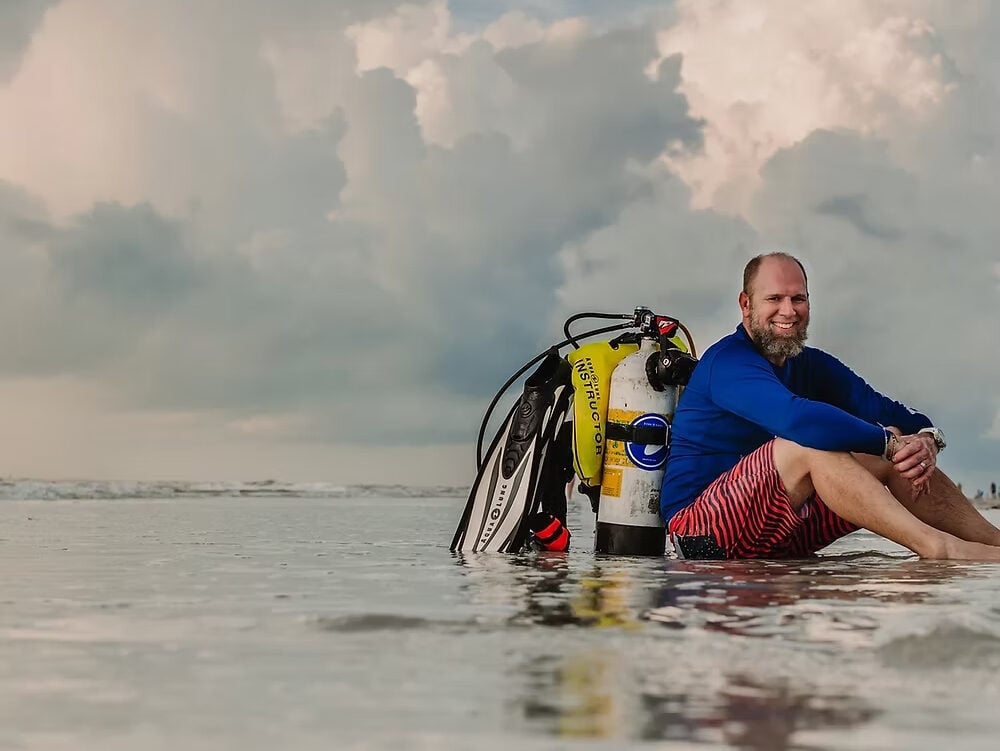
Aqua Hands was established in 2010 by Thomas Koch, who has since become a PADI Ambassadiver. The PADI dive-centre in Clearwater, Florida caters for Deaf and hard-of-hearing people and says it conducts all its scuba-diving classes and trips using ASL to ensure accessibility for both hearing and Deaf individuals.
Also on Divernet: WILL WE EVER HAVE A GLOBAL SIGN LANGUAGE?, HAND SIGNALS IN DIVING: BRIDGING THE COMMUNICATION GAP UNDERWATER