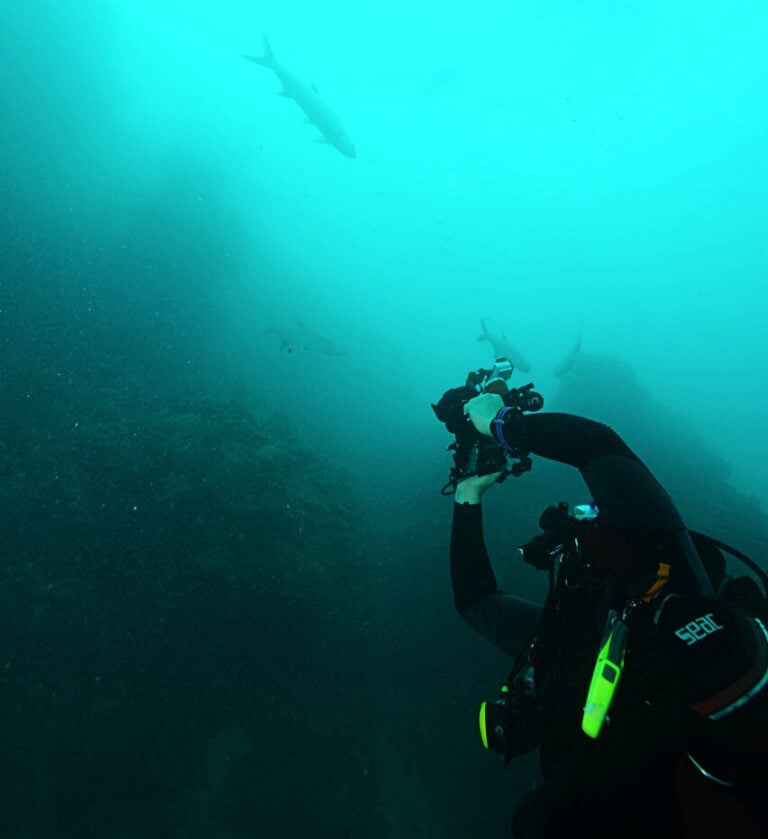
How do you tell another diver that it’s time to hang up their fins permanently, or at least undergo some serious remedial training? Underwater photography instructor LISA COLLINS shares a quartet of real-life underwater experiences – how would you have acted in her place?
Over the decades I have taught underwater photography classes all over the world, though mainly in the UK and Cayman Islands, where I now live and work.
And on many occasions I have thought to myself: “This diver needs to retrain” or: “That diver needs to give up diving!”
This is a very easy thought to have when watching divers who seem unprepared and unco-ordinated, or who struggle with techniques, or seem very unfit or immobile, or perform frankly dangerous and unsafe actions.
Following the latest such occasion, I began to think more deeply about this, and analyse why it happens so often. Am I jumping to rash conclusions? Are some divers really so bad that they should retrain or give up driving, or are there underlying reasons for them coming across as being the last people with whom you want to spend time under water?
All-round air shortage
Way back in 2006, I was visiting a very remote part of Indonesia. At 30m after only a 20-minute dive, my first stage malfunctioned and I was left with no air.
My equipment had been serviced before I left for my trip, in line with my regular habit especially when diving in remote places, so I hadn’t expected a malfunction. I had already done more than 10 dives with the equipment over the previous few days without issue.
I calmly signalled to my dive-guide that I was out air and pointed to his octopus, which he pulled out and gave to me. Sucking once, then twice, I hit resistance – no more air! His octopus was malfunctioning too!
We were the only two on the dive so he was my only option for air. Having done around 250 dives I was fairly experienced, but it took all my willpower not to rush to the surface and to signal that we needed to ascend while buddy-breathing and completing a safety stop.
Once we had surfaced safely I was thankful but didn’t give much thought to what had happened. Only many years later did I reflect on the incident.
My equipment had failed. I normally check everything myself before I don my kit but the dive-centre had been run concierge-style, with the dive-guides collecting your kit on the first day, taking it to the boat, putting it together, breaking it down and storing it each day on the diver’s behalf.
I had checked my equipment the first couple of days, then this service made me lazy. I trusted my dive-guide and the dive-centre to look after my equipment and set it up properly.
Perhaps my first stage had got dropped or been damaged in some way that wasn’t visible. Perhaps even if I had checked I wouldn’t have picked up the problem. However, when you are trained to be a diver it is always emphasised that you look after yourself and your own equipment first and foremost. I was remiss in not doing this every time.
But my dive-guide, a local, had also been remiss in checking that his own equipment was working correctly. At the very least he should have checked air supply to both his regulator and his octopus, but he hadn’t done this.
Whether it was just that one day or that he never checked I will never know, but he certainly needed retraining to ensure that this didn’t happen again. Since that incident this is something I always do, and insist that my clients do the same as part of their buddy-check.
Spongebob pays the price
Roll on several years to a dive-trip to Mexico. We had hoped to dive Chinchurro Banco, a nature reserve in the southern Yucatan Peninsula, but unfortunately a tropical storm made the sea too rough for the crossing.
We had made it down to Xcalak, a small town almost on the Belize border, where the crossing is normally made to the nature reserve.

Another group with a so-called ‘famous’ American online TV underwater presenter (let’s call him ‘Spongebob’ – apt, because he certainly was a cartoon character in my mind!) had also made it down and were meant to be on the trip with us.
When the dive-shop owner and main instructor ‘X’ gave us the bad news that the trip couldn’t go ahead, Spongebob had what can only be described as a hissy fit, and insisted that we go. Of course, we had our safety in mind and refused, but that didn’t stop Spongebob from coming to our room later that night to try to bribe us to insist that X took us.
When we told X the next morning, he was very angry with Spongebob for trying to endanger everyone’s safety. Of course, Spongebob had plenty to say, calling us wimps and yellowbellies (as well as a few more choice descriptions!).
After calming things down, X agreed to take us all to a local dive-site just outside the reef. This was still quite hairy, because the cut through the reef had breaking waves that needed to be breached by the small dive-boat, and he wasn’t sure of the current.
He gave us a very thorough briefing and insisted that we all follow him on the dive, because it could be extremely dangerous for the boat-captain if divers separated and were washed onto the reef in the prevailing conditions.
The dive-site was called Tarpon Alley, a channel between two fringing reef where we had to follow the sand bottom through the alley on the right-hand side before crossing over at a certain point and ascending to a pinnacle where we would wait while doing our safety stop, then ascend back away from the reef.

X stressed the importance of staying together several times and made us all agree individually that we would follow his instructions.
Of course, you can all imagine what Spongebob and his minions did! Only my buddy and I followed X to the pinnacle. When we broke the surface, the captain skilfully swept in and had picked us up within a minute or two.
X immediately spat out his reg and a loud stream of the bluest language I had heard in a long time spewed from his lips as he berated Spongebob.
As predicted, Spongebob and his cronies came up between the two fringing reefs and were pushed against one of them. The captain and X were screaming at them to swim away from the reef, but no joy.
If not for the skill and daring of the captain those divers would have been pounded onto the reef in the breaking waves. Risking the boat, himself and us, he gunned the engines and rode the waves to the divers whilst X lifted them physically out of the water, dumping each one unceremoniously on the deck.
X was so angry that he could no longer speak. It took the captain four attempts to pass over the cut nearest to where they had picked up Spongebob, with the waves threatening to engulf the small boat.

This was definitely a case of several divers needing to be retrained, or even being forced to give up diving, having endangered not only their lives but those of several other people and the dive-boat.
Spongebob’s cronies, so afraid of losing their jobs and the friendship of a ‘famous’ person, definitely needed to question their ability to follow the correct person’s orders and to be retrained on safety!
Drinking and diving
Fast forward several more years to a shore-dive in the Cayman Islands with two divemasters on holiday from the USA. I had dived with them previously with no issues, and they asked me to take them out for a fun-dive to photograph some macro subjects.
I knew that both were drinkers and that they had enjoyed quite a few on their first night, from the antics they were telling me about the next morning, when I met them at the shore-dive site. It wasn’t that early in the morning, and I thought they were just excited to get diving and were completely sober.
Kitting up, I did a buddy-check with them before I descended the ladder and had them hand their cameras to me. The ladder goes into a large protected cut in the ironshore that we call an ocean pool, with calm water and a sand bottom about 3m deep.
The first diver decided to forego the ladder and do a giant stride entry – without putting her regulator in her mouth or air in her BC. Straight to the bottom she sank!

Her dive-buddy (and remember that both were divemasters) just stood watching her, while a friend on the shore who wasn’t diving shouted for him to jump in and save her.
In the clear water he could see that she was flailing about unsuccessfully trying to find her reg, but he went on standing there like a deer in the headlights.
I dropped the cameras and deflated my BC to go and help her, only to see her finally come to her senses and push off from the bottom, swimming with all her might for the surface.
I was close to the ladders, having expected her to follow me in, but she had jumped a little way from me, so I wasn’t as close to her as her buddy. I finally reached her and inflated her BC so that she could float on the surface safely.
Thankfully everything was OK. Before we continued the dive I spoke to both of them quite sternly, asking if they had kept up their divemaster education and skills, but neither of them had, expecting simply to remain divemasters without practising safety procedures.
I strongly recommended that they do a refresher course before their next dive-trip, and went through every safety precaution I could before each dive with them. Several months later both actually admitted to having been high-functioning alcoholics, but after that experience had gone to rehab and were now very sober.
Again, I wondered whether I had been remiss. I was doing a fun-dive with them. They were dive-buddies and I was just leading them around the dives-ite to show them where to find some subjects. I had done a normal buddy-check with them and expected them, with their experience and several hundred dives under their belts, to keep an eye on each other. I hadn’t figured on them still being drunk!
How can I put this?
The final experience I want to share involves an older diver who has been an underwater photography training client for the past six years.
I have dived with him every year, apart from during Covid. I know he is overweight, has mobility issues and is relatively unfit, and each year I question whether he is fit enough to dive.
He always gets signed off by a diving doctor before his trip and assures me that he has been playing golf, walking and increasing his exercise levels before coming down to Cayman.
Each year he arrives, seemingly a few kilos heavier and a little less mobile. Each year he needs a little more help, both getting into and out of the water.
Each year I speak to him about this and ask him to do certain exercises to help with his mobility, such as stair climbs with weight, squats and lunges, and chair yoga.
This last year he assured me that he had been doing this, but it was quite obvious that he hadn’t, because he needed even more help than normal. He admitted that he had been travelling a lot because it was his 70 birthday year and loved to eat!
Eating out was his passion and he had sampled a huge number of restaurants on his travels that year, hence his weight gain and added mobility issues.
He was unable to carry his dive-gear to the ladders for the shore-dive, or even get out of the water with his dive-gear on. He was also unable, without a huge amount of help, to put his gear on himself in the water once I had carried it there.
He even had difficulties descending because he has very ‘fatty’ legs. They are extremely buoyant and he is unable to get them under his body to let the air out of his BC sufficiently for him to sink.
After the first day of diving, I questioned him about his mobility and weight issues. He admitted that although he played golf fairly often, he used a golf-buggy all the time and parked as close to the ball as he could. He had not been getting as much exercise as he had led me to believe.
For the remainder of his trip I had booked us some boat-diving with Don Fosters, an excellent dive-centre set up to help people with mobility issues. This was a game-changer for both him and me, because there was a bench for him to sit on close to the water where he could be helped on with his kit before ‘falling’ into the water.
I would unclip his BC and hand it up at the end of the dive, making the process much easier and safer.
On our last day he asked me to tell him whether I thought he should still be diving. I had to think seriously about this. He loved diving and underwater photography and the weightlessness and freedom it gave him. I could see that as soon as he was under water he was comfortable and in his element.
His buoyancy was excellent and the joy on his face being under water really gave me pause to think. Should I be the one to tell him when to give up diving, or should he decide for himself?
He has booked me again for a week of underwater photography next spring. Before I agreed, I felt I had to speak to him candidly and seriously.
It isn’t just a matter of getting signed off by a diving doctor, because he could be completely medically fit to dive. The problem comes from whether I feel it is safe enough for both him and me to take him diving.
I have no issues once he is under water, but it is everything that happens before he sinks below the surface and when he resurfaces that worries me.
I have insisted that we do only boat-dives during his next visit and that he is to do more stair and lifting exercises. He has also promised to lose weight.
I have also scheduled a call with him early next year to check on his progress – he knows if he hasn’t progressed sufficiently I will recommend that he does give up the sport. Let’s see whether he really wants to keep diving!
Seeing how happy he is under water, I am reluctant to stop him being a diver, but if we work together to improve his weight and mobility I believe he can continue.
Both he and I are very aware that safety in diving is a key to continuing. With luck he will do as he says and be able to dive for a few years more – I certainly hope so!

LISA COLLINS is the only underwater photography instructor operating in Grand Cayman. Find out more at Capture Cayman or email lisa@capturecayman.com.
Also read her Divernet feature Another day in the life of an u/w photography instructor