“Ah man, you should have been here last month!” You feel your heart sink into the pit of your stomach, the penny starting to drop as to why your trip of a lifetime had been so much cheaper than you had expected. “Yeah, there were loads – we were seeing them almost every dive.” With visions of dramatic big-animal encounters dissolving before your eyes, you can only sit and inwardly kick yourself for not researching your trip more thoroughly. And with so much information out there, it just became too overwhelming to trawl through it all – far easier to book and take your chances, right?
Wrong. Turns out that in the age in which everyone seems to be an app developer, there are plenty of apps out there designed to simplify your diving. This month I look at five to find out if they’re worth packing for your next trip. From Scuba Calendar, which could have helped our hapless traveller have the encounter of a lifetime, to Tripwhistle, which could be your best friend if it all goes wrong, these are the apps put forward to help you get the most out of your long-awaited dive holiday.
Table of contents
Table of contents
Scoring the travel apps for divers
I have scored these travel apps on a scale running from 0 (completely hopeless) to 5 (utterly fantastic) in the following categories:
Usefulness:
While some fulfil a genuine need, others seem to serve no purpose other than to eat up your hard-earned dive dollars. Should you be snapping these apps up or leaving them on the virtual shelf?
Ease of Use:
Nobody wants an app that is over-complicated and fussy to use. Can the everyday diver get the most out of this app, or do you have to take advice from a teenage buddy?
Value for Money:
Some apps are direct, pay-upfront affairs – others trade money in your pocket for a constant bombardment of ads. Which should you be forking out for?
Additional Features:
Does the app offer any add-ons, extra functionality or support that sets it apart from its peers?
4 – Dive+ is an excellent tool for connecting divers, logging dives, and finding dive sites. Its integration of social features and dive-site info makes it highly practical for solo travellers and dive groups alike.
Ease of Use:
4 – The app is intuitive and user-friendly, though some advanced features take a little exploring.
Value for Money:
5 – Completely free with no intrusive ads, Dive+ provides impressive functionality at zero cost.
Additional Features:
5 – Dive+ offers dive logging, location mapping, social networking with other divers, and a dive-site database with conditions, depth, and marine-life info.
Verdict:
4/5. Dive+ is one of those travel apps for divers that actually makes life easier instead of more complicated.
It connects you with dive sites, logs your dives, and even lets you check who else is in the water nearby. The social features are fun, the dive-site info is detailed, and the app overall feels polished and reliable.
A few advanced tools take a little exploring, but once you get the hang of it, it’s genuinely useful for both solo travellers and groups. Free, practical, and surprisingly clever, Dive+ earns its place in your dive bag and on your phone for planning, logging, and sharing your underwater adventures.
4 – High on the agenda for most folk is heading off to spot some bucket-list critters. In this respect it’s excellent, though it loses a point for not catering so well to the macro market.
Ease of Use:
5 – Super-easy. Simply spin the wheels to select your criteria and hit search.
Value for Money:
5 – As a free app with no obvious ads, it gets top marks on this one.
Additional Features:
3 – While not bursting with additional features, I was a big fan of the fact-files presented for each animal, which are written in an interesting and down-to-earth manner.
Verdict:
Verdict: 4/5 – Manta-ray mad? Batty for basking sharks? This is the app for you! Ridiculously straightforward, it’s one of those I will be holding onto.
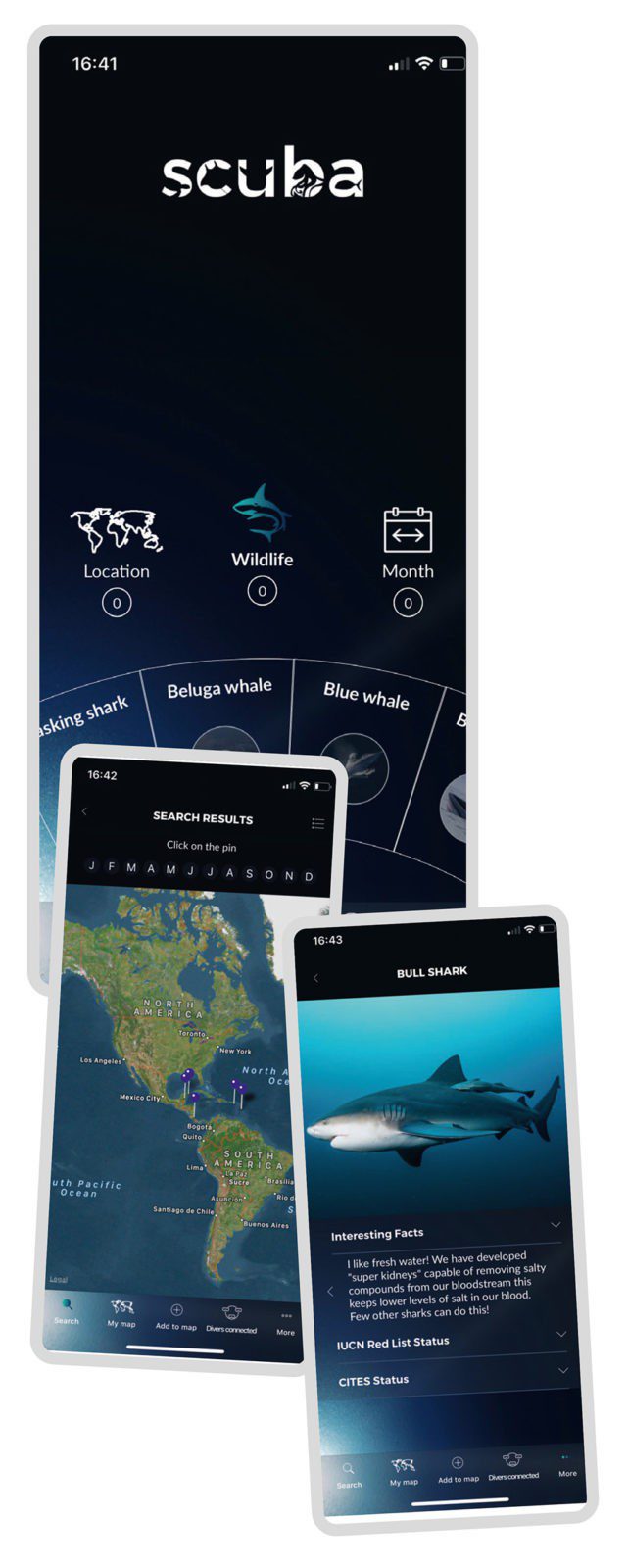
Scuba Calendar lets you know which marine animals can be found in different parts of the world at various times of year. Comprising three wheels – location, month and wildlife – it either allows you to plan a holiday around seeing a specific creature or gives you a feel for what you might see there.
At the moment Scuba Calendar carries most of the larger, better-known creatures (from bull sharks to belugas and blue whales) but has yet to add smaller critters.
It can’t tell me where I might find a pygmy seahorse or flamboyant cuttlefish – instead grouping them into “macro” or “muck”.
I can but hope for this upgrade in the future, but for now it does what it does with refreshing simplicity and eye-catching good looks. It feels uncluttered and invested into its key purpose.
My favourite feature is the bursting fact-file that comes with each creature, crammed with enough interesting titbits to convince fellow-divers that you’re the resident marine biologist.
Another big win for this app is that it works offline, so you don’t need to worry about having a signal to impress your buddies. Could Scuba Calendar be improved? Yes. Do I love it anyway? Absolutely.
Tripwhistle – Global SOS – Free on IOS and Android
Developer:
IBM developerWorks
Usefullness:
5 – I hope you never need this app, but if you do, it’s undeniably top marks here.
Ease of Use:
5 – This app has eight buttons. Eight! That’s it. Tripwhistle receives top marks on ease of use, being the simplest on test by a whale’s tail.
Value for Money:
5 – An app that could save your life one day, and all for free. What’s not to love?
Additional Features:
2 – Simplicity has to come with a trade-off. Having said that, its single additional feature is relevant and has a number of different applications.
Verdict:
5/5 – Ever needed to call the emergency services? It’s stressful enough in your home country and you know where you are. Now imagine you’re alone, in a foreign country with no clue where you are – your day has just gone from bad to worse.
Tripwhistle is here to help! Its one function is to get emergency help to your current location as quickly as possible, wherever you are in the world.
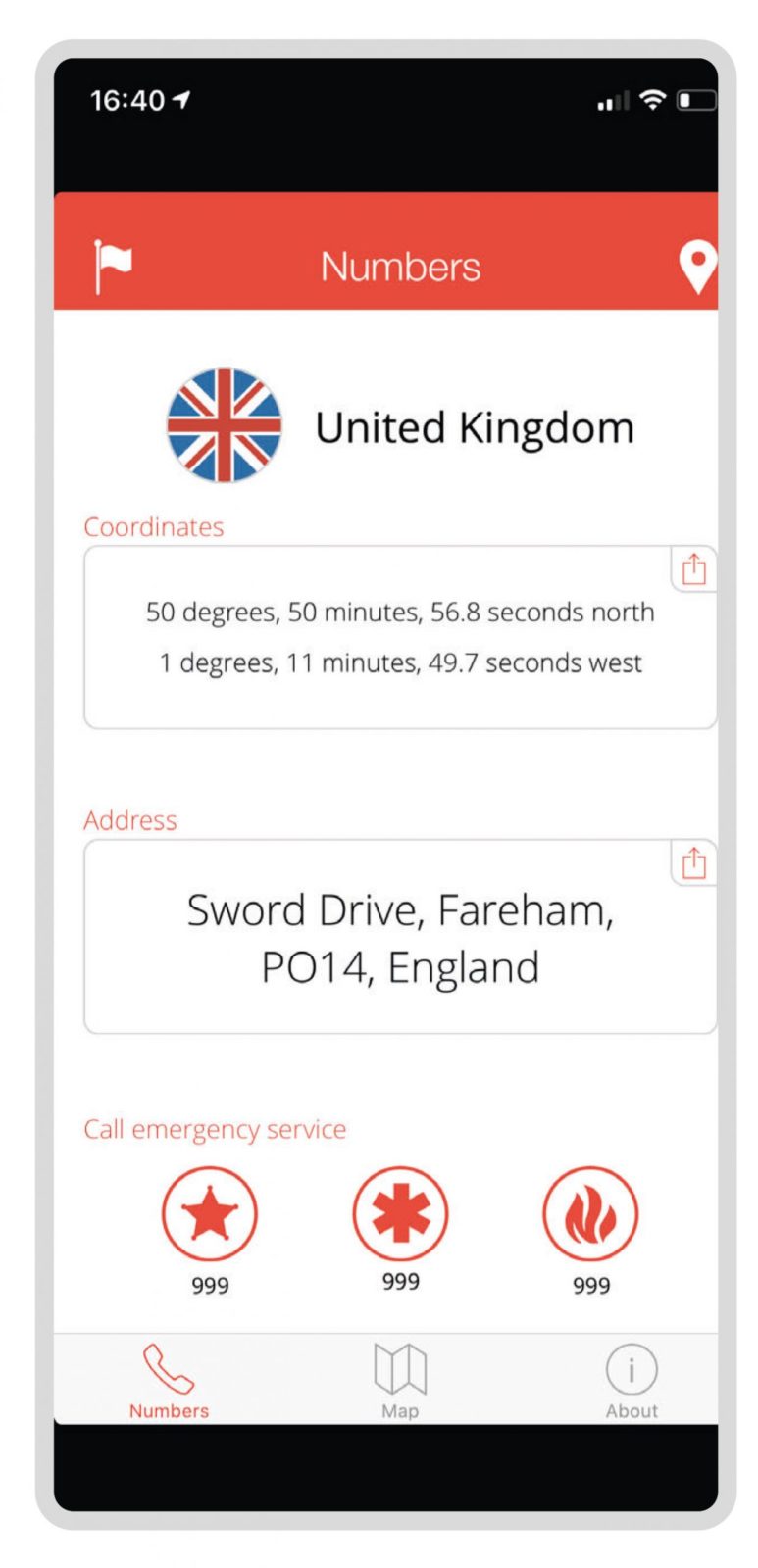
Hook it up to your phone’s GPS and it displays phone numbers for local police, fire and ambulance alongside your street location and latitude/longitude.
Alternatively, hit the flag and you can select a country manually – particularly useful for group-leaders making sure their evacuation plans are up to date before they go.
Cleverly, if you do end up having to use it to make a call, your location will display as the contact name, enabling help to get to you all the quicker.
Tripwhistle glosses over one of its best functions. Not only will it provide you with a street address for your location but it will also show you on a map and allow you to share a Google Maps link to your position. I’ve already needed to use this to find a group of friends in Italy and can attest to its usefulness. This is not an app that you will be using every day, but for a paltry 32Mb of space, it’s definitely a keeper.
3 – A strong concept: Divebase is an effective catalogue of dive-sites. However, a catalogue is only as good as the person entering the data…
Ease of Use:
3 – Somebody get this app a set of filters! While there are lots of different ways to search, I’d have loved to be able to narrow down my choices.
Value for Money
5 – You can’t fault a free app on this front.
Additional Features:
2 – There’s nothing here that will have you writing a letter home, though there are features that could justify a quick text.
Verdict:
3/5 – While BLU seeks to hook you up with a new buddy, Divebase promises to hook you up with a new dive-site.
Although the opening screen is quite busy, Divebase is fundamentally a catalogue of holiday hotspots aimed at ensuring that you get your underwater fix wherever you find yourself.
Navigation is straightforward, and the individual site-pages hold a wealth of useful information, including maximum depth, average visibility, expected currents, type of entry and experience level advised.
Top of my Divebase wish-list is a way of filtering sites by these parameters. For example, if I were an Open Water diver, it would be the icing on the cake to be able to filter sites to include only those with a maximum depth of 18m – however, I’ll have to keep my fins crossed that that one makes it into the next update.
Most sites also include a brief description, often containing useful information such as the prime time to dive for the best visibility, or to avoid currents.
Beware! As with any community site or app, these are only as good as the diver who reviewed it – so take any information given with a pinch of salt, and double-check any safety-critical points before you hit the water.
A quick browse of the App Store reveals that Divebase is not alone in wanting to occupy this corner of the market. It shows promise as one of the forerunners, but it will need to work hard to keep a raft of developers from the door.
Is it worth a download? Very possibly.
Is it worth keeping an eye on the apps nipping at its heels? For sure.
Ocean Maps – Free (Demo Version), £variable (Site Specific Version)
Ever felt that trepidation about dropping onto a new and unseen site? Worry no more, with this virtual dive-site app.
Ease of Use:
4 – The controls take a little getting used to, but anyone who belongs to the PlayStation Generation will have no problems with it. If in doubt, ask a five-year-old.
Value for Money:
3 – Pricier than some of the other offerings in this review, Ocean Maps is nevertheless in a niche of its own, justifying the cost somewhat. If you’re smart about it, there are ways to keep costs to a minimum.
Additional Features:
4 – Ocean Maps doesn’t contain any extra features per se, but each site is information-rich and a treat for the eyes.
Verdict:
4/5 – Many a great diver has experienced the butterflies associated with visiting a new site unguided for the first time. Indeed, more than a few have shelled out significant amounts for a guide to help abate the nerves.
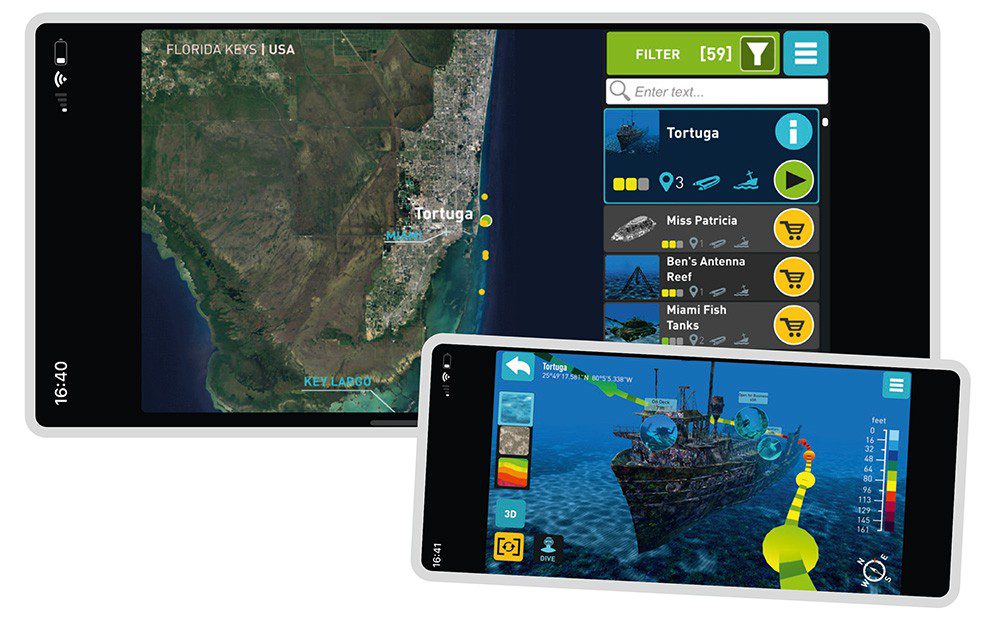
This is where Ocean Maps comes in – providing immersive 3D maps for common sites, with a comprehensive fact-file to match.
It’s relatively easy to find the demo version of Ocean Maps, but it can be tricky to locate the site-specific versions on the app stores. One tip is to search by the “Ocean Maps” developer, which will offer you all the versions without a long-winded trawl.
You’ll notice I said versions – yes , Ocean Maps produces a separate app for each geographical area. And because it’s a company relatively new to the scene, these are somewhat limited.
At the time of writing, apps available to UK users cover Florida, Aqaba, Kreidesee (the developer is Austrian) and, if you’re feeling flush, a Stuart Cove-specific version for the Bahamas.
The company is really pitching itself at the commercial market rather than individual recreational divers, hoping that larger dive-centres such as Cove’s will front the costs to survey their local sites. So if you’re after mapping for some far-flung site, don’t hold your breath!
Still, what this app does, it does fantastically. It’s a fabulous asset from which dive-guides can brief and can be used to produce detailed sketch-maps for slates, with the potential to improve navigational safety.
I trialled the Florida version, which seems to be one of the more swept-up offerings. It covered 59 sites, from wrecks to reefs, all in glorious colour.
Though the initial download was free in this case, sites were charged at either £9.99 for single-site lifetime access, or £2.75 a month to view all sites in the app.
For most divers, a month is probably all you need, though don’t forget to cancel that contract once home! Other versions vary in price from nothing for the Aqaba app to an eye-watering £48.99 for the Bahamas!
Aside from the organisational mess Ocean Maps seems to have got into with a multitude of similar apps, these are a great asset so long as your chosen site is, literally, on the map.
CONCLUSION
Dilemmas, dilemmas. This decision is tricky, and with such a wide-ranging array of apps on offer, it’s hard to choose a clear front-runner.
In this case I feel that simplicity has won out; when I’m on holiday, I don’t want to have to spend too much time with my nose in my phone.
As such, coming out on top is Tripwhistle and, although not strictly a dive app, I firmly believe it’s one in which every traveller should invest their 32MB.
At the other end of the scale and a worthy runner-up lies Ocean Maps. This visual feast can bring your dive adventures to life and perhaps even tempt the most nervous of potential buddies into the water.
Although a very close call with Scuba Calendar, once Ocean Maps takes off it could take dive-briefings or plans to the next level.
With this clutch of apps you could have all you need to ensure that your holiday runs without a hitch. And you never know, with Scuba Calendar in your pocket and your eyes on the water, you just might have that big-animal encounter after all.
FAQs
What are the best travel apps for divers?
Top apps include Tripwhistle for emergencies, Scuba Calendar for spotting marine life, Ocean Maps for 3D dive-site navigation, Divebase for dive-site catalogs, and BLU for connecting with dive buddies.
How can Scuba Calendar help plan dive trips?
Scuba Calendar shows which marine animals can be found in specific locations and months, helping divers schedule trips around bucket-list encounters.
What does Tripwhistle do for divers?
Tripwhistle provides emergency numbers and GPS location anywhere in the world, allowing divers to call for help quickly during crises.
Are dive apps like Ocean Maps worth the cost?
Yes, Ocean Maps provides immersive 3D dive-site maps with detailed fact-files, improving safety and planning for both recreational divers and guides.
Can dive travel apps work offline?
Some apps, like Scuba Calendar, function offline, allowing divers to access key information even without mobile signals at remote dive sites.
How do dive apps improve safety and experience?
They provide dive-site info, emergency contacts, marine-life spotting guidance, and social connections with other divers, enhancing both planning and safety.
Subscribe today with promo code DIVE1 — enjoy 12 months for just £1!
One of the world’s longest-established diving websites, Divernet contains a wealth of information about diving destinations, equipment, techniques and much more, as well as daily news updates from around the world.