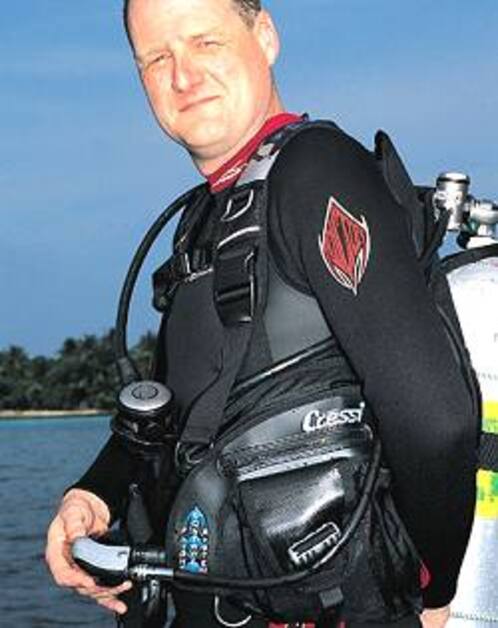
WHEN I UNPACKED THE CRESSI J115 BC IN THE OFFICE, I asked a fellow-diver what was missing. It took her a moment to spot that there was no corrugated hose.
Taking up the challenge from neighbouring Italian manufacturer Mares, which has had some success with its patented Airtrim, Cressi has introduced its own remote-controlled buoyancy system.
It’s called, ambitiously, the Flight Control System.
The direct-feed hose from the regulator goes directly to a small hand control at the bottom left side of the BC.
This handset is also used to operate the direct-feed and dump valve remotely but, unlike the Airtrim, which uses pneumatics to operate the dump, the Cressi system uses a mechanical link.
Both systems are intended to dispense with the sometimes untidy conventional corrugated hose affair.
Already I can hear doubters worrying about what happens if the system goes wrong.
Well, no-one could hope to sell a BC which appeared unable to dump air whatever the circumstances, so naturally there is a conventional rapid dump valve, operated by a pull-cord and toggle at the opposite shoulder, and another at the lower back in case you need to dump air while inverted.
You could also use it for draining any water that might find its way into the buoyancy bag.
The upshot is that the whole rig looks cleaner and neater, unless you think that the hand-control could get snagged on things.
It does stick out a bit, and in a rather masculine way, and the hose from the regulator was a bit on the short side to allow for it to be routed neatly. At least it gave me somewhere to hang my towel!
I have always been a great fan of Cressi BCs, not least because this company was the first to address the problem of accidentally dropped integrated weights.
Cressi weight-packets are stowed in such a way that they do not weigh heavily on any Velcro, and this is achieved simply by rotating the design of the pockets through 90°.
When vertical, at the surface for example, you simply lift the weight-packets out from where they sit. You would have to be head-down to be in any danger of dropping them.
Even so, the Velcro is augmented by a heavyweight press-stud and webbing strap.
In an emergency during which you felt inclined to drop weights, I suggest that you would probably be vertical and going for the surface.
Don’t try to assess the success of this system safe and dry in the dive shop. There, it will need a lot of effort to free the weights. Under water, where Cressi products are designed to be used, it’s as easy as pie.
For use with aluminium tanks, two trim-weight pockets are installed at the back. I managed to get 8kg in the front and 4kg in the back easily, and that must be enough for most people.

Cressi BCs seem to grow bigger every time I try a new model. This one gives masses of lift when inflated to the maximum, and because the harness is separate from the buoyancy cell there is no hint of squeeze.
It also has a sufficient number of strongly attached D-rings. However, there were comments about the weight of my dive bag when this BC was in there.
Overall, the J115 worked very well. Two big double-zipped pockets are still totally accessible even when the BC is filled to the maximum and air is squeezing out of the over-pressurisation valve.
The integrated-weight system being optional, flaps can be fastened over the unused pockets to stop any drag effect.
When the integrated-weight packets are installed, these flaps hide away in their own zipped pockets.
Diving in a place famous for its fast currents, I left one of these flap pockets unzipped and kept my reef-hook in it.
So comfort and buoyancy control was good and there are plenty of places to install accessories.

But then I began to wonder if, in its enthusiasm to meet the competition from Mares head-on in the market-place, Cressi had lost the plot.
Why do I say this? Well, I never now raise a BC hose to dump air, as we did when first taught to release air from the highest point.
This fills the bladder with water that runs back in at the same time. I prefer to use the dump valves.
When using a conventional BC with a traditional direct-feed and corrugated hose, and a dump-valve operated by pulling, I like to tuck it under the sternum strap so that it doesn’t flap around, and the business end is somewhere near my navel.
I can put air in or dump it by operating this control with either hand, pressing the button or tugging the hose as required. If you like, I have perfected my own flight-control system.
So why do I need a patented device, positioned inconveniently away to one side, to do exactly the same thing?
Not only that, but if I should come to the surface with the air in my tank much depleted, with a conventional system I know exactly where the hose for manual inflation of the BC is – where it has been throughout the dive.
With the Cressi J115 I would have to start searching through the pockets for the independent manual inflation hose. And that’s when you realise just how many zips and pockets there are.
The J115 worked impeccably. Do we need its Flight Control System? Probably not. You can decide.
The Cressi J115 costs £455 and comes in sizes S, M, L and XL.
Cressi UK 01484 310130, visit Cressi website
Plus
+ Most up-to-date development of a successful BC
+ Good weights system
+ Neat layou
Minus
– Heavy
– Do we really need the Flight Control System?
Cheap, cheerful and slow on the draw
It grieved me to have to spend thousands of pounds on a replacement underwater photography outfit, just because my previous one had begun to wear out.

It was especially annoying with everyone around me saying that digital cameras were the thing to have.
Most of them certainly seem a lot cheaper and a lot less cumbersome. They give instant gratification and the shots taken look great on your computer screen.
However, to get the continued quality of result that you see reproduced in the pages of this magazine, it seems we are still locked into the use of wet-processed film.
So at the moment it’s digital for personal use and wet-processed film for the professional. The businesses which will suffer in this digital revolution seem to be the endless mini-labs that litter every high street.
Who will want cheap enprints in the future?
Well, one company thinks there is still a future for the traditional photographic colour snap. That’s Fantasea Line, which has just sent me its Wet ‘n’ Wild 35 underwater camera to try.
The Wet ‘n’ Wild 35 is a very basic camera, equivalent to the original Box Brownie or basic Instamatic. It is a simple fixed-focus point-and-shoot job that relies on the conditions being right rather than on settings.
It uses any 35mm colour-print film and has a built-in power-wind (two AA batteries not supplied). The film is automatically rewound after use.
There is a built-in flash which can either be activated before you put the camera into its purpose-made waterproof housing or will be automatically activated by a pressure switch when you get below 5m.
Once you have clamped the little camera shut inside its clear plastic watertight box, sealed by one O-ring, there is only the sprung-loaded shutter release to operate.
Don’t take it deeper than 25m (it was formerly rated only to 15m) or disaster might strike in the form of a leak.
The Wet ‘n’ Wild 35’s wide-angle lens allows you to get quite close to your subject, but there is no way to control the focus.
I found that it worked well only for head-and-shoulders portraits of people at around 1.5m distant, otherwise things were out of focus or out-of-range for the flash.
The fold-up frame viewfinder was not very precise when it came to lining up the shots. Fast 400ASA film is recommended.
This camera is not for those who want to flash off lots of pictures. The flash takes about six seconds before it is ready for another go, and that can seem an inordinate amount of time when you are in a hurry.
This camera is intended only for those taking their initial steps in the sea. It’s cheap and the closeness of the flash to the axis of the lens demands the clearest possible water, of the type you might come across at Eilat in the winter.
Don’t hold your breath if you are expecting top-quality results, and remember that you will need to find a mini-lab afterwards to get your pictures processed.
In these days of digital revolution, I fear that such outlets might start to get rather thin on the ground.
Expect to find the Wet ‘n’ Wild 35 selling for around £30 in dive shops.
Cameras Underwater 08700 660384, visit Cameras Underwater
Plus
+ Cheap and basic
Minus
– No settings for conditions
– Slow flash
– You need to find a mini-lab afterwards
Using cold water for warmth
Philosophies on how to go about designing a regulator that will resist free-flow due to icing are diametrically opposed.
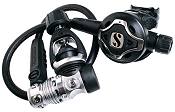
Most regulator manufacturers say that you should keep the working parts of the first stage dry and well-protected, yet some others say that you should get as much water in contact with and flowing past the moving parts as you can.
It’s easy to understand the reasoning of the majority. The others suggest that we should consider the properties of water, because the main body of water in which we dive cannot ever be frozen.
It must be warmer than that or it would be solid. So if this water is not frozen, it must have some heat in it, and why not use that heat to keep the regulator’s moving parts warm?
Warmth and cold are relative terms. The very cold water in which you might dive is certainly warmer than the depressurised air you breathe from your tank.
So even if the water is at only 3 or 4°C, it can be used to keep the regulator from being chilled by its own airflow and above zero, the temperature at which fresh water turns to ice.
Scubapro is of this second persuasion. For example, its newly designed MK25AF piston-type first stage has enlarged flow holes to facilitate that increased water flow through it.
The company has also backed its launch with an extensive coldwater-diving advertising campaign. So will it freeze?
I don’t know, but I can tell you that it was taken for a swim under water round Wraysbury Lake in early February by Gerry Gooch (see the Drysuit Test in this issue), and he tells me that the water was at a sweltering 4° above freezing.
The regulator certainly didn’t freeze up on him. Not fully convinced, the next day I asked George Buxton to swim it round the same lake. It didn’t freeze up on him either.
Next I asked Tim Bradley to do the same.
The effect was the same, even though this time he intentionally breathed off it heavily in the air before descending and gave it some very heavy inhalations to get as big a flow-through of air as possible, two approaches which are certainly the wrong thing to do in cold freshwater conditions.
Of course, all my guinea-pig divers had the option of an alternative regulator on the H-valve of the tank in case the MK25AF/ S600 let them down.
It didn’t freeze up. But then neither did the Mares Abyss, the Poseidon Cyklon or the Apeks TX40 regulator being used by the other divers alongside it.
What does all this prove? Nothing really. No-one can anticipate when the conditions within a regulator’s moving parts are right for a free-flow due to freezing. We can only do our best to avoid the circumstances that might lead towards the event.
The fact that the Scubapro MK25AF/S600 didn’t fail probably means that it has a good design that will help avoid that happening.
I can’t guarantee that one will not freeze up on you, but I can say that it is less likely than with some other regulators.
I can make no guarantees, because you never know how close you come to the edge of disaster until you are beyond it.
I can’t tell which if any of the regulators in use at Wraysbury on those days was close to freezing.
It’s very hard to test for internal icing. Purging regulators continuously while they are submerged in a bucket of ice water provs only that any regulator will freeze up if you try hard enough, and purging a regulator while diving in cold fresh water is simply asking for trouble.
You should avoid big airflows.
Scubapro has done its best to improve the coldwater performance of an otherwise very high-performing and well-thought-of regulator.
If you intend to dive in very cold fresh water, it is worth considering.
However, from my observations of experienced ice divers and my comparison of many less-than-experienced divers I see going diving in cold fresh water, I would say that the most important thing is to learn the techniques to suit the conditions.
The Scubapro MK25AF/S600 has the now-familiar revolving turret first stage with two high-pressure and five medium-pressure ports.
Apart from the enlarged flow holes, a series of heat-exchanging fins are obviously a new feature. These are also said to help prevent any ice that might form creeping up towards the turret.
Out of view, the internal mechanism has a polyurethane-coated spring and a mirror-polish to the piston shaft to deter ice from sticking.
The piston itself has a composite end that prevents heat being drawn from the spring.
The second stage is of a mainly plastic construction with a dive/pre-dive venturi control and a breathing-resistance adjustment knob.
Scubapro recommends removing the hose protector from the mp hose, where it joins the second stage, to help heat transfer in cold conditions. It has an easily unclipped-for-replacement mouthpiece.
The Scubapro MK25AF/S600 costs £349.
Scubapro UK 01256 812636, visit Scubapro UK
Plus
+ Now good for use in cold fresh water
Minus
– None encountered
When you’re writing under pressure
People often ask me if I log all my dives. Well, I never dive with fewer than two computers. If one goes down, I can continue diving without a lost 24 hour period.

These take care of actual dive profiles should any third party need to know them, assuming that my body is recovered. Otherwise, the simple answer is: “Yes, you’re reading it!”
Besides my camera, which makes a detailed visual record of almost every dive I do and is ideal for diving experience or travel features, for the purposes of Diver Tests I have to make copious notes.
My diving store-room is littered with slates that have been so well-used that they are almost beyond cleaning.
I am also very familiar with all the problems associated with using underwater slates, such as their being not too small, or the pencil snapping in two at the most inappropriate moment.
Then there is the mystery of the triple bowline and double anchor-bend that comes so easily unravelled under water, and allows my hard-won notes to float away.
A message in a bottle? The world must be full of beachcombers who have collected these esoteric messages that have washed up on distant shores. I imagine them scratching their heads, trying to decipher the codes.
I was recently shown how to attach a heavy karabiner to make a slate negatively buoyant. Why didn’t I think of that?
The Aquapak is a slightly flexible plastic slate which unfolds to provide a very useable 24 x 19cm area. Of course, you can choose to use it folded, and you can write on both sides.
It has a slightly matt white finish to provide a certain amount of bite for an ordinary pencil.
A 6B pencil is provided but it is protected within a broad fluorescent-yellow plastic holder, so only the extreme point can snap off on you.
You can release the pencil gradually by unscrewing the knurled end, and then sharpen it with your dive knife as needs must. So there is a use for a dive knife, after all!
The whole thing slots into a tube-like holder attached to the slate, and both are provided with holes for the attachment of a second lanyard. That means even more knots to tie!
The Aquapak slate costs £12.50
Aquapak, visit Bdlonline website
Plus
+ New take on an old idea
Minus
– More knots to tie
John Bantin has been a full-time professional diving writer and underwater photographer since 1990. He makes around 300 dives each year testing diving equipment.