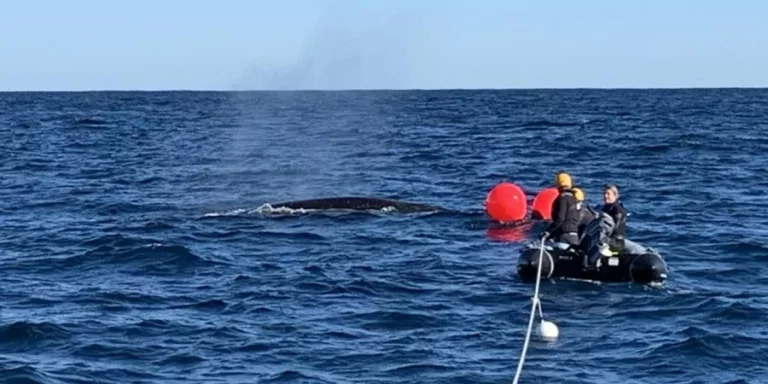
Significant entanglement incidents involving humpback whales have occurred on both sides of the Pacific in the first two weeks of July, highlighting how fishing-gear entanglement remains one of the principal threats to the migrating animals.
Ningaloo Marine Park in Western Australia is well-known to divers as one of the world’s primary destinations for whale shark encounters – but at present it appears to be a danger zone for humpbacks.
The whales are being spotted entangled in line consistent with commercial fishing gear. Five entanglements have been reported there in less than a week, with one of the whales known to have died as a result.
Another was freed by specialist rescuers and the other three could not be relocated despite extensive air and sea searches, according to a report by ABC News.
Specialist rescuers responded to reports that a 9m humpback had been seen struggling with line near Osprey Bay on the evening of 8 July.
The ’s whale-disentanglement team from the WA Department of Biodiversity, Conservation & Attractions (DBCA) spent hours attempting to free the whale but they were able to remove only part of the gear before it succumbed to its injuries.
The carcass drifted into the shallows of Ningaloo Reef on the tide, attracting large numbers of scavenging bull, tiger and other sharks and prompting the authorities to close the popular Oyster Stacks and North Mandu snorkelling sites until it could be removed.
Rapid responses vital
Up to 40,000 humpback whales are said to swim past Ningaloo Reef every winter in what is one of the world’s largest migrations. They move between their Antarctic feeding grounds and the warm waters off Western Australia’s Kimberley coast, where many females calve before returning south.
The whales usually pass through Exmouth Bay between June and November, though this year they started arriving in numbers only in July.
The DBCA asks anyone spotting entangled whales not to spend any time trying to cut the line themselves, because it is both dangerous and likely to delay a specialist rescue. Only trained and authorised responders are permitted to attempt whale disentanglements in Western Australia.
The Baloo Blue Foundation runs a wildlife rescue hotline in the Ningaloo area. “We’re seeing a lot of rope consistent with commercial fishing-gear like crab and cray pots, and there’s a lot of uncertainty as to where they’re coming from and why there’s more this year,” the BBF’s Brinkley Davies told ABC News.
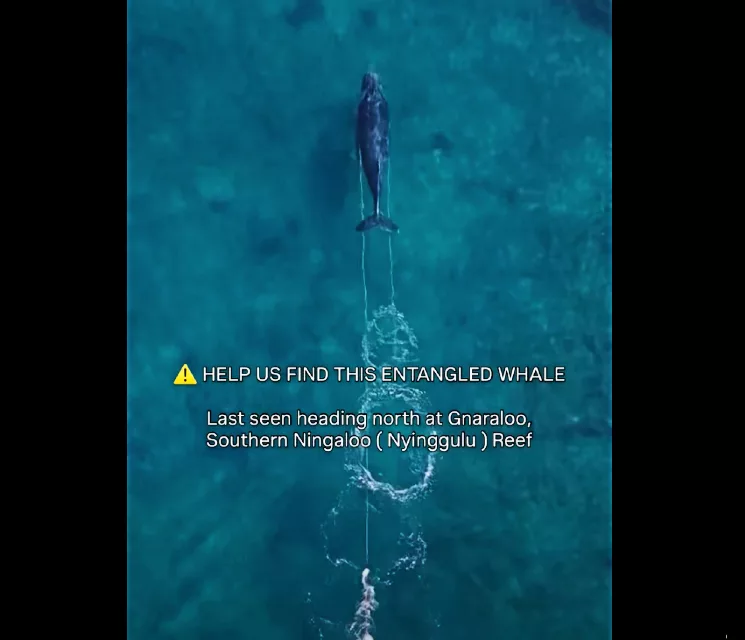
Whales can drag entangled gear for weeks or even months, becoming exhausted by the effort required and making it difficult to determine where the original entanglement occurred. “An entangled humpback can travel tens of kilometres in a single day and, if it disappears, it may never be seen again,” says the BBF.
Across the Pacific
The Ningaloo incidents are not isolated. During the first half of July, humpback whales have required disentanglement operations across much of the Pacific.
On the other side of Australia a humpback became the subject of a four-hour rescue operation after becoming trapped in a Gold Coast shark-control net on 4 July. Queensland Fisheries’ Marine Animal Release Team collaborated with Sea World Foundation rescuers to complete the whale’s release the following day.
There were also reports from New South Wales of humpbacks becoming entangled in fishing-gear and marine debris during their annual migration, with rescue teams conducting multi-day tracking operations to free affected animals.
Acros the Pacific off British Columbia a well-known humpback nicknamed Pop Tart was freed after spending almost a week trailing hundreds of metres of fishing-line near the Canada-US border.
Whale-watchers first spotted the whale’s distress on 2 July but, because of adverse weather, it was not until 10 July that Pacific Whale Watch Association’s Large Whale Entanglement Response Network was able to pronounce the rescue a success.
The same week the Hawaiian Islands Humpback Whale National Marine Sanctuary reported that response teams had successfully disentangled two humpback whales from life-threatening fishing-gear, in rescues involving NOAA and partner organisations.
In Australia, the BBF says that rapid reporting by scuba divers, snorkellers, pilots, whale-watch operators and other water-users is critical if further entangled whales are to be located before they disappear offshore.
The foundation encourages anyone who spots an animal carrying line, floats or buoys or appearing to behave abnormally to film or photograph it, record a GPS location, note its direction of travel and report it immediately.